

Update 17 March 07:00 GMT: Israel resumes war in Gaza which means that a regional war will be underway in all the points of tension Gaza, West Bank, Lebanon, Syria and Yemen, but also potentially Iran and the Gulf. The reason that Netanyahu is restarting the war has nothing to do with the Palestinians and everything to do with the collision at the heart of the Israeli state between the Supreme Court and Netanyahu, when the Attorney General said he couldn’t fire the head of Shin Bet, which is investigating corruption charges against Netanyahu. Netayahu calls the Supreme Court and the judiciary (dominated by European/Ashkenazi Jews) the ‘deep state,’ as opposed to the extremist theological/Mizrahi Jews, whom he is trying to keep in his government, so that he is not brought to account. This is a civil war. Netanyahu is taking this action, knowing that Ansar Allah will strike Tel Aviv at some point, hoping that this will drag the US into a major regional war with Iran, given that merely bombing Yemen will have no effect.
Update 16 March 08:00 GMT: Donald Trump ordered a pre-emptive strike on Yemeni cities, killing and injuring civilians alone. The Yemeni armed forces of Ansar Allah (the Houthis) retaliated with a series of strikes on the USS Harry Truman aand its battle group, after which the aircraft carrier sailed to the northern Red Sea, to put a distance between it and its attackers. A New Yemen War has started. Ansar Allah leader have vowed to escalate with every American escalation. sIndeed, with Syria in the balance it looks like a regional conflagration is under way. Trump started this war.
Update 15 March 08:00 GMT: Following the massacres of Alawites in Latakia, the Syrian regime of al-Shara’a/Jolani looks like it will be condemned at the UNSC, although there has been no formal move yet. This is not because the US and Russia don’t agree on this, but because the EU (read the German military industrial complex) is embarassed by the events given their unqualified backing of the regime. Al-Shara’a says the groups of Takfiris that committed the atrocities were not under his control. So the embarassment comes from the fact that al-Shara’a/Jolani is not the government of Syria, which begs the question as to what meaning can be attributed to his handshake with the Kurdish SDF. Another question is: will the British back the Turks or the Germans in Syria?
Meanwhile, Steve Witkoff shuttles around the world trying to negotiate temporary ceasefires everywhere. Putin’s offer of an ‘Easter ceasefire’ for religious (not diplomatic) reasons is music to his ears, whereas Hamas wish to stick to 17 January agreement is ‘unrealistic.’ As the Trump administration sinks into financial chaos, everyone is glued to their screens wondering if the slight uptick in the S & P 500 (the measure of imperial money) is a breather on the way down or perhaps a return to the glory days.
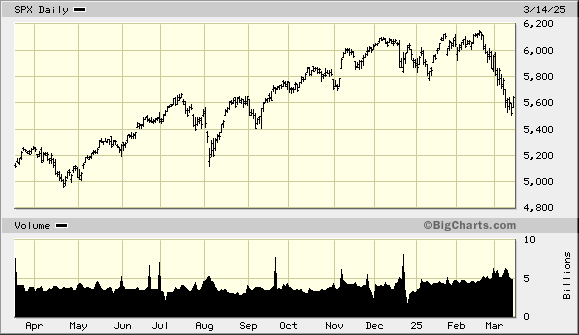
The fact is that the unprecedented layoffs that Musk has engineered in his ‘efficiency’ campaign, and the directionlessness of Trump’s tariff policy has most market watchers coming round to the Atlanta Fed‘s prediction of a recession. The facts add up to one thing: Trump needs a win, somewhere, anywhere, quick. The weidest thing is that this one term president, facing early disastrous approval ratings on foreign policy, the economy and inflation, thinks he has time. The only place where he thought he was going to get a big win and a Nobel Prize for Peace, with Russia, he isn’t. The Euroamerican military industrial complex has destabilised Trump’s trajectory. Everybody everywhere want deals, it is only natural, but nobody trusts the Americans. What can Trump give his deep state opposition to enable him to go forward? The freeze is now truly on globally.
Update 14 March 21:30 GMT: After the Arab League Summit in Cairo of 4 March and the Organisation of Islamic Cooperation meeting in Jeddah of 7 March, which formally adopted Egypt’s proposal for Gaza reconstruction, Trump appeared also to back the plan with his statement that now ‘nobody is expelling Palestinians from Gaza.’ Despite the Arab League resolution, an area of contention remains among Arab leaders around the question of the governance of Gaza during reconstruction. Saudi Arabia and the UAE oppose the proposals on that score put forward by Egypt, although Qatar supports them. The Egyptian leadership has, unusually, taken a strong stand and prepared a fully worked out plan for Gaza, but it looks like it doesn’t yet have the full funding commitments to proceed.
The metaphor of the Middle East freeze returns and the overall picture remains too unclear to warrant a big picture survey. Updates will continue.
Update 13 March 09:15 GMT: Conflicting statements from different Trump envoys have sent Gaza ceasefire negotiations into a tailspin. After Adam Boehler declared that negotiations with Hamas had been ‘very helpful,’ rebutting Israeli recriminations about the talks with the statement that ‘We’re not agents of Israel,’ Steve Witkoff finishes his talks in Doha with the remarks that Hamas position ‘is impractical,’ walking back his ‘‘there will absolutely be a second stage .’ He is now saying that there must be an extention of the first stage of the ceasefire.
Update 10 March 09:15 GMT: X GENOCIDE ALERT X All the politicians and countries consciously or unconsciously aiding and abetting the Gaza genocide have another thing coming. As UN Rapporteur on Palestine, Francesca Albanese tells us: Not sanctioning ‘Israel’ means Gaza genocide complicity.
Update 9 March 10:30 GMT: Steve Witkoff, US Special Envoy for West Asia (and occasionally, for the World), is travelling to Doha on Tuesday 11 March to negotiate a new ceasefire deal with Hamas. So the direct relations between the United States and Hamas are set to continue.
Update 8 March 13:40 GMT: In line with Trump’s usual incomprehensible methods for achieving unclear foreign policy objectives, he has asked Russia to mediate on the Iranian nuclear file, as well as on a laundry list of other files such as Iran’s missile technology, Iran’s relationship with Hamas, Iran’s relationship with Hezbollah as listed in his National Security Presidential Memorandum (NSPM) that restored “maximum pressure” on Iran on February 4 (the same maximum pressure that didn’t work last time). The Bloomberg Report of Putin agreeing to mediate with Iran is implicitly ridiculed in Kremlin spokesman Dimitri Peskov’s commentary in response. To begin with there are ongoing negotiations with Russia on Ukraine which are – in the eyes of the Russians – not progressing smoothly. Presumably this is why Trump messaged (“truthed”) that he is putting maximum pressure on Russia to finalise a quick agreement. There is a perception in Russia that Trump faces considerable opposition to his plans for Ukraine and that even if a deal is reached, it is unlikely to be in the form of an overarching long-term treaty ratified by Congress that would prevent a return to hostilities once Trump is gone in four years time. Trump is not at all thinking in terms of such a treaty, only in terms of how to come out of Ukraine with a cash bonus that makes him look good. He has also written directly to Iranian leader Khamenei, telling him that it would be ‘better for him to negotiate,’ angering Netanyahu.
Update 8 March 08:00 GMT: The Republic of Sudan has raised case 197 at the International Court of Justice against the UAE for ‘complicity in genocide.’ The forces originally known as the Janjaweed militias led by General Hemedti (Mohamed Hamdan Dagalo) now forming the “Rapid Support Forces” (RSF) backed by the UAE in the Sudanese Civil War are accused of committing a genocide in Darfur – against the region’s non-Arabic groups. The story has already been told and retold (sources updated) of how the Arab world has been destabilised by a trillionaire prince leading the counterrevolutionary current in the region, who has also very often acted on both sides of a conflict (which is not often reported). This site has attempted, however, to raise the profile of patterns of structural change in the Arab region that have begun to act as countervailing forces against these currents of destruction and (neoliberal) pillage. One such element on the economic side is the role China’s investment in Saudi Arabia is playing, which it will continue despite American fury. Another, on the political side, is the balance that the Axis of Resistance has provided to date, which will in fact continue as the Axis reconfigures.
Update 7 March 21:00 GMT: Abdel-Malik al-Houthi announces today resumption of naval operations against Israeli-linked vessels, in the event that humanitarian aid deliveries into Gaza are not resumed within 4 days. UN experts are lining up to condemn Israel’s cynical weaponisation of starvation in the continuing genocide. In a move that will publicly shame the Arab League and Saudi Arabia in particular, al-Houthi says that religious duty and human conscience demand immediate action.
Update 7 March 18:00 GMT: It turns out that Trump had expectations of Netanyahu when he announced his Gaza Plan, but their different interests appear to be colliding. Netanyahu wants to keep the war going to keep his government together but physically the army can’t do it for him (see updates below). It is not the resignation threats from Smotrich which keep the war drums beating, but the threat of the orthodox Haredi parties not voting for the budget on May 31, if Netanyahu doesn’t grant them exemption from military service, in which case his government falls. For this reason, he seeks to keep Smotrich on board until that date by delaying the implementation of the ceasefire agreement. However, this involves his refusal to complete withdrawal of Israeli troops from the Philadelphi corridor, Rashid St, and Salaheddin St., which has hit a Hamas block. Hamas refuses to release any captives and is willing, as previously reported below, to return to war. This has in turn uncovered the new and strange fact that the United States, in a scoop originally by i24NEWS, has been holding separate secret negotiations with Hamas. The US has not to date recognised Hamas. This seems to have changed. It appears that there is a US Special Presidential Envoy for Hostage Affairs called Adam Boehler, who has led these talks in Qatar, with a view to prioritising the release of American captives which, if achieved, would be a display by Hamas of ‘good faith’ and would open the door for further moves. Those ‘further moves’ have to do with Trump doing a deal with Saudi Arabia, which he is apparently prioritising as part of his strategy of maximum pressure on Iran. No wonder MBS didn’t feel the urgent need to make any personal effort to appear at the recent Arab League summit. Be that as it may, Netanyahu’s intention to delay phase two for 42 days under some pretence or other to save his government is colliding with American plans. Hamas balking on transferring American captives is causing serious trouble for Netanyahu.
Update 7 March 12:00 GMT: The Organisation of Islamic Cooperation is meeting today in Jeddah to back Egypt’s Gaza Plan which was unanimously endorsed by the Arab League.
Update 7 March 08:00 GMT: The Middle East freeze/Hamas. Spokesman for the Qassam Brigades, the Hamas military wing, Abu Obaida, stated yesterday that the group is ready for war if that is what Netanyahu wants. The massive amounts of unexploded ordinance, discarded weapons and available steel will have provided the group, together with the other fighting groups alongside it, plenty of materiel for their foundries and factories underground to rearm. They will have had time also to recruit and train. We stated below that there is only one decision maker in all this – Netanyahu – a survivalist suffering from third degree cancer, who will be balancing the demands of his extremist partners with the extreme pressures facing a decimated and overextended Israeli armed forces advancing (and committing genocide) on several fronts at once. The White House as noted in the updates below is not an interlocutor here, Steve Witkoff or no Steve Witkoff. It is fast sinking into the contradictions of its policies, with a collapsing stock market accompanying record declines in job approval ratings for Trump. Expect even greater incoherence and lashing out as Trump finds himself boxed in.
Update 6 March 20:45 GMT: The Middle East freeze/Lebanon. Lebanese president Joseph Aoun made his first international trip and visited MBS in Riyadh. The meeting was cordial but meaningless. Saudi Arabia issued a formal statement on its relationship with Lebanon which didn’t even reboot Saudi tourism as had been expected. This attitude is in line presumably with a sudden retrenchment which has, perhaps not in such a contradictory way as might at first be perceived, accompanied the more independent diplomatic stance it has adopted. Maintaining cordial relations with Iran and a refusal to normalise with Israel is as far as it can go against the American empire as things stand.
Update 6 March 20:45 GMT: The Middle East freeze/Saudi Arabia. Saudi Crown Prince Mohamed bin Salman (MBS) didn’t turn up for the Arab League Summit in Cairo to discuss Egypt’s Plan for Gaza. How does this square with Saudi Arabia’s increasingly hardline stand on the question of a Palestinian state? Essentially the problem with Gaza for the Saudis is that there cannot be funding for Gaza without recognition of a Palestinian state. Gaza has been rebuilt three times. The issue of a Palestinian state is also important for Saudi Arabia because it is tied with America’s demand for normalisation with Israel and the payment protection money (MBS offered $400bn over ten years, Trump demanded $1 trillion). Saudis want to do neither of these things. A combination of the Yemen War 2015-2022 and the costs of its development plan Vision 2030 has severely depleted its reserves, and it is now looking at budget deficits which it will have to keep financing from reserves (as well as borrowing short-term). UAE President Mohamed bin Zayed, presumably knowing this, wanted to avoid the carrying the can and so, like MBS, absented himself from the summit. Both leaders sent cabinet ministers to represent them. The Gaza Plan was nevertheless approved unanimously.
Update 6 March 20:30 GMT: The Middle East freeze/The United States. Continuing on the theme of White House opacity in the past two updates on the question of Gaza, it has become clear that Steve Witkoff’s description of Trump’s off-the-wall ideas and incendiary remarks being intended to get people to ‘shake-up everybody’s thinking,’ should really be understood as meaning that everybody else should be doing the thinking. Trump isn’t going contribute. He is just going to go along with whatever Netanyahu decides. In that sense Witkoff’s statement that ‘there will absolutely be a second stage’ should be understood as a Delphic pronouncement. Netanyahu is currently really negotiating with himself. If he hasn’t restated the war with Gaza, it is because the army isn’t in a position to do so. It may not be in such a position for a long time.
Update 6 March 0900 GMT: If the Trump administration seems to be all over the place at the moment, this is because there is messaging going on that seeks to respond to the record collapse on Trump’s job approval ratings in record time compared with Biden, Obama, and Bush before him, on foreign policy, the economy and inflation. As pointed out in the previous update in regard to Gaza, there is confusion and lack of direction in the White House.
Update 6 March 0700 GMT: Trump as usual makes wild incendiary statements about meeting out death to Hamas if they don’t release all hostages immediately, even as Hamas -unusually- met with US intelligence officers to discuss how to proceed, albeit that the US side had only been given a narrow remit for their negotiations. Nevertheless, Egyptian security sources told Reuters that the Israeli delegation in Cairo is attempting to reach an agreement to extend the first phase of the deal for 42 days. All the signs are that the Trump administration doesn’t know what it wants to do and seems to be hoping that the problem will just go away. Something will break although it doesn’t look as if either Hamas, Egypt, or Qatar are breaking just yet.
Update 6 March 0630 GMT: Yesterday, an update was made to the 25 January article calling for Julia Sebutinde to be removed as Chair of the International Court of Justice (ICJ). Glad news had come of unexpectedly early elections for Judge Iwasawa Yuji to replace her. All those who submitted letters to the ICJ under the article CALL TO ACTION received thanks. Israel has until end July to submit its final response to the case raised by South Africa and joined by many other nations against Israel on charges of genocide.
Update 5 March 0900 GMT: The Arab League has unanimously agreed Egypt president Sisi’s Gaza reconstruction plan, which would keep Gazans in place while reconstruction is ongoing over a five year period. Mahmoud Abbas has declared an amnesty of all Fatah members he has got rid of in the past, taking a triumphalist position on Fatah now ruling Gaza and the West Bank. Hamas it seems doesn’t mind. But US National Security Council spokesperson Brian Hughes disagrees, by saying that the Sisi/Fatah plan is not viable. Now that the Axis of Resistance is not there to do their job for them, can the Arabs COME IN FROM THE COLD AND DO WHAT IS NECESSARY. Are their threats about the use of force empty threats? Netanyahu has shown them time and again that they can’t even get their aid into the enclave when they want to. The prospects at the moment are in the balance. But there is an important point on which the video associated with this article concludes: will America and Israel suddenly turn rational and keep the COUNTERREVOLUTIONARY DAM IN PLACE that these Arab leaders represent, so giving them what they propose? Or will they go with the SAMSON OPTION (as Trump is doing with his tariffs) and PULL DOWN THE HOUSE THAT HAS PROTECTED THEM ALL THIS TIME?
Main Text
President Putin of Russia betrayed the Axis of Resistance as explained in the last article posted on this site. It looks like he had set the Syrian situation up for just such an eventuality [correction – possibility]. On 25 February Russian FM, Sergei Lavrov went to Tehran, it seems to try to explain to the Iranians the reasoning behind Russia’s arrest of President Assad of Syria at the Presidential Palace in Damascus on 8 December last year. This move led the Syrian Arab Army (SAA) – Syria’s national army – to fold, or more accurately, to retreat in good order, in the face of an attack by fighters of the ex-al-Qaeda Hay’at Tahrir el-Sham (HTS) and the Syrian National Army (SNA), organised by Turkey from the Syrian opposition. The consequences were unexpected and surprising for all concerned. On 28 February, Sergei Shoigu went to Beijing to discuss those developments with Xi Jinping directly.
Almost two months have elapsed between these visits and the initial actions by Russia in Damascus, which led to the collapse of the régime. The decision by Putin was taken in the midst of a cloud of intrigue in Istanbul and Kiev around a Syrian called Khalid al-Fayoumi, who produces drones for the Ukrainian armed forces in various parts of Ukraine under licence to the Turkish defence conglomerate owned by President Erdoğan’s son-in-law, Selçuk Bayraktar. Erdoğan’s approaching final end of term had turned insider Turkish politics into a frenzy focused on seeking to reengage Kurdish politicians in Turkey with the democratic process, to wean them away from the militant path taken by the PKK, the Kurdistan Workers Party which had suddenly returned to the scene with the bombing on 23 October of a Turkish Aerospace Industries factory near Ankara.
The overwhelming concern of the Turkish establishment was to find a final resolution to the Kurdish situation before Erdoğan last term in office ends. For Erdoğan personally, on the other hand, as explained in previous articles on this site, the idea was to get Kurdish political parties to ally with the Justice and Development Party (AKP) and the Nationalist Party to call for early elections, and thus, under the terms of the constitutions, to lengthen Erdoğan’s current term (give a third go at the presidency, in other words), if not to actually change the constitution to allow three terms.
The PKK bombing followed a move by the Turkish establishment to try once again to isolate the PKK within Kurdish politics, which was led by Turkish politician Devlet Bahçeli, leader of the Nationalist Party. Ever since the events of 2015, when Erdoğan’s Justice and Development Party (AKP) sought an alliance with Kurdish democracy in Turkey to achieve its aims of constitutional reform, the Kurdish umbrella organisation, the KCK (or Group of Communities in Kurdistan) vetoed the prospective alliance, in fact ruling against their imprisoned leader Abdulla Öcalan’s wishes, much as they are doing today. After the Suruç bombing on 20th July 2015 (claimed by DAESH/IS but executed by radicalised Kurds), the PKK, a Marxist organisation dedicated to armed struggle, declared war and an end to the reconciliation process that Erdoğan had begun in 2009.
The political moves by Bahçeli in September 2024 followed the failed attempt the previous July by Erdoğan to restore ties with the Assad régime in Damascus. The purported aim of the outreach was to join hands to isolate the Kurds in northeastern Syria, and force them to come to terms with Ankara. This failed when Erdoğan’s overtures were summarily rebuffed by Assad. The Syrian president demanded that Turkish troops withdraw that were protecting and/or containing the enclave of Idlib (depending on how you look at it) where HTS was bottled up. Erdoğan’s message to Assad that he was in no position to make such a demand fell on deaf ears. With the 23 October bombing by the PKK, the political road ended and conspiracies swirled around Khalid al-Fayoumi in Ukraine and al-Jolani in Idlib to begin an attack on Syria.
On 26 November, Erdoğan let HTS out of its pen in Idlib and sent the only slightly more organised SNA in pursuit to attack Aleppo. As the pressure built up on the ground, Erdoğan was urging Syrian rebels forces onto Damascus to take the Syrian capital, even as Turkey, Russia and Iran met in Doha, under the Astana format. At the 7 December meeting, Lavrov reported:
‘We talked about regional affairs – Palestine, Gaza, Syria, where the situation has sharply worsened in recent days as a result of the clearly prepared aggressive attack on the positions of government forces by “Hayat Tahrir al-Sham”. The organization was long ago defined by the UN Security Council as terrorist. Some disparate opposition groups have joined it. Our common position is that it is necessary to urgently stop the hostilities and seek the implementation of UN Security Council Resolution 2254, which requires respect for the sovereignty, territorial integrity and unity of the Syrian Arab Republic, the establishment of a direct dialogue between the government and various opposition platforms, including the Moscow Platform.’
Lavrov was not aware that Putin would arrest Assad on 8 December, cause him to burn all presidential papers, and take him to Latakia and Russia’s base at Tartus and inform him there that his rule was over and that he was going to be taken to a Dasha that had been prepared for him and his family outside Moscow. It was this action which led to the Syrian Arab Army simply melting away on the battlefield, to the immediate withdrawal of Hezbollah to Lebanon, to Erdoğan calling Tehran to tell them that there was no point in reinforcing Assad’s forces because he was now gone, and to the collapse therefore of the Damascus régime and the base of the Axis of Resistance in Syria. Putin’s medal ceremony for heroes of the Ukraine (Special Military) operation on 9 December mentioned absolutely nothing of this military debacle. Why did Putin do this?
Putin was trapped by his own policy in Syria. As soon as Erdoğan decided to move on Assad militarily, the word would be out to US intelligence through Ukrainian intelligence and al-Fayoumi. Israel would make its move. But Putin had long standing orders to Russian forces in Syria not to shoot at Israeli aircraft. Israel would, therefore, immediately dominate the skies in Syria and Russian forces would be unable to support Assad as a result. Assad had complied with Putin’s strange policy because, cash strapped as he was due to the Ceasar sanctions, and Kurdish control of Syrian oil, he planned to sell Syria to the Emirates in exchange for funding, in the knowledge that the Emirates were planning to allow Israel into the division of spoils in the country.
As explained previously, Iran’s president Raisi had tried to remedy the situation, but he had found Assad intractably opposed to Iranian air defences being established to protect Iran advisors and supply lines in Syria. Hezbollah leader at the time, Hassan Nasrallah, had nevertheless decided to live with the situation, given that he himself thought it was a good idea to change Hezbollah’s image and project it as an Arab organisation.
But why did Putin have this policy of not shooting at Israeli planes? There can only be a complicated answer to this.
As of 2022, Russian-speakers number around 1,300,000, or 15% of the Israel’s population, many of whom continue to have ties with Russia. Putin has relationships with Israelis dating from his youth. In addition, the majority of the Russian oligarch community which was formed during the corrupt loans-for-shares scheme under Boris Yeltsin are Jewish and Israeli. They are an important part of the oligarch community which Putin’s Bonapartist style of government uses to balance out the enormous political influence of the military-industrial complex in Russia. Infact, Putin regularly suppresses pro-Palestinian opinion polls of the Russian population produced by the Levada Centre in order to navigate all these sensitivities.
But there are external foreign policy factors at play as well. Russian intelligence, despite everything, keeps up relations with Israeli intelligence. And Israel has always been an important mediator in the relationship between Russia and the United States as Naftali Bennett’s attempt to mediate the Ukrainian conflict would demonstrate.
However, avoiding a firefight with Israel in Syria in December, would be of primary importance as Putin negotiated with Trump over the future of Ukraine. The difficulties were two sided. Trump was in turn facing stiff resistance from the Euroamerican military industrial complex led by British Prime Minister Keir Starmer. A storm gathered, both in London and Washington, as soon as Trump was elected in November. It burst with the signing in January of an extraordinary 100-year pact between Britain and Ukraine. It has been clear, since it was reported on this site two years ago, that ‘Ukraine had become a British War.’ The aim of the British state now is to freeze the conflict and invest Britain in a rump Ukrainian state that would engage in a permanent quest to retake lost land. Starmer seems to believe that he can maintain the Zelensky régime in power long enough to outlast Trump’s single term. It isn’t clear, but there must be elements in Washington, therefore, that have a similar view. Zelensky’s aggressive, confrontational approach to his 28 February meeting with Trump and Vance in the Oval Office, speaks of some kind of confidence in that regard. At least one thing is clear, Starmer’s formal agreement with Zelensky predates and pre-empts any future agreement between Trump and Ukraine, which now appears infeasible.
As things now stand France is backing the British call to put ‘peacekeepers’ on the ground in Ukraine, and to enlist other countries in Europe to join them, but most essentially to get Trump to agree to give them the security guarantees (i.e. air, missile and intelligence cover) without which such a venture would be ineffective. Such a confrontational approach would undermine meeting Russia’s terms. A permanent peace, the formal acknowledgment of Russia’s annexed territories in Ukraine, and the turning of Ukraine into a neutral state without an anti-Russian government, are the broad terms Putin now seeks.
As Erdoğan would not be convinced to stop his aggression against Syria, using air power to protect the Syrian Arab Army (SAA) and calling on Iran and Hezbollah to field troops to prop up the Damascus régime would not be possible, in the light of ongoing negotiations over Ukraine. This is what led to Putin pulling Assad out. And that is in turn what led to the SAA melting away.
THE DESERT FREEZES OVER: THE ARABS OUT IN THE COLD.
Netanyahu is a politician following his own interest. But his latest sabotage of the peace process that he and Trump signed with Hamas is a challenge not to Palestinians who, in Gaza, have met such serious challenges before, and won, but to the Arab nations convening in Cairo tomorrow. If Hamas political bureau member Mousa Abu Marzouk stated that he now had reservations about October 7, because of the scale of destruction of Gaza that ensued – this is nothing other than an indictment of the Arab nations that just let the devastation take place without taking action.
This indictment by the Hamas leadership no less, spurred Netanyahu on to sabotage the ceasefire once again just before the Arab League meeting.
The Saudi cabinet finally made a strong and irrevocable statement about their commitment to a Palestinian state on 11 February. Saudi Arabia certainly seems to be taking its leadership of the Arab world seriously these days, especially in the light of the existential threats from climate change and the shift to renewables that have imposed the need for a major new development plan for the country.
But the background to all that it has to be rememebered is a series of catastrophes – the Egyptian coup of 2013, a counterrevolutionary rampage, the seven year Yemen war that started in 2015|, the Qatar blockade, the Sudanese civil war raging since 2023, in which 150,000 people have died, the unqualified Gulf support for the Ethiopian Renaissance Dam built without consideration for the hundreds of millions living along the Nile whose lives will be irrevocably changed, and now THE GAZA GENOCIDE. The amount of money that Saudi Arabia, Qatar and the Emirates have wasted on all this comes to some trillion dollars.
Now that they are gathered together with their other Arab partners, hopefully as a unit, they can take positive steps for the future. We can only pray that they have seen the light and that they understand that united they stand and divided they fall and that Israel only understands the language of might. Israel doesn’t believe they will.
But Israel itself is a dying star now undergoing a supernova explosion across the region. This is not a rationally expanding state with plans for the future. There is no political reality to Greater Israel. Should Israel indeed expel the Palestinians populations from their lands, they will self-destructively cause the counterrevolutionary dam that has kept the status quo against the will of the Arab street to collapse.
There is chance of redemption if the Arab régimes now align with their own people.
Appealing to Trump won’t help. The White House is now led by someone as divorced from reality as the last president, albeit in a different sense and with different priorities. Reasoning with Trump, like reasoning with Israel, will be pointless. Standing firm and looking genuine about the threats of war already levelled at Israel by Egypt and Jordan is the only way.
March 4-5 is a crossroads. The desert has frozen over, and it is time for the heat of action to make itself felt. Let’s see what happens.


Leave a Reply