

There is a strange quiet in Gaza. Relatively speaking, of course. By Israel’s brutal and malicious standards, its current infringements and killings are running at normal “peacetime” levels. It has delayed the release of 600 Palestinian prisoners under the first stage of the ceasefire agreement that began to take effect on 19 January, and caused 13 more Gazans to be added to the official list of dead and injured on 24 February, which then reached a gruesome total of 160,105. Israel has also refused to allow much of the heavy machinery that the first stage of the agreement provided for the clearing and rebuilding of Gaza and many of the tents and mobile homes that had been projected for the ravaged enclave, with the result that children are dying of the cold. But, if this is the quiet before the storm, it doesn’t yet look as if the storm will be in Gaza. We are left with the apparently clear message from Steve Witkoff, Trump’s unofficial envoy for West Asia, now famous for bulldozing through the first stage, that ‘there will absolutely be a second stage’ to the ceasefire agreement.
So what happened to Trump’s threatened beachfront real estate development in Gaza? According to Witkoff, this decidedly odd announcement on 4 February was just a manifestation of the method Trump regularly uses to ‘shake up everybody’s thinking.’ As the post on this website suggested at the time it was ‘…a way for Trump to keep the peace in Gaza’ that, after all, his envoy had negotiated. But Netanyahu wasn’t going to be put down this way and just took things a stage further two days later, while still in Washington, and suggested that if Trump’s beachfront plan for Gaza was going to work, and the enclave had to be emptied, perhaps it was time for Saudi Arabia to set up a Palestinian state on its territory, because ‘they have a lot of land over there.’
If there has been a single remark that tipped the scales of history, or that broke the camel’s back as it were, this was it. Tracking the shift in Saudi Arabia’s official foreign policy stance over the past three years, it is clear that there were three stages in its development: (1) The 23 March 2023 peace with Iran, in line with the needs of the China-backed Vision 2030 development plan, which brought about the ‘New Diplomacy;’ (2) The announcement of the Netanyahu cabinet of the plan for a ‘Greater Israel’ (see the new Israeli military badge with a map of Greater Israel), which led Crown Prince Mohamed bin Salman (MBS) to make the 10 November 2024 announcement of a new ‘strategic partnership with Iran; (3) On 11 February, the very same day that Trump reiterated his Gaza Plan to a shocked King Abdullah of Jordan in the Oval Office, MBS called a cabinet meeting led by King Salman in order to repudiate Trump’s Plan and make the agreement on a Palestinian state with its capital in East Jerusalem an ineradicable part of any future negotiations on relations with the United States and/or Israel.
This was a considerable hardening of Saudi Arabia’s position on Palestine, given that the country’s leadership had been prepared to consider a formal ‘road map’ to a Palestinian state, rather than a full and immediate recognition. This sets up an inevitable confrontation with Israel’s current extreme right-wing government and its visions for the future. Since then, Trump has been quiet on Gaza. When Hamas delayed releasing some hostages because Israel was not keeping to its side of the ceasefire bargain, this was met with an apparently furious Trump on 10 February, who promised that ‘all hell will break loose’ in Gaza if all the hostages weren’t released by the following Saturday. They weren’t, Hamas just stuck to its side of the bargain without flinching. Trump has said nothing and has done nothing, since the official Saudi statement was released on 11 February. All we’ve had since then was Witkoff’s 17 February ‘there will absolutely be a second stage.’ Clearly, Trump’s dream of gaining a trillion Saudi dollars risked evaporating if there were to be a rupture with Riyadh. He had made this demand publicly over his podium at the World Economic Forum in Davos, in response to Saudi Arabia’s generous plan of $600bn 10-year investment in the United States. Clearly, that offer was Saudi Arabia’s plan to keep up friendly relations with the Americans and give the United States a stake in its future.
However, the potential for a rupture was now very real. Much as the Saudi Crown Prince, Mohamed bin Salman, has been known in discussions with American and Israeli politicians to make light of the Palestinian question, this tactical behaviour intended to keep negotiators on side by gaining their sympathy has been misunderstood. Achieving a Palestinian state would be vital for the peace necessary to Saudi Arabia’s strategy for survival – the Vision 2030 development plan – as well as to consolidate the very essence of this plan, given that it is predicated on engagement with the world’s Muslim community in the Global South, with religious tourism in fact counting for far greater revenues projected into the future, than leisure tourism from Western countries would bring. There is a very real sense in which Saudi Arabia finds itself in a very difficult situation. This, it will only be able to resolve through the adoption of the one tactic which, in the past, it has avoided, and that is confrontation.
An informal mini summit of Arab nations in Saudi Arabia took place at an undisclosed location on 20-22 February. It ended without a joint statement, other than to agree a formal Arab League summit in Cairo set for March 4. Gaza is definitely on the agenda for that meeting. In that respect, however, strong counter-measures had already been taken by Egyptian president Sisi to redeploy Egyptian armed forces along the border with Israel, right after the 4 February Trump announcement of his Gaza Plan. This was accompanied by threats of an ‘endangerment of peace,’ (which was a diplomatic way of saying that there will be war), should any attempt be made to push Gazans out. Furthermore, any remaining fear on the part of the governments of Egypt and Jordan about financial pressure coming from the Trump administration over the Gaza Plan, through the illegal suspension of sums due under their respective (Camp David, Wadi ‘Araba) peace agreements with Israel, will have been allayed in the 20-22 February mini-summit through Saudi Arabian assurances.
Most significantly, however, a special invitation has been extended to the current head of the Syrian government, ex-Hay’at Tahrir el-Sham (HTS) leader, Ahmed al-Sharaa, to attend the Arab League summit in Cairo. This suggests that discussion at the mini-summit of regional policy went far beyond the Palestinian question and recognised the urgent need to produce a united overall regional policy between the meeting’s participants. These participants were Saudi Arabia, the Emirates, Qatar, Kuwait, Bahrain, Egypt and Jordan. The invitation extended to al-Sharaa tells us in no uncertain terms that the fate of Syria is integral to this regional plan.
THE COMING STORM OVER SYRIA: HOW NATURE ABHORS A VACUUM
It is only too clear that Syria will increasingly be contested. Israel has demanded the full demilitarisation of southern Syria, including the provinces of Quneitra, Daraa and Sweida, from any troops or fighters belonging the new Syrian regime. The area we are talking about is the land between Israeli occupying positions in the buffer zone they have created along the Golan Heights, and Damascus (see map below). Following that announcement, there was intense aerial aggression yesterday (25 February) that continued deep into the countryside surrounding the south of Damascus.
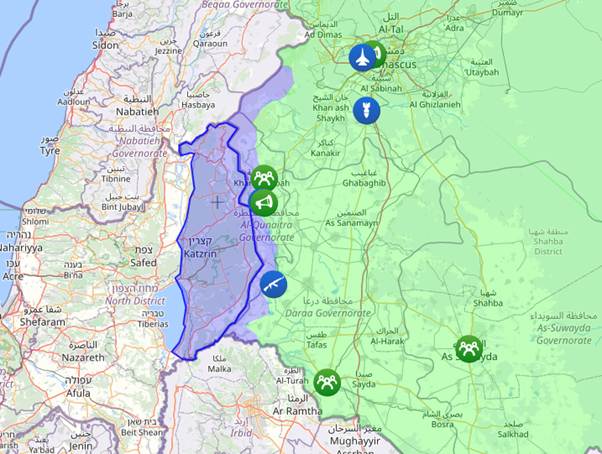
Source: Syrialivemap.
The demands for demilitarisation seem to be accompanied by Israel undertaking the reshaping of the area along sectarian lines. It is looking, in particular, to create a “Druze state” in Syria, which Druze leaders in Syria don’t want. The irony is that the Druze in general have no political mission, and whether they live in Israel, Lebanon or Syria, they tend to identify with the state they live in, unless they have specific reasons to disagree with a ruling regime. In fact, it seems that Israeli Druze are happy to continue as second class citizens of Israel. They even fight its wars without being reported on casualty lists when they are killed, because they are not proper Israelis. Meanwhile, the Druze communities in Lebanon and Syria have differing orientations to their states. The Lebanese Druze, for instance, backed Hezbollah in their war of support for Gaza, even as Israeli Druze fought in the ranks of the Israeli army.
This demographic management of southern Syria by Israel is part of a policy of explicitly dividing Syria up into cantons. It bears all the signs of ground being prepared for the expulsion to this area of Palestinians from the West Bank. 40,000 Palestinians have been displaced from refugee camps primarily in Jenin and Tulkarm (see Jenin at the bottom left hand corner of the map). They are crowding towards the of the West Bank with Israel. Israeli tanks have been deployed to the West Bank, in an unusual move, in a signal of a potential massive escalation of atrocities. With the control that the Israeli army seem to be able to achieve in southern Syria, there would appear to be the intention to use this opportunity to execute mass expulsions in a way that would obviate a direct confrontation with Jordan.
Like Egypt, Jordan has been successful in resisting any attempts to push Palestinians onto its territory, going so far as threatening Israel with war. Both the Jordanian and Egyptian armies are organised armies that Israel will have to respect. This is especially the case in the light of the devastation its army has suffered in the 15 month war in Gaza and the 66 day war of assault on Lebanon (which followed the war of support for Gaza) in which Israeli forces failed and were repelled.
Following on the criticisms of many informed observers and ex-generals of the Israeli forces, Israeli military historian Uri Bar-Joseph recently called the Israeli army a ‘trillion-Shekel’ operation that is a ‘bad and hysterical army, which has lost all its self-confidence.’ But the threat is all the more serious for Israel because, were confrontations to unfold, the Egyptian army would have the support of Hamas (both inside and outside the Gaza strip), while Jordan would count on the support of the Lebanese resistance. Hezbollah secretary general Na‘im Qassem’s last but one speech suggested that anybody who needed help to counter the problem of Palestinians being expelled from their homes need only ask.
But there are many conflicting interests in Syria representing regional powers. What is plain to see on the Syrian scene is increasing Turkish anger over Israel’s advances in Syria and the fact that the southern Damascus countryside appears increasingly to be turning into a border between Israeli and Turkish zones of influence.
But if the Arab nations gathering in Cairo on 4 March are angry at Israel, they also find Turkish influence over Damascus, and the potential coming division of Syria, unacceptable. Be assured that plans are afoot to change all that. The Umayyad mosque in Damascus is as much a symbol of Arab history, as al-Aqsa is of Islamic history.
What the mini-summit of 20-22 February will most certainly have done for Saudi Arabia is to bring the UAE in from the cold on Israel, and pull Qatar away from its the relations it built up with Turkey at the time of the blockade of Qatar between 2017-2021 during and encouraged by the first Trump administration (Trump administration animus against Qatar at that time could have had something to do with Jared Kushner’s mammoth failed investment in 666 Park Avenue). How things are fast changing! Qatar has already been playing a supportive role to Saudi Arabia in Lebanon.
Furthermore, there is evidence to show that the marginalising of ex-PM Neguib Mikati in the recent new elections for PM, in favour of ex-ICJ Chief Nawaf Salam, was done at the behest of Saudi Arabia. Mikati’s early unscripted visit to Damascus to visit with ex-HTS leader, now Syrian president, Ahmad al-Sharaa, who was clearly installed there by the Turks, had caused anger. Al-Sharaa’s invitation to Cairo will see him tested for the extent of his Turkish allegiance. This is unlikely to be a satisfying encounter for gathered Arab leaders, however, given that it has become patently clear that al-Sharaa is all things to all men. Watch this space for trouble to come. (N.B. In Syria Iran is being courted by the Arab nations of the mini-summit on one hand, and by Turkey on the other, as it waits to see how Trump policy towards it takes shape).
BOMB DIPLOMACY AND THE FUTURE OF GAZA
Meanwhile, the United States continues to pursue what can only be called ‘bomb’ diplomacy. It has supplied Israel with the 30,000 lb GBU-43 Massive Ordnance Air Blast bomb (also called the Mother of All Bombs) which can only be dropped from the back of a C-130 Transport aircraft. As the name indicates, however, it is an ‘air blast’ bomb which is useless against Palestinian and Lebanese tunnels, and pretty useless not only against Iranian underground facilities but also against Iranian missile defence systems, given that the C-130 travels at the speed of a fast car. The fact that it was announced by Steve Witkoff in Germany to the pro-Israeli BILD tabloid, seems to indicate that the United States is seeking to counter the Russian propaganda over the new Oreshnik missile, which has massive destructive power, but without the radioactive fallout of a nuclear weapon.
Nevertheless, incoming Zionist Secretary of Defense, Pete Hegseth, made a show of releasing a batch of 2,000lb bunker busting bombs to Israel recently, as a mark of friendship and commitment. Perhaps this a sign of a reboot of the Gaza War. The problem with that scenario is being hotly debated in Washington right now, because if the Arab nations meeting on March 4 are, for the first time since 1967, deadly serious about what they say they want, and there is every reason to think that they are, Israel restarting the war will be extremely expensive for the Trump administration. It has to be remembered that the security establishments across the Arab world have watched intently as the Israeli army has been defeated on the battlefield by indigenous insurgent groups, despite absolutely historic levels of bombardment. As the Israeli military historian Uri Bar-Joseph said of the trillion shekel army, it has been shown to be an empty shell, although it is currently on a dangerous course, overreaching as it is in Syria, only because there is yet no one there organised enough to confront it.
 Globalshiffft
Leave a comment