
Update 5 March: Judge Iwasawa Yuji is elected President of the International Court of Justice. The election wasn’t expected so soon. The Japanese people are amongst the most vocal in the world about Gaza. See their Ministry of Foreign Affairs statement on Gaza. THANKS TO ALL WHO RESPONDED TO THE CALL TO ACTION WITH THE LETTER BELOW.

Main text
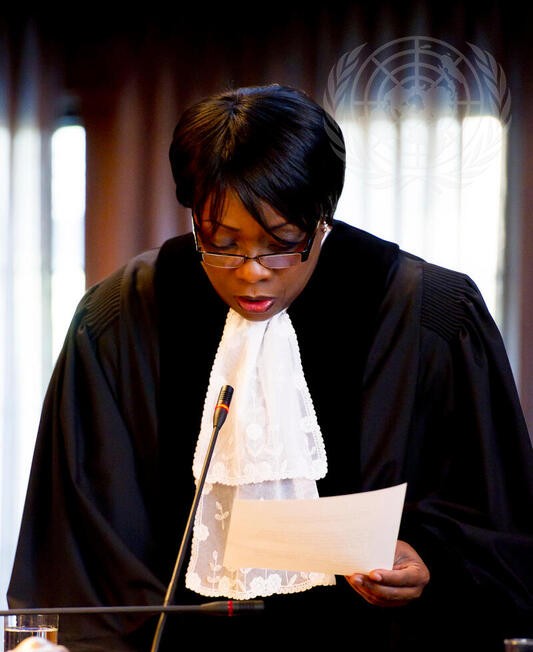
When the Chairman of the International Court of Justice (ICJ), Nawaf Salam, was suddenly shunted over to be summarily appointed Prime Minister of Lebanon in place of acting PM Neguib Mikati, whom the majority of MPs in the Lebanese parliament backed for a permanent position, his job was taken over by Ugandan Judge Julia Sebutinde (lead picture).
She had become Deputy Chairman of the ICJ after she stood out as the only judge out of 15 judges to vote against the decision of the court to apply special measures against Israel on 26 January 2024 in case no 192, in which South Africa charged Israel with crimes of genocide under the Convention on the Prevention and Punishment of Genocide, 9 December 1948. (On the sabotage of her dissenting opinion see below).
So far the following countries have joined South Africa (‘made a declaration of intervention’) in the case against Israel: Nicaragua, Belgium, Colombia, Turkey, Libya, Egypt, Maldives, Mexico, Ireland, Chile, Palestine, Bolivia, Spain and Cuba.
Sebutinde said in her dissenting opinion on the case that ‘I firmly believe that Israel has the right to defend itself against its enemies, including Hamas, and to continue efforts to rescue its missing hostages. These rights are not incompatible with its obligations under the Genocide Convention.’ In other words, she believes that the actions against Gaza’s civilians are purely military actions and have no genocidal intention, despite the mountain of evidence that Netanyahu’s cabinet has tried its very best to ethnically cleanse Gaza, including direct verbal statements recorded on TV footage to that effect.
The ICJ has dragged its heels on making a final decision. This prompted several organisations to conduct their own research and make their own judgements on the case, which were listed on a recent post on this site:
The United Nations, 1 October 2024: Genocide as colonial erasure;
Amnesty International, 5 December 2024: Israel is committing genocide against Palestinians in Gaza;
Human Rights Watch, 19 December 2024: ‘Israel’s Crime of Extermination, Acts of Genocide in Gaza’;
Medecins sans Frontieres, 19 December 2024: ‘What our medical teams have witnessed on the ground throughout this conflict is consistent with the descriptions provided by an increasing number of legal experts and organisations concluding that genocide is taking place in Gaza.’
Max Blumenthal at the Grayzone recently commented on Sebutine’s dissenting opinion (186-20240719-ADV-01-02-EN PDF), reading it through carefully and pointing out that the Ugandan judge resorted to accounts of the Jewish presence in the biblical land of Israel in her arguments, whilst strangely omitting any mention of UN resolutions or international law.
In the opinion, Sebutine writes that there ‘… is substantial evidence that Jewish people lived in the region of ancient Israel between 1000-586 BCE. This period corresponds to the era of the United Monarchy under Kings Saul, David, and Solomon, and the subsequent divided kingdoms of Israel and Judah. The evidence includes archaeological findings in the City of David….’.
She continues: ‘The Hebrew Bible (Old Testament) offers detailed accounts of the history, culture, and governance of the Israelites during this period. While these texts are religious in nature, many scholars consider them valuable historical documents.’
The Grayzone adds that her opinion was so extreme, and so shot through with theological commentary, that it prompted Uganda’s ambassador to the United Nations, Adonia Ayebare, to declare her ‘…ruling at the International Court of Justice does not represent the Government of Uganda’s position on the situation in Palestine.’
Please read the full Grayzone article. Note, however, that on the ICJ website for case no 192 Sebutine’s dissenting opinion has been cannibalised to exclude all the Zionist end times arguments and the documents given a different reference number (192-20240524-ORD-01-01-EN PDF). Max Blumenthal’s article has usefully recorded the original opinion.
This a CALL TO ACTION to flood the International Court of Justice with charges of tampering with evidence. Judge Sebutinde original submission is evidence of the fact that ICJ judges use arguments from the Zionist end times playbook while ignoring UN resolutions and international law potentially laying the ground for a miscarriage of justice. The fact that Sebutinde is Chairman of the ICJ must put the whole institution now under the spotlight. It must not be allowed to proceed with this case with this person in charge.
CONTACT THE COURT
https://www.icj-cij.org/contact-the-court
Feel free to use the email or letter template below:
Dear ICJ
I am writing to express my concern that there has been an abuse of process in relation to Judge Julia Sebutinde’s dissenting opinion in Case 192 in which Israel is accused of committing genocide against the Palestinian people.
Judge Sebutinde was the only dissenting opinion in this case. Her opinion as originally submitted cited Zionist justifications for Israel’s assault on the people of Gaza including that Jewish people lived on the land in the BCE era. Her opinion contained no references to international law or UN resolutions.
I understand that the opinion of Judge Sebutinde has been amended to exclude her extreme Zionist arguments and the document has been given a new reference number. This is clearly an abuse of process that must be rectified. It is an attempt to cover up the extreme views held by Judge Sebutinde, views that cannot be supported in law.
That Judge Sebutinde is now the Chairman of the ICJ makes these actions even more concerning – is it an attempt to obscure the fact that she is influenced by Zionist beliefs that cloud her ability to properly apply international legal principles to Case 192?
I call on the ICJ to make a statement explaining the tampering with Judge Sebutinde’s dissenting opinion.
Kind regards,
Name
Citizen of (country)
P.S. 28 January: Judge Sebutinge is accused of plagiarising her dissenting opinion. Zachary Foster posted the following on X: https://x.com/_ZachFoster/status/1883555090465804702?mx=2 text below
Breaking: the President of the International Court of Justice (@CIJ_ICJ), Julia Sebutinde, plagiarized sections of her dissenting opinion (https://icj-cij.org/node/204162)** [see note 29 January below] in which she voted against all provisional measures of South African’s case of Israel’s genocide of Palestinians. On p. 6, Sebutinde writes: “”The name “Palestine” applied vaguely to a region that for the 400 years before World War I was part of the Ottoman Empire.” This sentence was plagiarized word for word from a 2021 article published by Douglas J. Feith by the @HudsonInstitute titled, “The Forgotten History of the Term “Palestine,” (https://hudson.org/node/44363) in which he writes: ““Palestine” applied vaguely to a region that for the 400 years before World War I was part of the Ottoman empire.” It gets worse. Sebutinde plagiarized the next two sentences as well. She writes: “In 135 CE, after stamping out the second Jewish insurrection of the province of Judea or Judah, the Romans renamed that province “Syria Palaestina” (or “Palestinian Syria”). The Romans did this as a punishment, to spite the “Y’hudim” (Jewish population) and to obliterate the link between them and their province (known in Hebrew as Y’hudah). The name “Palaestina” was used in relation to the people known as the Philistines and found along the Mediterranean coast.” These 2 sentences were also plagiarized from the same Feith piece, in which he writes: “In 135 CE, after stamping out the province of Judea’s second insurrection, the Romans renamed the province Syria Palaestina—that is, “Palestinian Syria.” They did so resentfully, as a punishment, to obliterate the link between the Jews (in Hebrew, Y’hudim and in Latin Judaei) and the province (the Hebrew name of which was Y’hudah). “Palaestina” referred to the Philistines, whose home base had been on the Mediterranean coast.” Sebutinde make a pitiful attempt to change a word here or there, but this is a textbook case of plagiarism. Feith’s piece is not cited in her legal opinion, even though she copied and pasted multiple sentences from the piece. What a joke of judge. She’s making a mockery of the ICJ and should be removed immediately.
P.S. 29 January: Zachary Foster’s post on X refers to the same dissenting opinion that the Grayzone preserved for posterity (document number 186-20240719-ADV-01-02-EN).
Also researcher based in the Netherlands, Mihai Martoiu Ticu, found additional instances of plagiarism in Sebutinde’s dissenting opinion.
 Globalshiffft
Leave a comment