
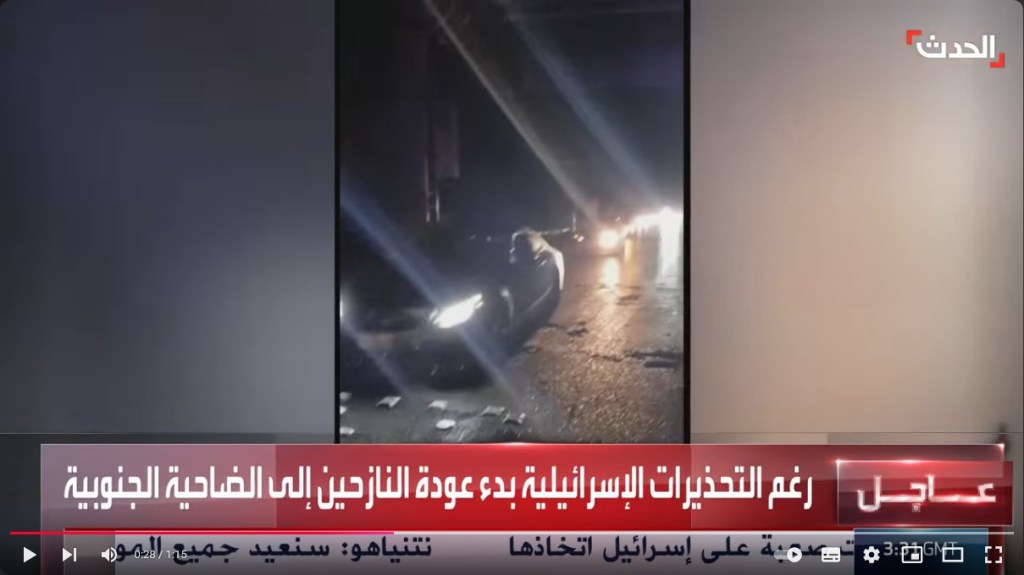
Before the 4.00 am GMT (27 November) start of the 60 day ceasefire agreement with Israel, in the pre-dawn darkness, Lebanese residents of the southern towns of Lebanon poured back into their villages destroyed by Israeli bombing. Before rebuilding, the bodies of relatives will have to be removed from the rubble (some 4,000 are estimated to have been killed). Well over a million people had moved out, now they were moving back. The Israeli military spokesman announced that military units were going to remain in place on the border points that they had reached in the last phase of the war along with their tanks. So there have been scuffles on the ground and detentions of local residents arriving in the darkness on the allegation that they are Hezbollah operatives. But the whole of Southern Lebanon, millions of people, ‘is Hezbollah.’
Now that Lebanese families are erecting tents and children are playing ball 10 metres away from their tanks, the Israelis are stuck for answers. If they don’t pull back to pre-war positions, and allow the formal Lebanese army to take over control of the Lebanese border area, neither will Hezbollah. The Lebanese negotiating team led by parliament speaker Nabih Berri stuck to its position backing continuation of UNSC resolution 1701 throughout the fraught negotiations. This had been enacted to regulate the end of the conflict with Israel in 2006. The United States and Israel were forced to agree. The only thing of significance changing, is that an international committee is now to be established to oversee the enforcement of the resolution and to guarantee both sides live up to commitments.
Clearly the situation can blow up at any time. So what’s new? But apart from “minor” infractions, mostly because of Israel, this is unlikely to make much difference. Israel can’t afford to go back to war. In his 5 November departure speech, Defence Minister Yoav Gallant had effectively said as much. It was necessary to return the Israeli hostages from Gaza and stop the war, he said ‘with a clear-eyed view of reality, I state that this is achievable but involves painful compromises that Israel can bear.’ The war in Lebanon would have automatically ended, since Hezbollah’s terms would have been met as a result. Beneath it all, however, the ‘clear-eyed’ reason for stopping the war was that the Israel army was exhausted and degraded. Besides the losses on the ground, the unprecedented air campaign in Gaza and Lebanon, had worn out Israeli aircraft and pilots, even as military bases all over Lebanon suffered daily attrition from Hezbollah drone and rocket fire.
Netanyahu wasn’t going to listen to Gallant’s plea. The October 1 campaign launched against Hezbollah had long been planned. This is clear from the fact that high spec explosives had been inserted into the pagers and walkie-talkies sold to Hezbollah at the beginning of 2024. But as we know, there was much more to what was being planned than merely injuring 4000 Hezbollah support staff by activating these hidden explosives (combat troops didn’t use these devices). Planning the knock-out blow against Hezbollah goes much further back. The assassination of almost the entire senior Hezbollah staff (including Hassan Nasrallah on 27th September), was only possible because of the acquisition of a detailed data bank on the persons and families of these leaders. This began when the UN international investigation committee into the assassination of Rafik Hariri in 2005 illegally provided all the data it had collected to Israel’s intelligence services. Evidence of this was provided by Lebanese army general Mounir Shehadeh, who participated in those investigations.
The intention to launch a powerful strike against Lebanon surfaced soon after the Al-Aqsa Flood attack by Hamas on 7 October 2023. At the time Netanyahu proposed it, the United States demurred. In a 17 October phone call ‘Biden expressed concern about the war expanding along the Israeli-Lebanese border.’ The United States continued to keep up the pressure. That is, until the pager and walkie talkie explosions led to a belief that Hezbollah had been dealt such a fatal blow, the time had come, in Netanyahu’s words ‘to change the face of the Middle East.’ The United States participated directly in the logistics supporting the wave of assassinations. With the wind in his sails, and a crushing victory over Hezbollah in his sights, Netanyahu let 70,000 combat troops, with tanks and air support from F-35 and F-16 fighter jets loose on Southern Lebanon. So what stopped him? It certainly wasn’t Hezbollah that initiated the cease fire negotiations.
The negotiations began two weeks into the assault
As Netanyahu led a devastating air campaign against the Lebanese population, he hoped that the more than a million displaced Shi’a Muslims landing in areas populated by Sunni Muslims and Christians would create bad blood between them. With this strategy in play, ex-Israeli army officer and Biden envoy, Amos Hochstein, launched a Kissinger-style shuttling effort between Beirut, Tel Aviv and Washington, which began a mere two weeks after the start of the October 1 campaign of destruction.
Hochstein was sent to negotiate harsh terms for a cease fire, hoping to gain adherents among the Lebanese who opposed Hezbollah’s war. Netanyahu demanded a buffer zone and the right of armed intervention in Lebanon whenever it considered its security was being threatened, and this as a unilateral condition with no court of appeal. He demanded the application of UNSC Resolution 1559 (2004) to Hezbollah, although the text of the resolution had no mention of Hezbollah. The point was to formally define the party as a ‘militia,’ which would lead to it having to be completed disarmed in law. US Ambassador Lisa Johnson was working Lebanon’s politicians to take this step, but only got the support of groups that coalesced around Samir Geagea, head of the “Lebanese forces,” which is a minority political force even among Lebanon’s Christians, albeit with a loud media presence.
Lisa Johnson is on a hiding to nowhere. America longer has any soft power; everybody hates you, even though some of those who hate you might from time to time do a deal with you that might be in their interest.
The West’s proscription of Hezbollah as a terrorist organization flies in the face of the fact that it has 27 MPs out of a total of 128 in the Lebanese Parliament which are part of the ruling bloc of 74 MPs, led by the Speaker of the Parliament, and leader of the Amal movement, Nabih Berri. The only reason Hezbollah is treated this way is because it stands in the way of imperial and colonial ambitions.
Even as Berri held negotiations with Hochstein and Johnson, his home town of Tyre was being bombed in a typically Israeli-American gun-to-the-head method of persuasion. Berri, however, wouldn’t give Israel political gains that it couldn’t win on the ground. The battlefield spoke. The Israelis and Americans caved. None of Netanyahu’s extraordinary demands came to be. So now, in terms of formal agreements with Lebanon, Israel is simply back where it was before the war started. This is an astonishing victory because of the way it was won.
The epochal nature of a Lebanese victory is in the big picture
Much is made of Hezbollah denying the ability of Netanyahu to achieve his stated goals of pushing the resistance movement north of the Litani river ‘in order to allow the settlers in Galilee to return safely to their homes.’ Given Hezbollah’s missile capability has a range of up to 200km, this would always be a red herring. Missile emplacements even at the furthest end of Lebanon would still threaten northern Israel. Netanyahu’s real goal, for which he was riding roughshod over Palestinians, Lebanese and Israelis alike, was to ‘remake the Middle East.’ He failed in this, his real goal.
Hezbollah’s acceptance to severing the link between Lebanon and Gaza in the final ceasefire deal will be discussed shortly. At this stage, this severance should be understood in the context of the fact that the war changed on October 1, from being about Gaza, to being about the ‘remaking the Middle East,’ in other words destroying Lebanon en route to destroying Syria, then destroying Iran.
One of the important reasons why this is victory is epochal is because of the way that Hezbollah regrouped after the devastating blows it suffered in September, then to hold off as powerful an onslaught by a modern army as has ever been seen, for two months. By all accounts, it could have continued for much longer. It was all about military organisational strength. The normal resistance tactics of retreat and ambush were largely dropped in favour of a stolid strategy of denial. The forward tunnels that Hezbollah had to occupy when the Israelis launched their 1 October assault kept functioning throughout, launching rocket attacks even as they suffered continuous heavy bombardment. No ground was given. This would be a devastating defeat for the Israeli superman who with its electric victory in the 1967 Six-Day War caught an American imagination that was mired in the failures of the Vietnam War.
Israel’s image has not only changed over this period from an apartheid to an insane genocidal state. It has also changed from the mean lethal military machine of the past, into a corrupt, figuratively and physically obese, Ben Gvirian, delusional outfit with mind-bendingly unrealistic ambitions. After its humiliation at the hands of Hamas in Gaza, the failure at the Lebanese front would be an extraordinary turn of events for Israel’s armed forces. Israeli propaganda would have to go into overdrive to compensate. At least at one point this last month, Israel resorted to old film from previous wars to produce PSYOPs victory narratives for Israeli TV.
To understand the true epochal nature of this victory, however, it is necessary to look in depth Hezbollah’s claim that this was a victory for “Arab nationalism.” This has two aspects.
The first is the political one: the fact that Hezbollah’s victory, secured now under resolution 1701 would allow Lebanon’s factions to finally form a nation. There will always be opposition to Hezbollah. However, this opposition if the analysis here is correct will have to shed the use of violence and pursue its goals in parliament.
Berri lost no time in announcing presidential elections for the coming 9 January. A country that has suffered devastating blow after devastating blow – with the 2020 explosion of the ammonia nitrate stores in Beirut port and the Central Bank governor gambling and losing the country’s foreign exchange reserves – will start rebuilding, both politically and physically. Now Government officials tour the country to collect damage claims from the population. The rebuilding will be funded principally by Iran, although Gulf Arab states may well participate. They will find it in their long term commercial interest to do so.
Lebanon will become an example for other weak states in the region to follow. Not just Syria, but Iraq, Yemen, Libya and Sudan have been cannibalised by imperial colonial interests since 2003.
The second aspect of the appeal to “Arab nationalism” is the futuristic technological one. No longer is an appeal to Arab nationalism an appeal for a revival of the past. Hezbollah has shown that it is at the centre of the digital revolution in warfare which is sweeping the world and disadvantaging the outdated armies of the imperial powers with their cumbersome equipment and associated strategies. The model of the vast fleets of the past build around huge aircraft carriers have turned from fearsome weapons into fearful and useless targets. No longer can the choke points of world trade be policed using the old ways. Ansar Allah have regularly engaged American destroyers and aircraft carriers and caused damage which is always denied as a matter of routine by US military spokespeople.
In this context, Israel’s reputation hasn’t only been damaged as a lean combatant. For a country with a vast and vaunted military industrial complex, its clients throughout the world are astonished that Israel had no counter for Hezbollah’s drone technology. This technological gap, more than Hezbollah’s capability with guided missiles, made its mark, especially among the security conscious Gulf Arab states. The most startling drone attacks in the course of the war occurred in a dining hall inside an Israeli military barracks, and at Netanyahu’s bedroom window. The uselessness of Iron Dome, Patriot and THAAD missile defence systems has become striking. Why pay through the nose for ineffective military equipment, when even embattled and deliberately starved Gazans have led the way in the production of highly cost effective weaponry? At the heart of the new Arab nationalism 2.0 is a technological and ideational revolution.
Why did Netanyahu cave?
What ended the war was Hezbollah’s 24 November ‘huge’ missile attack on Tel Aviv, the holy of holies. The campaign on Tel Aviv, which had been kept off limits, only began on 13 November with the drone attack on the Defence Ministry headquarters and escalated from there. But as Israel’s bloody air campaign spread into the centre of the Lebanese capital, the strategy changed. By 26 November, Israel’s financial centre came directly into Hezbollah crosshairs, and the war suddenly stopped. This was significant. The Israeli economy has tanked in the past year: the diamond trade, tourism, agriculture, high tech have all been severely negatively affected. Business has migrated. Countries throughout the world are offering tax breaks to these new migrants. Now Wall Street was going to see Tel Aviv – its Israeli base – go up in flames. So the war was stopped.
It was still two months until Trump’s inauguration. By caving, Netanyahu gave the departing Biden administration the gift of a ceasefire that he had planned to give to Trump on January 20, 2025. He thus obviously took a step he hadn’t planned or wanted to take.
Netanyahu would clearly want to talk to his public about this. He said that he had achieved a severe 80% degradation of Hezbollah’s capability, a meaningless statement that can’t even be tested. The main point of his caving speech was that he had succeeded in severing the link between Gaza and Lebanon. Yes, Hezbollah did agree to do that. But as just mentioned, the whole region came to be up for grabs from 1 October with Ben Gvir’s ‘Greater Israel,’ and Netanyahu’s desire to ‘remake the Middle East;’ waiting for Trump’s inauguration with baited breath to launch an attack against Iran. Lebanon had to consolidate its victory.
The Axis responding to the widening aims of the Israeli war
Hezbollah’s agreement to the cease fire was in coordination with Iran, and within the context of the 7 October pact formalising relationships between the various elements of the Axis, which to date had been ad hoc. With Israel’s new regional ambitions now Israeli public policy, the Axis has organised itself into a regional defence network. The battle in Northern Gaza is full on and will continue. The Israelis kill and starve civilian women and children. But the ranks of resistance fighters have grown and the ferocity of their forays against Israeli military units is undiminished.
Separate negotiations have now sprung up over Gaza that are quite significant between the United States, Qatar and Egypt, as Axis states such as Yemen and Iraq, are getting more closely involved with Hamas in Gaza, and as Fatah and Hamas finally come to an agreement in Cairo on the governance of Gaza. Just before Hezbollah finally agreed to the ceasefire terms, Hamas spokesman Ossama Hamdan announced his party’s consent to the agreement. In fact he encouraged the ceasefire on the Lebanese front. This in the context of the Axis responding to the widening of the war, even before the sudden developments in Syria.
Meanwhile, the International Court of Justice (ICJ)’s genocide judgement on Israel, which has been almost pre-announced by Francesca Albanese’s UN report, is likely to be contemporaneous with Trump’s inauguration. Israel has lost northern Gaza. It has no objectives left to pursue other than the release of the hostages. Gaza is a deal waiting to be made.
Syrian developments: But no sooner than the ceasefire with Lebanon was announced, Syria exploded. Israel, which is going to need a couple of years to rebuild, wants to do everything possible to stop Hezbollah rebuilding. Netanyahu immediately warned Bashar al-Assad against helping in this process. Syria is the umbilical cord linking Iran and Lebanon. American intelligence had been preparing Hay’at Tahrir el-Sham (ex-Al Nusra, ex-Al-Qaeda) [HTS] for just such an event and suddenly pressured Turkey to allow it fighters through to attack Aleppo, to throw the Assad regime off balance. Turkey decided to send in its own Syrian militia, the Syrian National Army [SNA]. This is a turn from the rapprochement Erdogan sought, but which Assad had rebuffed because the Turkish president refused to withdraw his troops from Syria as a condition of talks. The Turks were in a race to get to Aleppo first and then to go on to Hama. Meanwhile, the Kurds, in the form of the Syrian Democratic Forces [Qasad], who with the backing of the United States and Israel, fiercely oppose Turkey, also joined the race. The Turks have military control of Idlib, northwest Syria, where most of these groups (and other minor groups backed by French intelligence or Ukrainian intelligence) are based. They will find that their decision to open the floodgates will backfire. Their relationship with Russia will be severely strained.
[N.B. 2 December: Russia, Iran and Iraq are now forming a front against the advance of the Idlib based armed groups HTS and SNA, and are calling out Turkey’s actions. Turkey in a press conference held between Turkish FM Hakkan Fidan and Iranian FM Abbas Araghchi, maintained that the move by the armed groups wasn’t planned and had nothing to do with the Turkish government. Fidan insisted that the attack by the armed groups on Aleppo was due to the fact that the Assad regime had ignored the demands of the Syrian rebels for too long, which is a fair point. However, most of the genuine rebel groups are associated with the SNA, and so the question remains why Turkey continues to protect HTS, the chief perpetrator of the current attack, given that HTS is a CIA asset. The Russians told the Turks long ago that the solution to the overall Syrian conundrum, which includes the Kurdish problem, requires the disbanding of HTS. The Assad regime also maintains that it is unclear whether SNA, formed and trained by Turkey, is a genuine representative of the will of the Syrian opposition, or does it represent the ambitions of the Turkish state? All these issues, however, could have been put across a negotiating table long ago.]
Netanyahu and the Pentagon capitalists
What would Netanyahu want from Trump in return for the gift of a Gaza deal? Clearly, he wants Trump’s full backing for a war with Iran which Israel could not possibly launch by itself. Iran lies in wait. The day before the Lebanese ceasefire took effect, on 26 November, Iran reiterated its pledge to launch ‘True Promise Three,’ a planned missile attack in response to the last Israeli attack on Iran on 26 October, which failed utterly. The attack might have failed, but the few quadcopters coming in from Azerbaijan that ended up firing on the Parchin military base did constitute a violation of sovereignty, so a Promise is a Promise. Typically, an embarrassed Israeli military would nevertheless hype that attack as a major blow against its antagonist in what has been called an ‘Imaginary War Narrative Strategy.’
Can Israel, and Netanyahu in particular, take America to war over its wishes to conquer the Middle East? According to John Mearsheimer and Stephen Walt, this is precisely what happened over the Iraq War. After their book, the Israel Lobby was criticised over this allegation, a massive amount of evidence would subsequently accumulate to vindicate their claim. A previous article on this site goes over the facts about how all the intelligence about ‘weapons of mass destruction’ was actually doctored and prepared for public consumption by members of the Zionist cabal that had permeated the American security establishment in 2002 and 2003. It wasn’t a failure of intelligence, it was done on purpose.
This time, not only is the whole thing out in the open, but times, technology and the balances of power have changed.
Iran is a country four times the size of Iraq with twice the population, and hundreds of military and missile bases, a great majority of them buried underground. The nuclear sites, Fordo and Natanz are buried deep beneath mountains (unlike Dimona, the Israeli nuclear facility). Iran has always known about Israel’s nuclear weapons. So it planned its important military instalments with precisely that in mind.
Then there is the fact of the country’s highly sophisticated air defences, which were cause of the failed 26 October attack, when no less than 100 F-35s, it appears, tried and failed to penetrate Iranian airspace undetected.
Furthermore, a Iranian missile retaliation could easily flatten Israel. The impact of the True Promise Two missile attack was significant, although it was limited and focused operation. Iran’s capabilities are far greater than what has been put on display up until now.
All these facts are clear to Netanyahu, as they are clear to the Pentagon. As is the fact the US 6th Fleet in Bahrain and US air force bases in Qatar and the Emirates on the southern littoral of the Persian Gulf face missile launchers embedded in the rocks of the Gulf’s northern littoral. These are a mere 2 minute hypersonic flying time away and the US has no counter. It doesn’t have hypersonics, and relies for its attacks on the F-35 stealth fighter, into which multi-trillion project the Pentagon committed the majority of its high technology budget over the past 15 years. If this aircraft was indeed detected on its approach to Iran on the 26 October over Iraqi airspace, then its check mate against the empire.
The rope is tightening
Congress hawks and Netanyahu planning an attack on Iran is mere wishful thinking.
As was the plan to destroy Hamas.
As was the plan to release the hostages in Gaza by force.
As was the plan to destroy Hezbollah.
As was the plan to return the northern settlers to their homes and farms in Galilee.
Wall Street will not take kindly to demands from serial losers in Israel to destroy the oil market and cause a new collapse of imperial money. The banking system is still underwater from the 2008 crash. It was Wall Street that demanded a stop to the Lebanon operation and it will not stand idly by if Trump, unlikely as it is, decides to attack Iran. The Saudis have put them on notice that the world has changed and that the empire continuing in business in the Middle East has now to be on their terms. The Gulf Arabs are not exactly Arab nationalists but, right now, they don’t mind trying the new 2.0 version of Arab nationalism.
Pentagon capitalism (a different collection of interests to Wall Street) is in a panic over Trump’s accession to power and doing everything it can to promote the war in Ukraine by forcing Zelensky to reduce conscription age to include school leavers. They are in such a panic over the Trump factor that they completely ignore the fact that the equation in Ukraine has been turned on its head with the new Russian very large multi-warhead hypersonic intermediate range missile (IRBM) called the “Hazelnut” (Oreshnik). This missile reduced the entire industrial district of the City Dniepro to dust with 16 lightning bolts arriving from the sky more or less perpendicularly.
Trump will be only too aware that it was his Secretary of State, Mike Pompeo who was responsible for pushing him to cancel the INF (Intermediate Nuclear Forces) treaty with Russia, which allowed the Russians to build this extraordinary weapon, like Pompeo was responsible for pushing him to pull out of the Iran nuclear deal (JCPOA), and for the assassination of Qassem Suleimani (commander of the Iran Quds Force). Having realised what a complete idiot Pompeo is, Trump excluded him from his cabinet.
In regard to launching a war on Iran, it is hard to imagine that Trump would want to start something that would devastate the American economy, let alone the Israeli state. It is more likely that he takes the tack with all the Israel firsters in his cabinet that it is time that Israel be protected from itself. In a documentary doing the rounds in the United States American Zionism – no less – is on a warpath against the corrupt and obese Netanyahu régime.
The noose seems to be tightening around Netanyahu. Where it had been on the cards that Karim Khan, the ICC prosecutor who was responsible for issuing the demand for an arrest warrant on Netanyahu, be embroiled Assange-style in a sex harassment case, instead, the warrants were issued without any fuss. EU Foreign Policy chief, Josep Borrell has backed the arrest warrants. If Macron is doing otherwise, this is likely to be because he was involved in nudging the ICC to issue the warrant. He probably has a villa in the backwoods of New Caledonia, which he can sell to Netanyahu at a good price, where the Butcher of Gaza can eventually spend his last days if the walls narrow in too closely.
 Globalshiffft
Leave a comment