
The 11th June article on this site discussed how the imperial interests in the United States pushed through UNSC resolution 2735 for a ceasefire in Gaza, which Hamas found meaningful enough to accept. Those “imperial interests” are simply those interests that see Israel as a garrison state run by an army and security establishment powerful enough to deputise for America in the energy-rich Middle East. They are currenly in conflict with the forces of the Israeli Lobby, which demands unquestioning obeisance on the part of US Congressmen and women to the policies Netanyahu and his right-wing coalition. Be that as it may, if working as normal, the imperial garrison state plan would allow the United States to be effect its long delayed “pivot to Asia,” in order to confront China in the Pacific.
As mentioned in previous articles, the most fundamental pillar for such an arrangement would be a security agreement between the United States and Saudi Arabia that included Israel, which in turn would require that Israel and Saudi Arabia establish formal diplomatic relations. This is where a political solution to the Palestine question is seen as important.
It is to be expected of these imperial interests that they would watch anxiously as Saudi Arabia decoupled from their sphere of interest over the past years with its own development plan (Vision 2030), one which is essentially supported by China in the context of its Belt and Road Initiative. China’s ideology chief, Wang Huning, once called this arrangement the ‘docking’ of the development strategies of the two countries. The implications of that for the long term are clear: a strategic Saudi dependence on Chinese trade.
Geopolitical Shift in the Arab Gulf: Launching Vision 2030 with its absolutely crucial reliance on prospective revenues from tourism, both secular and religious, peace in the region became absolutely essential. Saudi Arabia therefore leveraged its new relationship with China to negotiate a peace agreement with Iran, eventually signed in March 2023. Saudi Arabia had by that time already begun peace talks with Ansar Allah (the Houthis), the Iranian ally in Yemen with which it had been at war, in September 2022.
This informal arrangement in turn would be consolidated in the formal terms of the Iran deal. The emergence of a “New Diplomacy” in the region as a result would, however, render ineffective the American imperial divide and rule strategy that relied on a Shia-Sunni split across the Middle East that could be exploited to control the flow of energy to East Asia, and thus to China. The New Diplomacy remained robust throughout the current Gaza war. Saudi Arabia and the United Arab Emirates were unequivocal in their rejection of American demands that they join the coalition of forces that was gathered to counter Ansar Allah’s war on Israeli and Israel-bound naval traffic in the high seas around the Arabian peninsula.
They continue to maintain that stance, despite Saudi Arabia verbally asking the Yemenis to tone down the level of their military action, under diplomatic pressure from the United States. The Yemenis didn’t respond. The Saudis did nothing.
For American imperial interests, there would be no time to lose. But for Saudi Arabia, as indeed for all the Gulf Arab states, the balance of power was changing. It changed with the US withdrawal from Afghanistan (2021) and with its miscalculations in Ukraine (2021/2). However, Saudi Arabia was not merely “reacting” to these changed circumstances with its development plan. It had launched the plan in 2016 after years studying the future catastrophic effects of climate change on the country and on the country’s revenues from fossil fuel sales. There were no longer “sides” to take. The United States, China and indeed Russia were by now all viewed as important Arab trading partners in a headlong effort for long term survival.
These developments pose a strategic problem for imperial interests. Still, the opportunity remained for a strong relationship between the United States and Saudi Arabia on its security and nuclear energy needs that would overshadow the desert kingdom’s essentially non-military relationship with China.
This is where the political solution in Palestine becomes important. For Vision 2030 to work as an attractive prospect for the populations of the Global South and to keep the peace in the Middle East, Saudi Arabia saw the need for Israel recognise the State of Palestine, if the US sought to keep it as the pinion of empire.
Before the 7 October 2023 attack, when Israel was still an unquestioned part of America’s imperial plans in the region, Saudi leaders were setting a low bar, in that a mere de juro recognition of a Palestinian state was seen at the time as sufficient ground allowing all other agreements with the United States to go forward. The Palestinian Authority would provide a minimalist de-militarised representation of a Palestinian “state” on the ground.
Al-Aqsa Flood, and most especially the Israeli response to the attack, changed all that. Saudi leaders were unequivocally vocal in the Organization of Islamic Cooperation (OIC) on 18 October in condemning Israel, as they would be in the joint demand by the Arab states at the United Nations Security Council (UNSC) on 26 October for a condemnation of Israel, and the subsequent United Nations General Assembly (UNGA) resolution for a cessation of Israel’s action.
The shocking manner in which Blinken sought to aid and abet Israel’s right wing regime with the ethnic cleansing of Gaza was a turning point in US-Saudi relations. Not only did Saudi Arabia respond to all this by hardening its conditions on the Palestinian state, repeatedly insisting that that normalisation would be impossible without an “irrevocable” pathway towards that state’s creation, but it also became clear that all future negotiations with the United States on questions of security and nuclear power would have to proceed, in the meantime, on strictly bilateral terms. Israel would be excluded.
The Saudi stance would inevitably influence the policies of the other Gulf Arab states. At the beginning on the current crisis, the UAE and Bahrain were perhaps the only Arab countries to maintain an ambivalent attitude towards Hamas as instigator of the crisis whilst condemning Israel’s disproportionate response at the same time. This was a function of their formal position as “normalisers” with Israel.
The UAE, however, had long been concerned about Netanyahu’s gradual transformation of Israel into a right-wing theocratic state. Within a couple of months of the October crisis, the UAE began to take Saudi Arabia’s lead in shifting its diplomatic stance more towards the issue of Palestine. It lead the effort on 8 December 2023 at the UNSC to end the war. Although that particular endeavour was vetoed by the US, the UAE then led the vote in the UNGA to admit Palestine as a full member on 10 May 2024, which was successful. The UAE also took pains to appear to the region to be a leading provider of aid and solutions for Gaza.
There would also be a shift in the Bahraini position. Under Saudi influence, it would begin a programme of releasing political prisoners who had protested Bahrain’s normalisation with Israel and would also begin peace negotiations with Iran brokered by Russia.
Overall, in the Gulf, a headlong rush to normalise with Iran takes over from the previous trend under Trump’s “‘Abraham Accords” to normalise with Israel. It is a serious mistake to take Gulf Arab satellite TV news as the official view, as informed commentary has made clear [←video in Arabic @ 38.40 mins], These channels are owned and operated independently by American Zionist interests.
This may all seem very odd, but in this period of extreme regional turbulence, two things are clear. Firstly, events are happening fast and often taking directions that are not clear to the leader and state officials involved in them. Secondly, in such a period of tension and change, a policy of constructive ambiguity is, for everyone concerned, arguably the best policy. In the event, the Zionist narrative emanating from Gulf Arab satellite station thus provides a useful smokescreen.
As an aside, to the extent that the leaders of the Arab Gulf countries set the tone of Arab politics in general, it is worthwhile pointing out that that so long as Mohamed bin Salman remains Crown Prince, albeit effective ruler, no overtly bold Saudi narrative consistent with the dramatic changes actually taking place in the country should be expected. That situation would clearly change when he takes the throne, not only when he is formally recognised in his country, but perhaps also having become wiser.
Netanyahu’s Papal Gambit: Israel’s pathway towards becoming a rabid right-wing theocracy, even as the Arab states normalise with Iran and turn towards Russian and Chinese trade, has caused an even more radical cleavage between Israel and the rest of the Middle East than ever before. The United States will find difficult if not impossible to overcome this yawning gap should it seek to reboot Israel’s deputising role in the empire, which is why the imperial interest in the United States, led by Senate Majority Leader Chuck Schumer, now seeks to remove Netanyahu. But Netanyahu continues to play for time, looking to bomb Gaza into submission and reduce it to the same status as the West Bank, while Smotrich and his bands of armed settler goons take the West Bank over from the army, and setting out to effect its annexation.
It would eventually become clear to the military establishment in Israel that Netanyahu was using the long war not only to kill as many Palestinians as possible, but to wear the army down into submission to his political reconstruction of Israel into a Jewish theocratic state under his rule. In meetings of the War Cabinet, Benny Gantz and Gadi Eisenkot, both ex-army chiefs of staff, repeatedly asked Netanyahu for a clear and realistic plan for the war in Gaza. None was forthcoming because no plan was in fact the plan. Netanyahu’s two enemies, the Palestinians and the military would wear each other out and he could then swing to a lifetime role as fascist pope, as long as he could outlast Biden and see Trump in to assure his ordination.
When Gantz and Eisenkot resigned from the War Cabinet on 9 June, Netanyahu proclaimed that Israel “was a state with an army, not an army with a state,” a clear repudiation of the political role that Israeli generals have played as prime ministers of the country ever since Ben Gurion. It has always been an unwritten part of the Israeli constitution that army generals played a central role in political decision-making. David Ben Gurion, Yitzhak Rabin, Ariel Sharon, Ehud Barak and others all led Israel at one time or another because they had been in the military. As relations between Netanyahu and the army collapsed, Netanyahu’s wife, an ex-Mossad agent, raised the stakes by accusing the army a few days ago of plotting a coup to remove her husband.
The 24 July Speech and the undermining of UNSC Resolution 2735: So, just as there are conflicting factions in the United States in regards to policy toward Israel and the Middle East, there are conflicting factions in Israel. In order to quell opposition to his handling of the Gaza situation and stop Biden’s constant bickering about the progress of the war, Netanyahu decided to invite himself to speak to the US Congress. Republican House Majority Speaker Mike Johnson, with the Israel Lobby in his sails, would then railroad Netanyahu’s self-invitation to speak to the US Congress over Chuck Schumer’s head, setting a date of 24 July for the speech.
Netanyahu moved on this idea to visit the United States on May 24, after it became clear that his plan to announce a final victory over Hamas in Gaza with his controversial Rafah operation, launched on May 6, collapsed. For months Netanyahu had touted a ground invasion of Rafah, in Gaza’s south, as the final solution, only to find that Israeli forces would be decimated there in ambush after ambush, with Hamas even showcasing new deadly longer-range anti-tank missiles (“Red Arrow”). As Rafah quickly became a synechdoche for the whole Israeli Gaza adventure and the trap of all traps, the Israeli army began going round in circles through all the Gazan districts that they had supposedly already pacified: Zeitoun, then Jabalia, then Shuja’iyya, then Beit Lahia and back the beginning again, always finding Hamas whever they went and incurring losses.
The imperial interests decided to hit back by supporting UNSC resolution 2735, which passed on 10 June, and thereby end the current impasse. This was the first UNSC resolution to pass that contained an unequivocal demand for an immediate end to hostilities, seeking to achieve a release of hostages along with a permanent ceasefire broken down into three separate stages of negotiations. Hamas agreed to the terms of this resolution, and the text of Hamas’ detailed response can be found beneath the 13th June article. Resolution 2735 contained what was essentially Biden’s ceasefire proposal of May 31, although Biden himself inexplicably called it “Israel’s proposal.”
But it was an unpleasant surprise for Netanyahu, who hadn’t counted on his wasting time on the phone with Biden, discussing the president’s ideas, suddenly turning into a fully-fledged ceasefire resolution. While Netanyahu walked back any previous agreement to this plan, he could rely on Blinken to do his best to undermine the process of implementation.
Pressure was neverthless mounting on the prospective Pope of Israel, who was losing patience as leaders of the military-security establishment backed massive street protests against his rule and then denounced Netanyahu’s ‘authoritarian remaking of Israel’ based on his razor thin parliamentary majority, in an open letter to the New York Times on 26 June, which asked the US Congress to ‘disinvite him,’ and cancel his speech. Conscious that the Israeli legislature was going to go into recess, and needing to keep his extremist right wing coalition together during the summer legislative lull, Netanyahu decided that it would be a good idea to escalate the war with Hezbollah in Lebanon.
The Lebanon gambit: If since 7 October 2023 the Israeli army has taken an unprecedented pounding in Gaza, the front with Hezbollah in Lebanon is in many ways much worse for the Israelis. As pillar of the Axis of Resistance, the collective regional opposition to American dominance in the Middle East, Hezbollah has surprised Israel over and over again with the advanced drone and guided missile weaponry it has developed in its own factories. It has destroyed Israel’s radar and listening systems all along its border with Lebanon, as well as major strategic military installations such as the Meron air traffic control centre. It has also devastated the infrastructure and buildings in Israeli settlements across northern Galilee, sending some 100,000 settlers into temporary accommodation, while collapsing the country’s agricultural output.
But there was even worse news in store for Israel. If the Aqsa Flood attack seriously damaged Israel’s military, security and intelligence reputation, Hezbollah’s Hoopoe (Hudhud) drone mission gave it a final coup de grâce. The mission delivered hours of uninterrupted footage of all Israel’s sensitive military and strategic sites in the northern and central regions of the country, parts of which were broadcast (picture below).
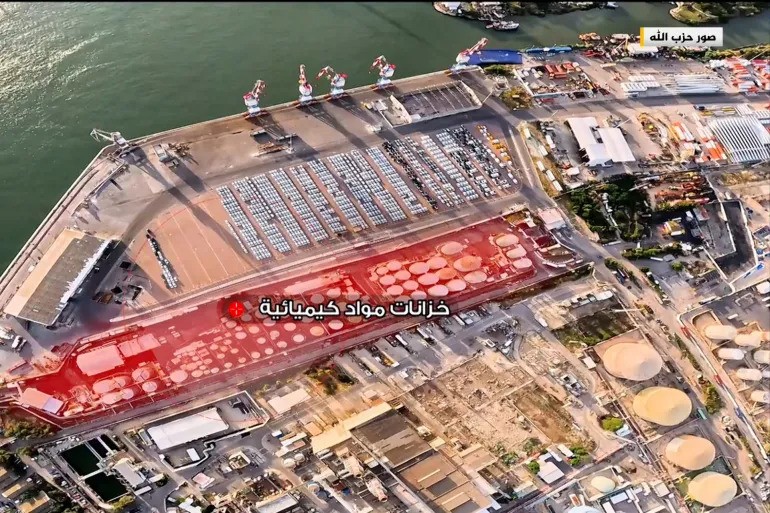
This store of vital information now available to Hezbollah, together with all the new weapons that Hezbollah unveiled in stages over the past nine months, as well as its demonstrated ability to destroy Iron Dome sites (Israel’s vaunted “protective shield”), adds up to very strong deterrence.
And yet immediately after the broadcast of the Hoopoe footage, Netanyahu, clearly seeking another time wasting exercise like the Rafah expedition that could put new oxygen into his precarious coalition, downplayed its importance and announced a “powerful operation” against Lebanon. Defence minister Yoav Gallant, meanwhile, made a sudden trip to the United States to discuss the idea of escalating against Hezbollah with his American counterparts. Gallant has been lobbying for an end to the war for a while. There had also been an uproar from the mayors of Israel’s northern towns and cities after Netanyahu’s announcement. But if there was going to be an escalation, he wanted at least to determine the kind of operation it would be.
US military experts reacted strongly during Gallant’s US visit. They expressed scepticism at Israel’s ability to survive a full scale war with Hezbollah. They informed the Israeli defence minister that they would not be able to help defend Israel from retaliation, if it attacked Lebanon.
Gallant’s visit, led him to change his mind about the wisdom of even the limited escalation against Hezbollah that he had been thinking might be possible.
The logic of the Pentagon’s arguments was clear. The proximity of Hezbollah’s highly developed arsenal of weapons to the multiple sensitive targets in Israel that had been identified by the Hoopoe drone meant, with the best will in the world, and even with the help of a US naval battle group in the Mediterranean, the United States could never protect Israel from being destroyed. It had been successful at doing so during Iran’s retaliation for Israel’s attack on its consulate in Damascus. But the reason for that success, besides being forwarned of the attack, was that US navy radars had had the opportunity to track Iranian ballistic missiles and drones over a 2000 km range. In Lebanon’s case there would be no such opportunity.
Biden’s End: The planned speech he intends to give to the US Congress on the 24th July is yet another of Netanyahu’s games and deceptions. Biden is the weakest US president in living memory and has caved in to every demand by the Israeli leader for an extension to the war in his search of an elusive victory. And yet Netanyahu intends to attack the US president for lack of support in his speech. Biden’s crime was to criticise Netanyahu’s genocide in Gaza. But that was a cynical attempt by the US president at mitigating damage to his electoral chances. Biden didn’t care, otherwise.
The vast majority of US Congressmen and women have their snouts firmly stuck into AIPAC’s barrel of swill. Many don’t, like Bernie Sanders and Elizabeth Warren, who are two senators, for instance, who as things stand will not attend Netanyahu’s speech. But the majority are set to assure Netanyahu wild reception with stand up ovations. Netanyahu will seek ordination as lifetime pope of his new genocidal theocracy, which will involve rallying support against the military-security establishment who want rid of him and wanted Congress to ‘disinvite him,’
Netanyahu may well have been hoping all this time that the atrocities he was committing in Gaza would bring about Biden’s electoral defeat. A win for Trump would mean, at least in his deluded mind, that his ordination could be decided en famille. His personal relationship with Trump’s son-in-law is well known.
Netanyahu cannot have been disappointed with the way Biden and Trump competed in the first televised presidential debate to prove how committed each was to ‘finishing the job in Gaza.’
But the shock outcome of the debate is the Democratic establishment’s turn against Biden and, most especially, the New York Times editorial board’s recommendation that he ‘should leave the race’ and not be nominated as their candidate for the presidency. No other voice could be more damaging for Biden’s future prospects, even if the White House now tries to engineer a bounce-back. Biden’s faltering and incoherent delivery in the debate wasn’t that much worse than on previous occasions, although admittedly, it was pretty bad.
But could it be perhaps that, after the escalating students protests, the scales are now suddenly weighted in the Democratic camp against Biden in a way they weren’t earlier? Perhaps Netanyahu has been successful in his intent to damage Biden and that far too much excrement associated with the genocide in Gaza has stuck to the weak old Zionist president?
We are now faced with the situation that the Democratic establishment seems to feel it has nothing to lose in its feverish quest to distance “the Donald” from returning to power, even if this means shoeing in an unknown as nominee in double time. If so then Biden is getting his comeuppance now rather than at the elections for his support of the Gaza atrocities.
Do we see here a final resolution of the debate around Hanna Arendt’s notion of the ‘banality of evil’? Can evil be a mundate act or must there be some internal psychological correlate to evil acts within the person perpetrating those acts? Biden and Netanyahu perhaps offer two different answers. The one is a machine politician, the other a demented megalomaniac.
Yet it is Biden – technically the most powerful person the world – at whose door the blame must ultimately be laid for not ordering a stop to the atrocities in Gaza. The outrage should have been stopped from the very start.
But having missed that obvious moral choice, the International Court of Justice’s 26 January order to Israel to suspend its military operations would have been a perfect opportunity for Biden then to do the right thing, order cessation of hostilities, and stop supplying weapons. He could even have spun this as ‘being for Israel’s own good.’ But no, the White House had to quibble with the legalities of the order.
So those atrocities will come at a horrendous long term cost to the United States, as it loses the moral ground for its hegemonic status. Many countries are formally joining South Africa’s case against Israel over the genocide in Gaza, but it is actually the application by Spain to join, which is the most damaging for the United States. Spain is a member of the EU, whose obeisance to the United States makes it a part of the empire. Yet here is a nation that is bucking the anomie of the EU by taking a moral stance, presaging thus the collapse of hegemony.
So what if Trump does come to power now? In yet another twist of fate, Netanyahu may then get his own comeuppance. Trump, confident of victory, is already planning how to engineer peace in Ukraine. Is he likely to be as inconsistent and irrational as the Biden administration has been in then sinking into a Middle Eastern quagmire that will militate against what he sees as the geopolitical holy grail: finally “pivoting to Asia” and confronting China after fourteen years of delays?
Even if it will always remain the duty of the United States to sink its own strategic interests to appease Israel’s leaders per the Israel Lobby’s directives, if Netanyahu survives to January 2025, and if Trump commits himself fully to Netanyahu’s papal ambitions, there is a serious obstacle.
Hezbollah will not back down until Gaza is left in peace. There is a clear moral aspect to this but also a significant strategic one. Gaza is an integral part of the Axis of Resistance. Israel’s constant aggression towards Lebanon has bred a formidable enemy on its northern border, whose military capabilities are considerable, yet still not fully accounted for. In any major escalation, this enemy, it is widely understood, will take northern Israel on foot through Israel’s towns and cities, after destroying its vital infrastructure. Repelling it is something the Israeli army is no longer capable of doing. This would require the United States to put boots on the ground.
Once upon a time Hezbollah was shunned by the Arab Gulf states at the centre of empire as a terrorist organisation. However, understanding the radical geopolitical changes in the Middle East that have taken place (and that are described above and in previous articles on this site), makes it unsurprising that this is no longer the case. Even as a quasi-state actor Hezbollah is now recognised as an important player in the Arab community of states. If past narratives are no longer applicable, ramming a rabid genocidal theocracy down the collective Arab throat will not succeed even if America tried with all its might. If Iran says that an attack on Hezbollah is an attack on Iran, this has to be understood in the context of the New Diplomacy, in which close cooperation between states on both sides of the Gulf has been tried and tested in the course of this war.
Trump may say all kinds of things to please AIPAC in this election. He doesn’t have another chance. So will it really be his plan to ‘Make America Great Again,’ by launching yet another major war that the United States will lose and that will involve American blood being spilled?
SYSTEM PAUSE*: Who knows what will happen with Netanyahu’s speech to Congress on 24th July, or even if it will happen? Or how long Netanyahu can remain.
Who knows now what will happen at the Democratic National Convention in Chicago starting 19th August? [*See post-script] The Democratic Party convention in Chicago in 1968 collapsed into chaos, as pro- and anti-Vietnam war protesters fought. The progressive anti-war candidate Eugene McCarthy lost to LBJ’s appointee, the pro-war Hubert Humphrey. The result in the presidential election was a refusal by progressives to vote, leaving the way clear for a Republican, Richard Nixon, to become president.
Could we see analogous events based on the backlash against Biden’s backing of the Gazan genocide, with Trump ultimately the beneficiary Here? Or is the NYT editorial board trying to tell Democrats that they have to learn from those lessons and move fast to save the party?
While we wait for these answers, the activity on this site will pause until the elections in early November. History is in the making. Many of its seeds, though clearly not all, were sown in the facts outined in these pages.
*P.S. 6 July
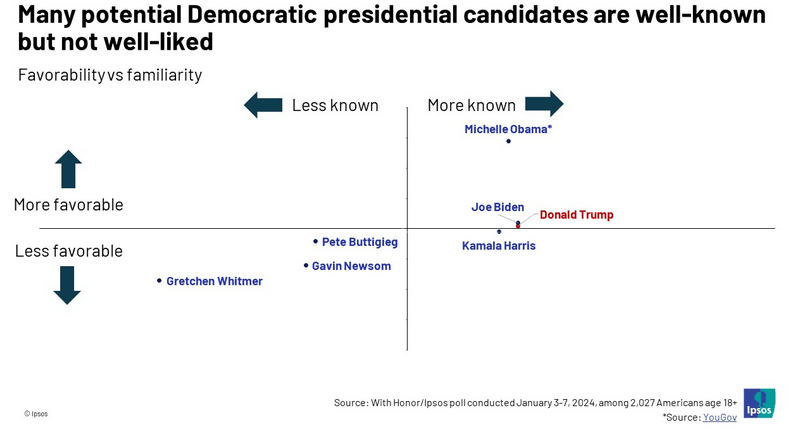
Biden is still in the running for DNC contender, although Michelle Obama it appears tops the list.
P.S. 7 July
In the upcoming list of political events listed above Netanyahu’s speech to Congress on 24th July will be a breakpoint. What is clear (especially from the negotiations in the past few days) is that there remains political backing in Israel for a continued war, irrespective of the pleas for the army to stop the war. This why Netanyahu remains against all odds, and why he refuses to call a ceasefire. The Israeli population that back Netanyahu do not view him as irrational and dangerous. A correlate of this stance is likely to develop in the United States, given he doesn’t look like he is going anywhere, with popular backing for him irrespective of the danger he poses to the world. The Pentagon has told Israel it cannot help with Netanyahu’s desire to expand the war against Lebanon. The White House also de-escalated the stand-off with Iran between 1 and 19 April, through joint efforts mediated by Oman, so at the political level in the United States there isn’t an appetite for a wider war. But with total confusion at the Democratic Party level, Netanyahu, if he continues to survive, will feel emboldened. Israel’s military situation being extremely weak, should remind us of the fact that Operation Nickel Grass was launched by Kissinger in 1973 only after Israel, facing total defeat at the time threatened to use its nuclear weapons against Egypt. For Netanyahu, it doesn’t matter if Lebanon is capable of wiping out Israel’s infrastructure and that the lights will go out in Israel. He has already told businesses in Israel that the collapse in the economy is a small price to pay for Israel’s “survival.” Iran can halt the flow of oil and gas to the West from the Middle East and lights will go out everywhere, if either Lebanon or Iran is threatened with a nuclear attack. But for a madman like Netanyahu, that is the trigger that will bring the United States full scale into war in the Middle East, a war that would devastate its economy and society. So far such attempts have failed. But if the Israelis who want to get rid of him, can’t get rid of him, this may well be in store. Middle Eastern populations are in a sense inured, and expect the worst, although they hope for the best (which is why they just elected reformist Masoud Pezeshkian in the Iranian elections). But such a war against Lebanon and Iran, if the United States is able to be blackmailed into war once again, would be its final reckoning. Netanyahu believes God is on his side and that only Moses was a greater leader of Israel than he was. That Western politicians do not see such irrationality as an immediate danger is a sign of advanced decay. That Western populations are not really interested in engaging with these problems and see voting as tantamount to choosing goods in a supermarket will cost them. It will cost them when the lights go out. Then they will wake up… in the dark…
P.S 8 July
New British PM Starmer surprised with his appointment of Israel critic Richard Hermer as Attorney General. After supporting genocide to get into power, he has since called for a ‘clear and urgent ceasefire in Gaza’ and dropped the last government’s challenge over the International Criminal Court’s Netanyahu arrest warrant. This puts him in line with the US national security state and the imperial interests in the United States that want to see Netanyahu gone and a “Two State Solution” tabled. Those are the same interests who fear a Trump win in the November elections would put NATO’s future in doubt. Note that NATO has been taking a more overt role in Ukraine of late. Having supported genocide to get into power, Starmer’s moves appear to want to wrongfoot his critics in the run up to the 4 July elections. Would he be taking his current position if what could be said to be the “establishment” in the United States, wasn’t at odds with the Israel Lobby?
P.S. 11 July
Chuck Schumer is open to dumping Biden. The establishment has spoken. Hillary appears to be lurking in the wings in one form or another, presidential candidate or vice-presidential (de facto presidential) candidate. Can you imagine a Hillary Clinton- Trump contest?
P.S. 19 July
For the first time, the International Court of Justice has ruled (order 186, press release 2024/57) that the Israeli occupation of the West Bank and East Jerusalem is illegal and that Israel must vacate those territories immediately. The order, issued as an opinion to the United nations, reflects the law. It wasn’t issued with the intent of being enforced. That would depend on the United Nations Security Council anyway. So it would be pointless given the attitude of the United States and the United Kingdom. No worries, it is a legal order anyway, and the Palestinians, with the help of the Lebanese the Yemenis and Iraqi militias, will enforce it in due course.
[Ref: Prt 15 Post-Script 26; info@globalshiffft.com; © 2024]
 Globalshiffft
Leave a comment