
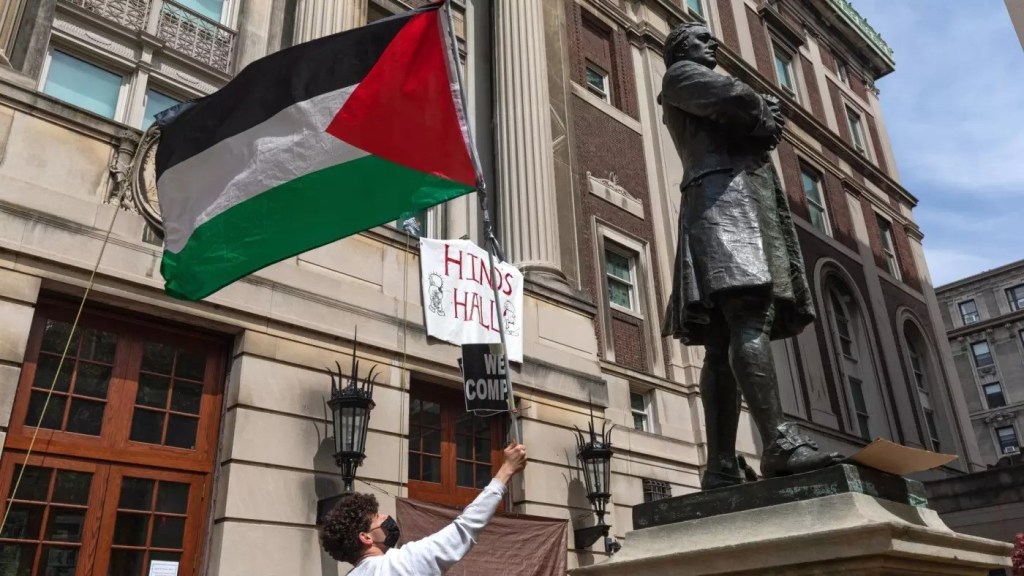
An intra-capitalist class war is raging in the United States. The current war isn’t just being fought in Gaza. The new money from financialization and quantitative easing that backs AIPAC’s febrile forays into congressional politics in blind support of Israel faces off against the broader imperial interests being harmed by the chaos and indirection of the Netanyahu government in the current Israel-Gaza war. This party to the war is fighting to try to keep Saudi Arabia within the ambit of empire.
The political standoff has been clear since the clash between William Burns and Biden over Blinken’s catastrophic handling of US foreign policy in the wake of the 7 October 2023 al-Aqsa flood attacks: what this site, on 4 February, called ‘Blinken’s unholy mess.’ The conflict in Washington exploded with full force when Senate majority leader, Chuck Schumer, the most senior elected Jewish leader in the United States, brushed past an unregenerate Biden on March 14 to declare Netanyahu an ‘obstacle to peace.’ Schumer didn’t just stand around making announcements, he went to war on the question.
It was Burns who would lead the subsequent ambush in the Oval Office by the security state on Mike Johnson, when the House majority leader was forced to ‘get religion’ on the four part Ukraine Aid bill that included aid to Israel. Johnson had doggedly opposed the bill since February. How Johnson was then “encouraged” to engineer the bill through the House with Democratic help was discussed here on 19 April.
The Israel portion of the bill included $9 billion in humanitarian aid that the United States intended to deliver directly through its now completed Gaza pier. The associated $16 billion arms deal was supposed to be leverage for Burns’ push for a Gaza cease fire deal on 5 May, which Hamas accepted.
Netanyahu also accepted it, but he then walked this back when he realised that Hamas was on board. Netanyahu really wanted to set Hamas up as the recalcitrant party, to blame them for the continuation of hostilities. The Israeli government claimed to have been ‘blindsided’ when Hamas announced its intention to back the peace deal.
As soon as it was clear Netanyahu had once again slipped through the net, Benny Gantz threatened to resign and bring down the Israeli government. Back on October 11, 2023, Washington had been instrumental in forcing the formation of a government of national unity for Israel, immediately after the al-Aqsa Flood attack. The new government would include Gantz, Netanyahu’s chief political opponent. Now Gantz threatened to pull this government apart. It was Gantz’s trip to the US and his meetings with Schumer in early March, against Netanyahu’s express wishes, that laid the groundwork for Schumer’s attack on the Israeli PM.
Gantz threatened to resign unless, in his words, ‘a credible plan to replace Hamas with a civilian administration for Gaza backed by US, European and Arab nations’ is worked out. He added to this that the demand that ‘efforts must be made to normalise relations with Saudi Arabia,’ which is code within the party in Washington that want to save the empire, for the demand that any such administrative ideas as are contemplated for Gaza must provide the groundwork for a ‘two-state solution.’ It is clear, however, that this will never get past the right-wing extremists that from their side are also holding Netanyahu’s rule to ransom.
The two-state solution is the only way of acceding to the unshakeable Saudi Arabian demand for a Palestinian state. This is recognised by all spokesmen for empire. Saudi Arabia is the lodestone at the centre of the India-Middle East-Europe Economic Corridor (IMEEC) (“Biden Corridor”), under which scheme Saudi Arabia’s geography and oil would be appropriated for empire. That was clear from the start of the current crisis back last October when EU leader Ursula von der Leyen said that she feared the ‘major geopolitical implications’ of al-Aqsa Flood on ‘the historic rapprochement between Israel and the Arab countries,’ i.e. Saudi Arabia.
Saudi Arabia, the empire and Palestine: Saudi Arabia has been at the centre of American imperial dreams ever since FDR shocked Stalin and Winston Churchill by suddenly abandoning the Yalta summit in February 1945 without finishing the business of dividing up the world after WWII. He was desperate to meet King Abdelaziz bin Abdulrahman al-Saud in Egypt before Churchill could get there. He wanted to cut a permanent deal on the oil reserves that Standard Oil of California (Socal/ Chevron) had found in Saudi’s Eastern Province (Gardner 2009: 16-18).
Much later, when Egypt went to war with Israel in 1973 to recover Sinai (taken by Israel in the 1967 war) the ground was laid for the creation of the neoliberal empire. This was when Saudi Arabia embargoed oil sales to those countries lending support to Israel in the war, and it led to oil prices quadrupling (from $4 to $12 p/b). This exacerbated galloping US inflation driven by government deficits resulting from massive military spending in Vietnam and the Far East and caused the legendary stock market crash of 1974.
In July of that year, in the wake of the Watergate scandal and just before Richard Nixon’s resignation, US Treasury Secretary William Simon flew secretly to Jeddah to meet with King Faisal. In the aftermath of the October War and with two US airborne divisions on alert during this period, the atmosphere was tense. An agreement was reached which would shape US-Saudi relations for the next three and half decades. In return for agreeing to buy oil at the new prices, the US would arm Saudi Arabia. But it was also a requirement of the deal that a large portion of the petrodollar revenues be recycled into US Treasuries to finance America’s spending. This money was to be kept in a secret fund.
Saudi Arabia became a stellar customer for Pentagon capitalism’s ridiculously expensive weapons (“charge what you like for your oil: we’ll charge what we like for our weapons”) and a financial prop of the neoliberal order.
With the Great Financial Crash of 2007/8, however, everything changed. A new era saw a revolution in Chinese foreign policy that culminated in Xi Jinping’s announcement in 2013 of the Belt and Road Initiative (BRI): a worldwide infrastructure for trade programme. This new opportunity, together with a mounting climate crisis promising extreme temperatures of 60oC+ for Saudi Arabia and the Gulf countries in the not too distant future, as well as the projected collapse of revenues from fossil fuel sales in a world fast switching to renewable energy, forced Saudi Arabia to form a plan for survival.
The so-called “Vision 2030” development plan sought to decouple from empire in order to benefit from what China and the BRI offered. This subject was covered in detail in a recent article on this site.
It has to be understood that an absolutely essential foundation for Vision 2030 is regional peace. This only became possible when Saudi Arabia signed the seminal March 2023 peace agreement with Iran, brokered by China. That Saudi Arabia is highly vulnerable to terrorist attacks and war, was a lesson it learned during the Yemen War, especially when Ansar Allah attacked Saudi Aramco’s oil facilities in 2019. Saudi Arabia’s insistence on a Palestinian state was integral to the new policy and reflected Iranian policy on the matter. It has to be remembered, however, that the desert kingdom has a long-standing commitment to a Palestinian state since its 2002 Arab Peace Initiative.
Palestinian statehood lessens the vulnerability of the tourist projects that are central to the success of Vision 2030. But importantly, there is also the moral aspect to this political goal in the responsibility Saudi Arabia has, as guardian of the Islamic holy shrines, towards its Muslim constituencies in the Global South. Besides, these constituencies are projected to provide the bulk of the country’s future growth in visitor numbers. The ongoing genocide in Gaza, which thanks to South Africa, is now formally framed in earthshaking international law suits, makes it impossible for Saudi Arabia to compromise its position any longer by cutting suspect deals with Israel behind the Palestinians’ backs.
The current Israeli government’s refusal to envisage a Palestinian state means “normalisation” plans as previously envisaged are no longer possible. Even the Emirates, which normalised some time ago, finds the Israeli government’s increasing extremism difficult to swallow. This is why it led the special UNGA session that voted in favour of Palestine’s full membership of the United Nations on 10 March, and why it continues to enhance its image as the lead supplier of aid to Gaza.
While Saudi and Emirati policies in the past decade have been rightly accused of being vicious, and their prosecution of the Yemen War an unmitigated outrage, the vast financial as well political costs of their blind zero-sum mercantilism has finally dawned on the two countries’ governments. As discussed in a previous article, in the case of Saudi Arabia, however, those policies were less consciously crafted and more of a manifestation of brutal internal political struggles.
In any event, the new relationships of both countries with China and Iran (the UAE’s albeit informal relationship with Iran being of much longer standing) are acting as a welcome stabilising and confidence-building factor. These developments have been all the more remarkable for enabling a genuinely “New Diplomacy” to thrive, which this site has repeatedly pointed to in its articles, and which, it cannot be repeated enough, has endured through a period of regional war.
The recent tragic deaths in a helicopter crash of the main architects on the Iranian side of the new policy, Ibrahim Raisi and Hossein Amir-Abdollahian, while clearly unfortunate, is highly unlikely to reverse the recent course of events. There are too many interests in Saudi Arabia, in Iran and in China riding on what can only be described as a diplomatic “missing link,” the kind of piece in a jigsaw that determines what the overall picture is about for each party, the kind of arrangement between them that should have been there all along had it not been for artificial attempts by empire to twist the region into an unnatural shape.
While it has been right to criticise Emirati and Saudi policy in the wake of the Arab Spring, it is important also to recognise their more recent positive turns in policy. Arab commentators understandably vent their anger at the past indifference of many of the Gulf states to the fate of the Palestinians, and especially to the resistance within Palestine.
But in the month after the Saudi-Iran peace deal, relations between Saudi Arabia and Hamas thawed. Furthermore, with the evident military successes of Hamas and the dogged resistance of Gazans in general, greater realism prevails. These changes may be pragmatic rather than morally courageous departures in policy, but it has to considered that these countries are long standing clients of empire who would seem now to be forcing the empire to adjust to a new reality: for that is precisely what it will have to do, adjust. The Gulf Arabs have been the world’s middlemen since time immemorial. In the brief quarter century of a unipolar world they were not in their element. This has changed.
The United States has struggled to girdle a world that has exploded in size since 1945 and whose centre of gravity has moved east. When plans were made to “pivot to Asia” to better confront a rising China, this involved delegating America’s security responsibilities for the IMEEC to Israel, its settler colonial offshoot. This has ended with the 2023-24 Gaza genocide and the charges that have issued from the ICC for the arrest of Netanyahu and Yoav Gallant [*see post-script 20 May on the recent ICC decision], and the much more serious charges that are in the course of being issued by the ICJ (initially raised by South Africa, and now joined by Colombia and Nicaragua, and Egypt). If ever Israel had been considered an asset, it is now a massive liability [* see post-post-script dated 24 May on ICJ decision including YouTube video].
Saudi Arabia’s discussions with the United States over defence and the development of nuclear power have now been reframed as “bilateral negotiations”, with all questions about normalization brushed aside, pending resolution of the Gaza question and the two-state solution.
But the United States own standing is in the line of fire. The pompous drivel constantly spewed out by the Biden White House in response to the actions of the ICJ and the ICC in regard to Israel, and the unremitting support it has given its settler colonial state, has undermined its credibility to an extent it has yet to feel. But feel it, it will, as time passes. Without legitimacy, hegemony is mere coercive dominance and this does not provide the glue that keeps alliances together. It may be that – right now – it is only the smaller nations at the European core of empire which are challenging American legitimacy, but if the metropole does not wake up and take control of its constituency soon, the larger nations will follow.
Since the neoliberal turn in the 1970s, but more especially since the period of NATO expansion in the 2000s, the United States has travelled the legal twilight zone of its self-serving “rules-based-order” (RBO). The increasingly threadbare character of that particular flying carpet leaves the United States isolated as it paints itself into the ever narrowing Israeli corner of the world of international relations.
The rotting republic: But it can only be internally within the United States itself that the country’s broken compass can be repaired or replaced. The rest of the world increasingly pushes back on what has become an irrational entity. It has lost patience. Having been sucked dry under the neoliberal world disorder, it has also lost capacity to withstand the costs of obedience to empire. America traded political for economic power in the early 1970s with the end of Bretton Woods and then, in a further dramatic change, it traded “bare money” power for economic power, with the financialization of the late 1990s. “Bare money” power dispenses with economic laws and structures altogether. It is beyond amoral, it is irrational and criminal.
It is particularly significant that the revolution that has hit the campuses of the world’s institutions of higher learning in the wake of the Gaza genocide began in the United States, erupting first at Columbia University in New York (where the Vietnam protests started in 1968), to then spread like wildfire to some 60 universities throughout the United States and across the world. It is equally significant that “business titans,” the majority of whom are Jewish, are recorded using their influence and the power of “their “bare money” to demand police action against the students. That money gushed forth from financialization and the quantitative easing used to continually prop up their Ponzi schemes. It is their money, and that of their class, that finances the American Israel Public Affairs Committee [AIPAC]’s assault on democracy.
[Lead picture: Columbia students change the name of Hamilton Hall to Hind’s Hall, after Hind Rajab a six year old Palestinian girl in Gaza who became famous for pleading for help from the Palestine Red Crescent on a phone while surrounded by her murdered family for a full three hours. When rescuers finally reached her 12 days later, they found that Hind, her family and two paramedics who had been sent to rescue her had all been killed.]
The 60s protests started in Columbia as mere local action protesting the university’s affiliation with the Defense Department’s Institute for Defense Analyses (IDA) in April 1967. Heavy handed police repression of that action predictably backfired and resulted in the full-blown antiwar protests of April 1968. On that occasion, American youth protested the draft and the death of Americans in a pointless war. In the new age of bare money and proxy wars they are protesting principles, the shredding of humanitarian rights, the settler colonialism, apartheid and genocide that have become the new externalities of bare money capitalism additional to pollution and climate destruction.
But the principle that is most visibly in play is the right of public debate in a free democratic setting, to which AIPAC poses the gravest danger. AIPAC’s influence has led to the rapid-fire passing through the House of the so-called Antisemitism Awareness Act. Were the bill currently sitting in the Senate to become law, a new definition of antisemitism created by the International Holocaust Remembrance Alliance (IHRA) would be inserted into Title VI of the Civil Rights Act of 1964. This is a federal anti-discrimination law that bars discrimination based on shared ancestry, ethnic characteristics or national origin. Adding the IHRA definition to this wording would allow the federal Department of Education to restrict funding and other resources to campuses seen as tolerating criticism of Israel, including calling “Israel” a “racist endeavour”.
Charging criticism of Israel as antisemitic is not developed in the IHRA definition through legal argument, but through ad hoc examples appended to the text of the IHRA definition, which are added specifically to supply an arbitrary interpretation of the basic argument. As a result, the First Amendment to the US Constitution – the right to free speech – would, in an extraordinary turn of events, be countermanded by an arbitrary exception embedded in the law – for the very first time in US history.
In the past, amendments to the Bill of Rights in the US constitution, such as the Fifteenth Amendment – the right of black citizens to vote – have been ignored and workarounds have been developed on the ground by racist politicians in regional state assemblies. These actions merely broke the law. This case is different. In this case, it is the law itself that is changed. For the first time, free speech would actually be legislated against. By the same token, however, for the very first time, AIPAC is being challenged directly in a serious way.
Israel will have to be rescued by the United States from itself and it will lose its independence

Israel humbled: On March 5, the Israeli newspaper Yedioth Ahronoth published the names of over 1500 officers and soldiers from the Israeli armed forces who have died in the fighting so far (see picture above). This was twice the number that the official IDF spokesman had so far admitted to, and doesn’t include names of soldiers whose names have been withheld by their families, nor the names of non-Jewish soldiers (such as Israeli Arabs or Druze members of the IDF), nor those of foreign mercenaries from France, Italy, Germany, Britain, Ukraine or the United States who have died in the fighting.
Only after this war ends will we know the true level of losses on the part of the Israeli armed forces in this war. Anecdotally, they are way beyond even the worst estimates, and this is not even to consider the fate of the permanently disabled and those with PTSD, which are way beyond the number of deaths. All this is important, because it is the first time that an Israeli leader pursues a war policy that is completely insensitive to personnel losses, once considered an Israeli establishment taboo.
As if in defiance of press criticism, Netanyahu launched his long-promised Rafah operation the very next day.
It is difficult to keep track of the setbacks the Israeli forces have met in Rafah at the hands of the resistance. However, the problems began even as the troops were subjected to missile attacks as they prepared to enter the southern Gaza district, and the attacks haven’t abated since.
These setbacks led to an immediate change in tactics, with orders issued by the command for multiple incursions in several areas at once – Jabalia, al-Zeitoun, Beit Lahia – as well as Rafah, only for the IDF to be met in every case with harsh opposition and to suffer losses at a rate higher than at any point of the war so far.
On Saturday 18 May, the spokesman for the Qassam brigades, Hamas’ military wing, promised a ‘long war of attrition.’ This and the fact that the heaviest fighting as well as much of the rocket launches towards Israel are taking place in the northern areas of Gaza where Israel’s ground operation started on 27 October last year, gives this war its grinding Sisyphean character.
In Galilee, northern Israel, as previously reported on this site, Hezbollah surprised Israel with radar evading short and medium range Kornet missiles. It used these innovative weapons to destroy Israel’s radar and listening posts across the entire border region, as well as its regional air traffic control centre at Meron.
But then, in his 5 April Jerusalem Day speech, Hassan Nasrallah promised a qualitative step change in military operations, in the event that Israel attacked Rafah. When this happened, new capabilities were put on display. Hezbollah’s drones destroyed Israeli air defence systems which in turn opened the way for multiple attacks on Israeli personnel and military bases, as well as the destruction of an American sourced SKYNET surveillance system and its base of operations, 35 km into Israeli territory. New rockets with much greater payloads were also used in these attacks, and new capabilities for intelligence gathering on Israeli troop movements came into play. On 16 May, Hezbollah launched an airstrike via an Ababil-T drone armed with two Soviet-era S-5 rockets on a grouping of Israeli soldiers in Metulla. Hezbollah announced that this attack marked the first aerial strike launched on Israeli positions since 1973. Israeli weapons establishments have heaped praise on Hezbollah’s advanced weapons capabilities.
Hezbollah’s actions have caused considerable losses among Israel’s armed forces and emptied the northern third of Galilee of its residents. Rings of fire have taken hold in the brush around Israeli settlements as a result of the intensity of recent rocket fire (picture below).

Israel has killed over 35,000 Palestinian civilians in Gaza not counting the missing, and wounded nearly 80,000. It has also caused deaths among fighters in Gaza and Lebanon.
But it has no prospect of winning this war – even with the unprecedented quantities of weapons and ammunition that continue to be supplied by the United States. US State Department employees responsible for monitoring arms exports have resigned their jobs in outrage over the flagrant violation of normal vetting rules.
In other words, no limits were put on Israel’s capacity for killing and destruction and yet it cannot win the war. The United States is also shielding Israel by intervening directly to counter Yemeni action in the Red Sea and the Indian Ocean in support of Gaza. In the words of one US admiral, the commitment is running at WWII-level pace. Yet despite all this help Israel still has no prospect of winning this war.
It hardly surprising that political moves are afoot not only in Washington and Tel Aviv, in Riyadh and Qatar, but also in secret negotiations in Oman, for a political settlement. These negotiations are not about what comes “after Gaza,” but what comes “after Netanyahu.”
The United States is going to have to come to Israel’s aid with more than just a supply of weapons, intelligence and special ops. It will have to become directly involved politically – administratively. This prospect became clear with the building of Gaza’s new offshore pier, which now nearing completion. The pier was initially interpreted as a PR stunt to get Biden of the hook with an enraged Democratic base. What it really is, is a new US military base.
Netanyahu has been vocal about how he wants to use the pier. Netanyahu wants to maintain Israel’s autonomy and to continue to instrumentalise American hegemony, rather than be subject to it. But even with Israel’s abject failure in this war, and with the IDF’s weaknesses so embarrassingly evident, the most glaring problem is not the loss of military reputation. It is rather the polarised and introverted nature of a polity that does not have the self-confidence to chart a course as a productive member of a world community, or the political depth to challenge corruption. Washington’s push for the formation of a national unity government at the start of this war has failed and it will now have to take further action.
Most analyses of Israel frame its trajectory from the ground zero of Auschwitz and German genocide. But that fails to take account of the faultline of the Nakba when Israel’s history truly starts.
The Jewish population that came to Israel did not stay in the lands of their birth to seek redress from their oppressors and torturers, they were transported to a new land that they took by force from another people. They were helpless and were badly guided and advised by the rulers of the victorious “Great Powers.”
These rulers, US president Truman most especially, decided to cooperate with the fascist incumbents in Germany in the reindustrialisation of Europe, in order to create a global liberal economic regime that would benefit the United States. The plan involved externalising the “Jewish problem” that German elites faced and reducing it to a matter of simply paying reparations out of the profits of reindustrialization.
The Israeli state created an identity around victimhood and the German genocide, but that was, in the true sense of the word, history as soon as the Nakba occurred in 1948. The Israeli state’s drivers and dispositions came all to be rooted in something else that belonged to the present: the forcible taking of the property of others and the guilt and fear associated with this criminal action.
The rise of a mafia state: The birth of Israel with the UN partition plan of 29 November 1947, midwifed by the Truman administration, is recorded by Clark Clifford, White House counsel at the time, in his memoirs. The decision was characterised by two things: (1) Partition was adopted only after ruthless arm-twisting by Truman and by 26 pro-Zionist U.S. senators who, in telegrams to a number of UN member states, warned that U.S. goodwill in rebuilding their World War II-devastated economies might depend on a favourable vote for partition. (2) The partition awarded 56 percent of Palestine to its 650,000 Jewish inhabitants comprising the country’s most fertile land, and 44 percent to its 1,300,000 Muslim and Christian Arab inhabitants.
Truman’s decision angered a group of American Arabists who had worked for the Office of Strategic Services (the precursor to the CIA) in Cairo during the war. They formed the Committee for Peace and Justice in the Holy Land (CPJ) to counter the Zionist efforts to create a Jewish state. With the recognition of the state of Israel in 1948 the CPJ became defunct, however, and the American Friends of the Middle East (AFME) was formed with covert CIA money to support the efforts of the American Jewish Committee (AJC) to help Palestinian refugees expelled during the Nakba to return to their homes. The Israeli government at the time considered the AJC the single most politically influential Jewish group in the United States during the 1950s (AIPAC didn’t exist).
There is apparently no reason to believe that the rabbis whose research and publications were funded by the AJC knew of the CIA link. The thinkers promoted by the AJC did nevertheless represent the mainstream American Jewish identity at the time: that of a historically dispossessed minority naturally seeking to help others in a similar situation. But there also existed a smaller independent group called the American Council of Judaism (ACJ) founded by a group of Reform rabbis who felt that the AJC’s anti-Zionism was too mild and who made common cause with the pan-Arabist Organization of Arab Students in the United States (OAS) launched in Michigan in 1949 (Levin 2023: 6-9). So in the Eisenhower and Kennedy years, although there were many Zionist organisations supported by the state of Israel, the mainstream (supported also by celebrities such as Dorothy Thompson) was generally pro-Arab.
Israel leader David Ben-Gurion secretly visited CIA Director Walter Bedell Smith and his deputy, Allen Dulles in April 1951, however, to advance Israel’s interests. He proposed that his country’s intelligence organizations be enlisted in the service of the CIA, an offer which was eventually accepted because of the Israeli leadership’s connections inside the Soviet bloc, in particular in Czechoslovakia.
Ben-Gurion’s main problem, however, was that Egyptian leader Gamal Abdel Nasser was trying to enter into an alliance with the United States. Eager American diplomats were listening. ‘In 1954, Israel was in the position of a desperate lover vying for the favours of an inattentive suitor.’ It wanted help from the US but (as is clearly still the case today) without interference. Ben-Gurion’s answer to his problem was to organise a series of incendiary bombings of the U.S. Information Service and libraries and other soft British targets in Cairo and Alexandria in July 1954 to try to disrupt relations between Egypt and the United States. He subsequently ordered attacks on Egyptian troops in Gaza in February 1955 to stymie American moves to make peace between Egypt and Israel (Cockburn and Cockburn 1991: 41-55).
Undeterred, the CIA under Allen Dulles ultimately launched “Operation Chameleon” – a plan to offer Israel the inducement of weapons supplies, on the condition that it signed a lasting peace with Egypt. When Ben Gurion agreed, or appeared to agree, the French government was designated as the intermediary for what would be a covert operation, and was given the go-ahead by Dulles to supply NATO aircraft to Israel. What Dulles didn’t factor into account was that a close relationship had developed between France and Israel that had begun when Algeria launched its revolt against French colonisation in November 1954. This undermined the power of the CIA to influence Israeli policy.
At the time, Nasser was building up his image of leader of the pan-Arab movement, talking up his support for the Algerian uprising. Nasser’s demagoguery was, however, all talk and no action. The French didn’t seem understand this and the Israelis had no interest in disabusing them of their convictions. The French believed that without substantial material support from Nasser, Algeria couldn’t possibly have dared to challenge the might of their military. Israel struck an appropriate antagonistic posture towards Nasser in contravention of its undertakings under the Chameleon deal, and France agreed to give Israel many more aircraft than Allen Dulles had originally sanctioned. Eventually, France would also help Ben-Gurion’s plan to develop a nuclear reactor in Israel.
Ben-Gurion eventually got what he wanted: to polarise the Middle East, with the Arab states on the Soviet side and Israel as the sole American and European ally. When Nasser despaired of getting Israel to talk peace, he strengthened relations with the USSR and opened up relations with China. This angered Allen Dulles’ brother, Secretary of State John Foster Dulles, who decided to veto Nasser’s request for a World Bank loan to build the Aswan Dam. The dam was eventually built with Soviet help.
From that point on, the CIA bought into Israel’s policy of undermining all the Arab states by giving special support to all the states around the Arab periphery: Turkey, Iran under the Shah, Ethiopia and the countries in sub-Saharan Africa. Dreams of conquering a greater Israel ‘from the Nile to the Euphrates’ could then be contemplated in Ben-Gurion’s fevered imagination.
Israel had been currying favour with the CIA all the while by doing much of its dirty work in Central and Latin America, aiding and abetting the death squads that devastated local communities branded as “communist” because they stood in the way of American business interests by living where they lived. It is hardly surprising, given this history, that we now find Colombia and Nicaragua joining South African’s lawsuit charging Israel with genocide at the ICJ, and that major Latin American nations like Brazil, Bolivia and Venezuela are antagonistic to Israel and have severed diplomatic relations with the settler colonial state.
When Kennedy became US president, there were furious clashes with Ben-Gurion over the potential for the French nuclear reactor to produce weapons-grade plutonium. After the Cuban crisis, nuclear non-proliferation lay at the centre of Kennedy’s foreign policy, and he insisted on American monitoring of Israel’s reactor. Ben-Gurion dissembled and dodged these questions. Ultimately his resignation in June 1963 was in large part due to the pressures put on him by the Kennedy administration (Cohen 1998: 135-6).
November 1963 and Kennedy’s assassination, however, saw an end of these problems for Israel. Kennedy’s vice-president, Lyndon Johnson, came to power with the first cabinet in US history which boasted a large number of Jewish members with Zionist inclinations. This was a reflection as much of social changes in the United States as of Johnson’s belief that Israel was an important tool against Soviet influence. Israel felt confident enough at this time even to steal weapons-grade uranium from a US facility.
When Israel launched the 1967 war, it sought to keep its movements secret and so it sank the USS Liberty American intelligence ship monitoring the area in order to prevent radio traffic from being intercepted. All thirty-four American personnel on board were killed. The Johnson administration brushed the matter under the carpet and no inquiry was launched – a clear testament to the extent to which the United States and Israel shared guilty secrets (Cockburn and Cockburn 1991: 152).
Although this war was widely propagandised as “pre-emptive” – as essentially a reaction to supposed intelligence that Israel’s Arab neighbours were about to attack – historian Ilan Pappé has demonstrated, using Israeli government archives, that Israel had long planned and prepared for this war. It was clearly a scheme for aggrandisement. Several Israeli politicians, including Ben-Gurion, have since admitted that there was no threat from Nasser. On the contrary, the Egyptian army was stuck in another useless war of Nasser’s own making at the time, in Yemen.
The 1967 war, however, changed Israel’s relationship with the United States which, up until that time, had been entirely mediated by Mossad through the CIA. Even on security matters, the Pentagon had been unenthusiastic about the Zionist state in its early years. As a small country, it wasn’t an important market for US weapons and the performance and tactics of the Israeli military had been of no any great interest to the American military-industrial complex. This changed when on 5 June 1967 the Israeli air force annihilated Egypt’s warplanes in the space of two hours, as they sat idly in their parking lots. Israel promptly became the darling of conservative America.
The psychopathy of American isolationists: The crucial role of air power in American politics needs to be understood not only to understand the sudden adoption of Israelis as “surrogate Americans” (Mart 2006: 112), but also to understand the genesis of the American empire.
This site’s lead video argues that the so-called “Dollar Gap” – the lack of hard foreign exchange in Europe after WWII to buy American goods – is what led the Truman administration to try out multiple schemes including the Marshall Plan to help Europe to its economic feet. The failure to obtain enough loan or aid money from a stingy US Congress riveted by an isolationist mentality in order to achieve this aim, is what ultimately led to militarisation, the Truman Doctrine, anticommunism in the NSC -68 strategy paper, and the first test of the Cold War in Korea. Juicing a “red scare” could always be relied upon to get the American public fired up and members of Congress to vote any amount of expenditure on the military.
The picture here seems to be one in the 1940s and 1950s of foreign policy élites embedded in the agencies of state striving to push trade and create a global liberal economic régime with Democratic support, while congressional representatives associated with industries and enterprises fearing foreign competition, on the Republican side, hold fast to a narrow political economy of self-containment. However, what needs explaining is the involvement of the latter right-wing strand of American politics with high technology and the development of airpower and nuclear weapons. Foreign observers of American politics are bemused about the fact that politicians avowedly hell bent on the idea of “the minimalist state” continue to vote through endless sums of money for insanely expensive military technology.
The bureaucracy of the US Air Force latched on to the politics of right-wing isolationists in the waning stages of the war. These members of Congress were firecely opposed to reintroducing the military draft after WWII on principle – because it was against individual “liberty,” and because it created a bigger federal bureaucracy – the “big interfering state” they hate.
They favoured air power over manpower, seeking to reduce the burden of armed service on the average American, reducing the number of government personel that needed to administer them, but at the same time extending the long and lethal arm of US power to areas of the world where America had business interests and important resources it wanted to exploit. The Air Force appealed to these constituencies especially because it was the carrier of atomic (later, nuclear) weapons. The entire globe could be controlled this way under shadow of massive US air power. This idea is still embedded in the psychology of right-wing congressmen today, like Lyndsey Graham, for whom no international problem cannot be solved by bombing: Libya, Iran, and more recently suggesting that Israel should “nuke Gaza.”
A previous article on this site discussed Pentagon capitalism and how the defence industry spreads its factories, contracts and bases across the United States so that its appropriations always get an overwhelming majority of votes in Congress.
The Air Force, however, focused its efforts on the South and West: on the country’s right-wing constituencies. The Air Force was also the innovator of the “contract system” used to order complex bespoke technology systems from the private sector on a cost-plus, no quibble, basis. In this way, it organised the finance of the very same powerful constituency of American conglomerates that would lobby for its interests in Congress (Hodgson 1976: 130-1).
The Ancient Egyptians built pyramids, the modern Americans, trillion dollar aircraft like the F-35.
There was another contradiction embedded in isolationist psychopathy – an obsession with Taiwan, the Chinese Nationalists and the idea that America had somehow “lost China” when the communists and Mao Zedong took over the country in 1949. When Truman launched the Korean War with the idea simply of pushing the North Koreans seeking to reunite Korea, back out of South Korea, the isolationists, along with their sympathiser and ally at the head of the US armed forces in the Far East, General Douglas MacArthur, thought it would be a good idea to use the opportunity to “rollback” communism in China.

When the Chinese got wind of this and intervened at a crucial juncture in the war, so driving back the army of “United Nations” (1950s version of the “international community”) and briefly taking Seoul, panic broke out in Washington and atomic bombs were loaded onto bombers. In the event, the Americans decided to use napalm instead, because it was a newer development. Korean War expert Bruce Cumings writes that by … 1952, just about everything in northern and central Korea was completely levelled. What was left of the population survived in caves, the North Koreans creating an entire underground society, in complexes of dwellings, schools, hospitals and factories’ (Cumings 1990: 755).
Much later, the North Koreans would help Hezbollah and Hamas build their tunnel complexes.
Social change in America: If the US Air Force lionised Israelis after the 1967 war, and used Israeli pilots to advertise their massively expensive technological products to the world for purchase, this would resonate nationally in the United States because of the conservative shift in social and political attitudes that rode on the greatest internal demographic change in US history.
What happened was that, between 1940 and 1960, more than four and a half million black people from all walks of life moved out of the South of the United States to the North and the West. This was the final act of a gruesome historical drama that had included enslavement, civil war, and lastly a failed Reconstruction when the South doubled down on the suppression of black rights (codified in the Fifteenth Amendment) with the help of terrorist organisations like the KKK, when the North gave up on reform, and when the Northern rich partnered with the Southern rich to control the political system.
Now, black families would simply get on buses to escape their social restrictions and get better jobs, and demobilised black GIs who couldn’t face returning home after WWII flocked to New York, Chicago and Philadelphia (Hodgson 1976: 57-63).
As these black populations moved into the inner cities of the North, white communities moved out to occupy a new suburban sprawl spreading across the major cities – in all parts of the United States. There had been similar stresses in the period between 1880s and 1920s with the mass immigration of culturally alien peoples that came from southern and eastern Europe and Russia – and that included Jews. Now all seemed to be forgiven as these immigrants were now assimilated into a new amorphous “whiteness,” in a way that the internally migrating black populations never would be.
As African American populations invaded old Jewish neighbourhoods, Geoffrey Levin tells us that the ‘dispersion of Jews, often from tight-knit urban communities, into sprawling suburbia populated by white Christians further accelerated the process of Jewish integration into white American society’ (Levin 2017: 44). A previous article on this site discussed how Christian evangelicals were influenced by dispensationalist preachers, how these preachers became politicised, and how the Israeli victory in 1967 came to be taken by the huge audiences flocking to the broadcasts of televangelists as the sign of a new “dispensation.” It was then that Zionism came to be woven into the fabric of American conservatism.
Historian Michelle Mart writes about a process of “Americanization, “Christianization,” and “masculinization” of Jews and Israel taking place. Israelis, Mart argues, ‘became surrogate Americans’ (Mart 2006: 112).
To understand this momentous social change, two additional factors must be taken into account.
The first is that Israel won a lightning war that the American military establishment was applauding, at the very same time that America was losing its war in Vietnam. The Israeli victory of June 1967 actually acquired its special status in the American mind once the surprise Tet Offensive that took place in January 1968 had conclusively proven the US military establishment to be deceitful and incompetent.
The second factor was how fast expanding suburbia was receiving its news. Network policy changed from a diet of quiz and game shows in the 1950s to suddenly focus on pouring raw news into people’s living rooms. News analysis or the longer format documentaries that we are familiar with today was not available. The 1960s, on the other hand, was precisely the time when that kind of programming would have been socially productive: a time of unprecedented tumult, conflict and social change.
Corporatisation and concentration of ownership in the media and changes in the share-out of time and thus of advertising revenue between the networks and their affiliates, resulted in increasingly fierce competition between the two giants, CBS and NBC, for the ratings that the sheer sensationalism raw news could deliver. So, as social historian Godfrey Hodgson wrote in America in our time, for ‘…its own, various reasons, the new, news-conscious television hastened the transition from the confident years of consensus [in the 1950s] to the anguished years of polarization’ (Hodgson 1976: 145).
So we had the fantastic irony of the cynical machinations of a mafia state bringing hope to white Christian suburban America, so becoming their “New Jerusalem.”
Zionism’s eclipse: In the killing fields of Gaza, the Israeli establishment understands fully how it now risks falling from grace. It desperately tries to reacquire the “masculinity” it has lost in the social sense and the marketability it has lost in the Pentagon capitalist sense with its humiliating defeat at the hands of Hamas and Hezbollah. But in doing so, it strips away the carefully crafted veneer of an advanced and democratic European society pretenting to tame a barbaric region on behalf of a civilized West. Israel’s pathetic efforts at the Eurovision song contest pale in the face of the world’s court of opinion which has charged it with it genocide, even as the plodding judges of the ICJ and the ICC try to catch up.
Of course, Israel has been defeated once before on 6 October 1973, when Egypt’s armed forces crossed the Suez Canal into occupied Sinai. The attack was a ‘shattering Israeli tactical defeat,’ write Leslie and Andrew Cockburn in their book Dangerous Liaison, and a time when Moshe Dayan was talking about ‘the destruction of the Third Temple.’
But America would pull Israel’s chestnuts out of the fire. The Pentagon, in full retreat from South East Asia, couldn’t possibly let go of the Israeli mythology built up since 1967 to market the effectiveness of its weaponry. So ‘…inside the Pentagon itself, buried deep in the bowels of the cavernous building… IDF officers worked round the clock to coordinate the American supply shipments, which became both massive and highly publicized a week after the fighting began’ (Cockburn and Cockburn 1991: 174).
Meanwhile, at the State Department, Henry Kissinger worked himself up into a shuttling frenzy as the Israelis prepared to use the nuclear tipped missiles they had developed with the French against Egypt to stop the war. Ultimately, an Israeli counterattack brought action to a stalemate when, by 22 October, the diplomatic negotiations ongoing in the background, took front stage.
Nuclear threats have been made against Gaza by members of the Israeli cabinet on this occasion too but the conundrum for Israelis is that their lives are too interwoven with those of Palestinians to make such a threat credible. Zionism is on a hiding to nothing.
As the United States itself enters a period of political change heralded by the student protests and the radically shifting public opinion among new generations of Americans, and as majority American public opinion also shifts on Israel’s action as a May Gallup Poll reveals, it is inevitable – just as happened in the 1980s with the apartheid régime in South Africa – that it will end up pressing for a single democratic state for Jews and Palestinians ‘from the river to the sea,’ as Ilan Pappé recently opined.
[Ref: Prt 15 Post-Script 24; info@globalshiffft.com; © 2024]
*P.S. 20 May 2024
After years of delay (while he and his predecessor suffered intimidation at the hands of Israel’s security apparatus), Karim Kahn has finally issued his judgement for international arrest warrants on Israeli and Hamas leaders. The ICC’s remit narrowly concerns war crimes committed during conflict and, in that respect, both sides are subject to sanction. However, many observers maintain that equivalence between Israel and Hamas (“double-side-ism”) is a false premise given Israel’s position as an occupying power and Hamas’ consequent inalienable rights under international law to an armed struggle. These are certainly arguments that have been made by the Chinese delegation to the ICJ, for instance, and have been well received. None of these developments will concern the Hamas leaders anyway, given they are under constant threat of assassination by Israel. On the Israeli side, however, the decision is a sizeable blow Netanyahu and Yoav Gallant. Never before have Israeli politicians been held to account by an international body. But there is a first time for everything.
*P.P.S 24 May 2024
The ICJ rules Israel must ‘immediately halt’ offensive in Rafah. The ICJ’s directive not only demands an immediate cessation of military operations but also calls for the opening of the Rafah Crossing, as well as unhindered access for international fact-finding missions.
 Globalshiffft
Leave a comment