

On April 13, Iran ended its decades-long policy of “strategic patience” in regard to constant Israeli provocations, in action that saw missiles and drones launched directly from Iranian territory raining down onto Israel (main picture). The military and political-strategic success of the operation served to defeat attempts by Israel’s deranged right-wing government to escalate a regional war, as well as to undercut Israel’s deterrent capabilities and regional ambitions, while finally also consolidating the New Diplomacy that has been ascendant in the region since March 2023.
Then, on April 17, students protests erupted at Columbia University in New York against the ongoing seven-month long Israeli assault on Gaza’s civilians. The protests spread to some 60 universities across the United States, after Columbia University president – Egyptian-British-American academic Minouche Shafik (ex-president of the LSE) – allowed police to enter the campus to enforce a violent crackdown against students. Evoking fears that have long gestated within the national security state, the New York Times compared these actions by American university students to the Vietnam protests of the 1960s. The only difference, however, was that this was a reaction, not to Americn citizens returning to the United States in body bags from Vietnam, but to pictures of unending massacres in Gaza perpetrated by Israeli troops and relayed through social media to new generations of American youth that have been thoroughly alienated by the increasingly repressive character of the self-censorship at mainstream media, if not the outright collusion between the media and the intelligence services.
In fact, a ban on the use of the social media platform TikTok, dressed-up as an enforced sale of the platform, through which a great deal of the information about the war in Gaza had been broadcast, was to be part of a gigantic military expenditure package passed by the House of Representatives on Saturday 20th April.
This legislation, which included aid to Israel, was rushed through the Senate on April 23, only to be signed into law by President Biden the very next day. The bill had been held up in the House since February and it looked very unlikely that it would ever pass due to objections from the Freedom Caucus on the right-wing of the Republican Party. This changed radically when House Speaker and majority leader, Mike Johnson, suddenly broke all his pledges to this faction of his party, and ended up pushing the bill through with support from the Democratic opposition. His new backers on this occasion included progressives on the left-wing of the Democratic Party, like Ro Khanna who, in an extraordinary turn of events, vowed to back Mike Johnson, were his job as speaker now to come under threat from outraged right-wing Republicans vowing to remove him.
Pentagon capitalists are panicking as the Ukraine War goes the way of all of their previous wars – towards total unmitigated disaster – and also as Israel’s vain attempts to recoup its military reputation after the devastating success of Hamas’ al-Aqsa Flood attack, continue to fail. The costs to the reputation of the United States over the long term are seen to multiply a hundredfold as the Israeli quagmire deepens.
The world’s failing hegemon is forced to stand shoulder to shoulder with Israel in the dock at the International Court of Justice on charges of aiding and abetting the genocide that Israel is undoubtedly perpetrating, while Israeli government officials also face war crimes charges at the International Criminal Court. [Note that the UN Congress is threatening retaliatory action against the ICC if it does pursue this action against Netanyahu and company. Mike Johnson has called for the Biden administration to ‘immediately and unequivocally demand that the ICC stand down’ and ‘use every available tool to prevent such an abomination.’]
But it is the domestic insurrection against the national security state that worries Pentagon capitalists most. As student protests exploded across America’s universities, Mike Johnson was driven over to the Oval Office and treated to an in-depth security briefing led by CIA Director William Burns. What followed, upon Johnson’s exit from the closed meeting, was a Damascene conversion, followed by Johnson’s ominous claim that he now wanted ‘to be on the right side of history.’ None of the public will ever be privy to the minutes of this meeting, if any were taken, although it was highly probable that he was treated to a full-blown sound and light show of how Putin was planning to invade Poland and the Baltics after Ukraine. This, from the same people that brought you the Iraq show and the weapons of mass destruction narrative.
Anyway, as soon as Johnson returned to the office (at which point it appears he made a big show of praying for guidance from the Almighty), a voice beckoned to him from the other side of the aisle. It was House minority leader Hakeem Jeffries on the phone with an offer of help in pushing through the controversial legislation.
Of the $95bn in the act which became law on the 24th, $26bn is slated to go to Israel. Besides the Tik Tok ban, the legislation includes a sweetener for progressive Democratic representatives (like Ro Khanna), in the form of ‘humanitarian aid’ for Gazan civilians. Apparently, this aid is going to be delivered by British soldiers, presumably because of the collapse in trust towards trigger-happy Israeli troops on the part of NGOs, after the killing of the World Central Kitchen workers.
In the eyes of those complacent Western states who consider Palestinian deaths – even in their thousands – as some unfortunate but still distant, and perhaps even justifiable, collateral damage, Israel striking the vehicles of the World Central Kitchen in which citizens of those very same Israeli allies were travelling to perform their humanitarian mission, one by one, with precision missiles, until they were confirmed dead, revealed the madness that the West had for so long refused to see in its settler colonial offspring.
Then there was the hubristic Israeli strike on the Iranian diplomatic mission in Damascus, which led to Iran’s decision to change the rules of the game in the region.
As the mood in Washington, London, Paris and Canberra, became decidedly sombre, threats of a Rafah operation temporarily receded. Just as there was going to be no support for more action against Iran and the full-scale regional war Netanyahu craved, there was going to be no support for a Rafah operation.
This wasn’t all simply about a collapse in trust. Now seriously weakened Israeli forces were clearly not going to make any of the gains in Rafah at this late stage that they had failed miserably to achieve so far in six months of continuous war.
Then there is the economic collapse. The $26bn slated for Israel in the Ukraine Aid Bill seems like a lot, but it is only a part of what Israel’s treasury needs to plug gaping holes in its finances. The funding gap has grown considerably since the last $6bn Israel bond issue last November, which launched at premium interest rates despite the guarantee of the United States that Israeli bonds enjoy.
So now we have reached a new stage where Israel has put forward its first proposal for a ceasefire to a sceptical Hamas, while still insisting, in its all-consuming madness, to continue strafing and bombing civilians all over Gaza and the West Bank.
Meanwhile, in a completely unrelated move, Hamas itself has proposed to lay down its arms if Palestinian statehood is recognised. This is a diplomatic move clearly not directed at the current negotiations with Israel, but intended to cement Palestine into the wider global coalition of nations opposed to American hegemony.
Hamas’ continued military success has led to a change in its geopolitical status. This has in part been due to supporting action by the Axis of Resistance, in particular from Lebanon into Galilee and in the oceans around Yemen, which have weakened the Israeli military and Israel’s economy. But it has also in large part been due to the success of Gazan forces, even after seven months of fighting, in causing severe casualties amongst Israeli forces. The Qassam Brigades, Saraya al-Quds and the other Gaza militias continue to control the battlefield, firing rockets at will towards Israeli settlements from all parts of Gaza.
Their stubborn resistance and the fortitude of a civilian population that has lived through the very pit of hell, has finally convinced the sceptics that Israel will not be able to turn this situation around in its favour.
First there came the conversion of Turkey, which has now stopped much of its trade with Israel, then Russia, which hosted a meeting of all the Palestinian factions including Hamas, and latterly China, which is now seeking to unite Fatah and Hamas in in a temporary government. Those three powers had previously forcefully condemned Israel’s actions in Gaza and supported, if not initiated moves, in the United Nations to halt Israel’s war. Yet their initial reactions were partially sceptical of the potential for Hamas to reap rewards from its Aqsa Flood attack, and this had tempered their more active participation in putting pressure to stop the war. Now things have changed and the geopolitical tables have turned in Hamas’ favour.
On a different level, the preparedness of Iran to hit Israel directly, and the almost imperceptible response to Iran’s missile attack by a now fearful Israel, has consolidated Iran’s regional position. The New Diplomacy is now backed with large dose of Realpolitik. If the Saudi-Iranian peace treaty of March 2023 astonished everyone by enduring through the entirety of this long war without a blip, this is a testament to the determination of Saudi Arabia to live in peace. It had been Saudi Arabia that actually initiated the peace talks with Iran, albeit through China’s offices. The desert kingdom is now tightening the terms and conditions of the kind of Palestinian state it wants to see, even as Blinken visits the region for a sixth time since the beginning of hostilities, to discuss the future of the empire’s fast-shrinking Biden Corridor.
Unbelievably, the United States preceded this latest round of pseudo-diplomacy with a typically arrogant veto of the motion at the Security Council for full Palestinian membership of the United Nations. Insanity “rules ok.”
Israeli Hubris and the Iranian Game Changer
On 7 October 2023, Hamas breached the fence around Gaza, infiltrated military installations and a various kibbutzes with the intent to take as many hostages as possible to be taken into Gaza for future prisoner exchanges. The subsequent conflict with Israel involved two highly organised militias: Hamas/ the Qassam Brigades, and Hezbollah. The attack by Israel on the Iranian Embassy in Damascus, however, now saw Israel facing conflict with a nation-state no less than ten times its size.
Having faced provocations from Israel in the form of assassinations of Iranian military and diplomatic personnel, terror attacks on Iranian soil, incendiary threats, cyber-attacks on its nuclear and other facilities over decades, and a permanent state of lobbying for a US-led war, Iran decided this time to respond with force.
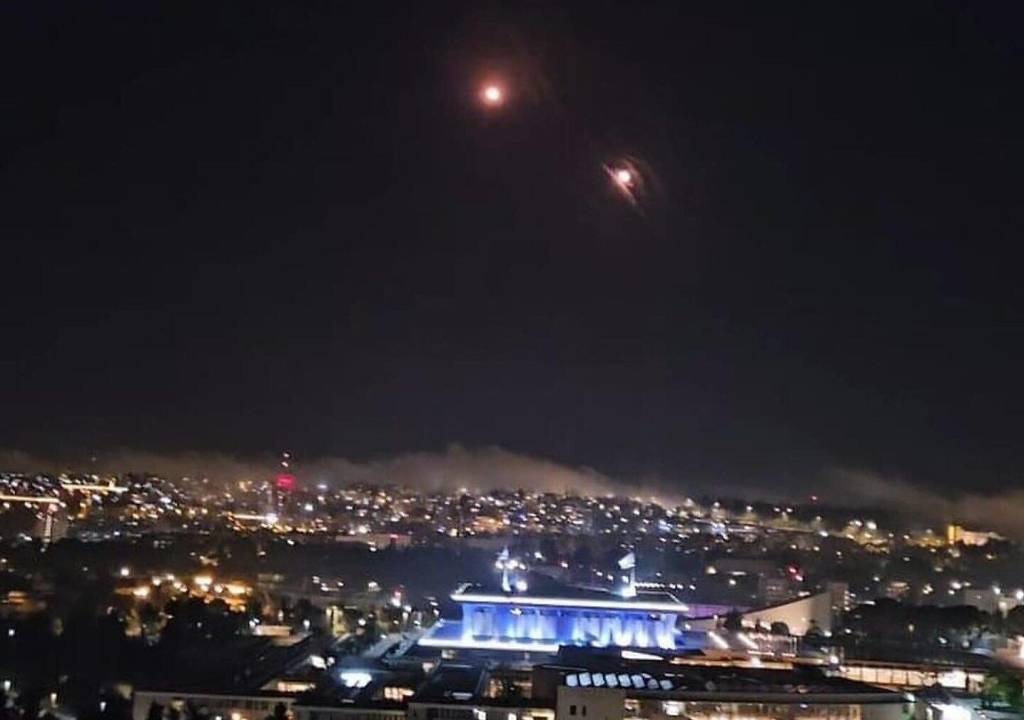
The Iranian leadership took the trouble of publicly announcing its intention to strike. This allowed Israeli allies, specifically the US, the UK, and France, but also Jordan, to prepare the defences that would take the majority of the heat from the Iran attack off Israel’s shoulders [While the Royal Jordanian Air Force shot down scores of incoming drones, the population of Jordan were cheering them on to their targets in Israel – the Jordanian régime simply acting on the survival imperative imposed by its geopolitical situation]. So when Iran launched 170 drones, 30 cruise missiles and 120 ballistic missiles, altogether five countries had made all the preparations necessary to repel them. Israel couldn’t have done it on its own.
Yet the majority of the drones and missiles were decoys. They were cover for the missiles aimed at the targets that Iran intended to hit, namely the Ramon and Nevatim airbases in the Negev desert and Israeli Air Force intelligence in Tel Aviv. These were hit successfully. This, it was claimed, was achieved with the use of hypersonic missiles. As discussed in a previous article, Russia, China and now Iran possess this radar evading technology, while the United States and NATO do not. Even then Israel’s much vaunted Iron Dome system failed to bring down of the decoys and the world was treated to the sight of Iranian missiles flying freely over the Knesset (picture above). Presumably, Iran could have taken out the Israeli legislature if it had chosen to do so.
A report about events on the ground (from military commentator Scott Ritter) provides the necessary evidence for hypersonics havin been used in this attack:
‘The U.S. has an advanced AN/TPY-2 X-band radar stationed at Har Qeren, in the Negev desert. Its mission is to detect Iranian missile launches, and pass targeting data to Israeli Arrow and David’s Sling and U.S. THAAD ABM batteries deployed to protect sensitive Israeli sites, including Dimona and the Nevatim and Ramon air bases. Iranian missiles struck both Nevatim and Ramon air bases. The best surveillance radar in the world, working in concert with the most sophisticated anti-missile defenses in the world, were impotent in the face of the Iranian attack. For all those trying to spin yesterday’s events as an Israeli victory, chew on that fact: The best missile defense system in the world could not protect the sites they were tasked with protecting from attacks by Iranian missiles. Who has deterrence supremacy? It ain’t Israel.’
After the attack, Iran promised a more ferocious response should Israel retaliate. Israel saved face by simply sending a few drones into South West Iran that ultimately the Iranians wouldn’t even rate as a response. So that was the end of that. But Israel taking Iran’s threat seriously in this way was also evidence that the first Iranian strike had been successful, the denials notwithstanding. Any second attack, obviously launched without any warning this time, and potentially much bigger, would have been devastating.
Student Protests and the Biden Electoral Nightmare

Columbia arrests.
Even as the security state meets student protests with maximum force, student protests become more entrenched, and their demands more strident.
Meanwhile, Biden’s approval ratings plummet. The biggest factor affecting these approval ratings other than his handling of immigration, and ahead of his handling of Ukraine, is his handling of Gaza. The students protests have substantially broadened a malaise in the Democratic camp that had previously been festering among Arab-Americans and in the Black community, but that now grips broad swathes of Gen Z. In a previous article on this site covering Zionism’s future “eclipse”, it was noted in a post-postscript dated 4 January 2024 that in the Harvard Caps Harris Poll 12-13 December 2023, we see 60% of 18-24 year olds in the United States saying that that ‘the Hamas killing of 1200 Israeli civilians and the kidnapping of another 250 civilians can be justified,’ and 50% answering in favour of Hamas when asked ‘In this conflict do you support more Israel or more Hamas?’ Finally, 51% argue ‘For Israel to be ended and given to Hamas and the Palestinians.’
Biden keeps telling Netanyahu that he desperately wants the Gaza business to go away. Trump, who still leads in the polls, has meanwhile been unusually quiet.
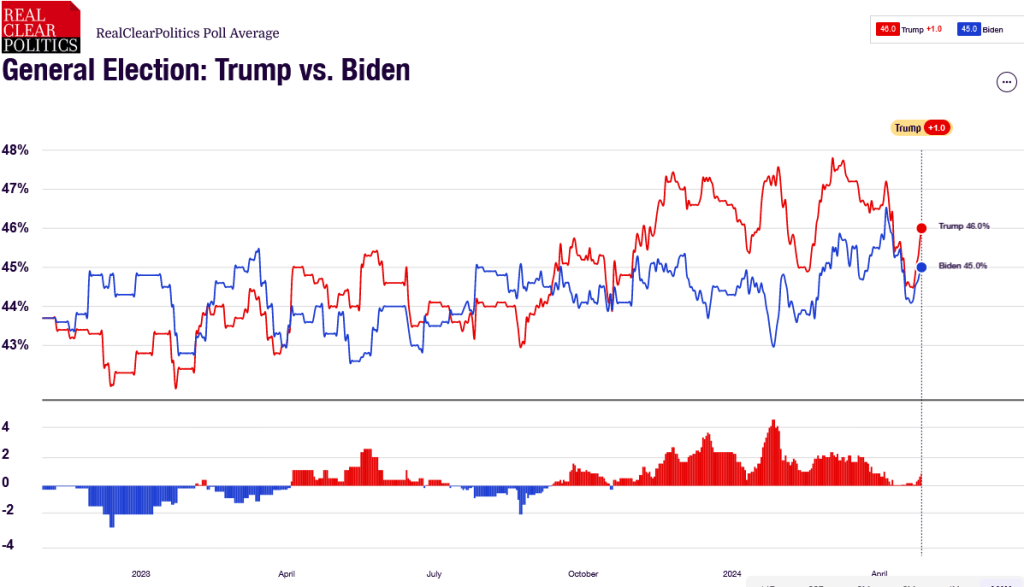
In fact, Trump spent the entire of the past couple of weeks in and around courtrooms.
On April 25th, he managed a partial victory in the Supreme Court, as justices delayed any potential decision on his immunity case over election riots. This is not likely until after the elections. But at the same time, Trump made history as America’s first ex-leader to face a criminal trial by attending the Manhattan Criminal Court over charges of an agreement with the National Enquirer to bury negative stories about him while attacking his rivals, during the last election campaign. That is not all, for he also faces a hush money trial in New York where he is accused of falsifying business records after allegedly paying money to porn actress Stormy Daniels to cover up his affair with her, as well a defamation case, brought against him by writer E Jean Carroll.
The American public thus faces the situation where (once again) policy is being made by the national security state by ramming through controversial legistion, this time in the form of the Ukraine Aid Bill. The bill is being rubber-stamped by Congress thanks to a witless Mike Johnson, who is now being lionised by mainstream media as a latter day Churchill.
All this is happening without debate or the slightest comment from either contender for the position of “leader of the free world,” and is happening during an election year – a time in which one would have expected some level of policy discussion. Trump’s excuse, at least, is that he was in court.
It is remarkable that the Ukraine Aid Bill managed to suddenly get pushed through Congress from a standing start, in a short week during which Trump was known in advance to be otherwise unavailable.
As Mitch McConnell, Senate minority leader, hailed the passing into law of this consequential bill, he openly blamed the delays it had suffered to date on Trump. He also blamed conservative media personality, Tucker Carlson, who had travelled to Moscow in February, on the second anniversary of the start of the Ukraine War, to interview Russian leader Vladimir Putin. That was part of a campaign to try to end the conflict.
Just to get an idea of how consequential this bill is, the $60bm slated for Ukraine is almost as much as the total amount of aid sent to the benighted country by the United States since the start of the war in February 2022.
As a result of the war, Ukraine is a shadow of its former self. The areas controlled by Kiev have suffered a catastrophic loss of population due to deaths on the battlefield and massive emigration. It seems that Pentagon capitalism’s logic “rules ok,” however. As Oliver North once explained, Ukrainians using ‘their blood, and our bullets,’ is ‘money well spent,’ because the money eventually comes back to US corporations, into the pockets of Pentagon capitalists.
These shareholders and executives of the largest American corporations have been failed, however, by their national security apparatchiks. They could not foresee how Russia could possibly have survived drastic economic sanctions and a long kinetic war. It seems to have thrived instead. Meanwhile, the United States is suffering a loss of face on the underperformance of what was once thought to be “game changing” equipment it had sent to Ukraine.
All this risks undermining the European alliance and NATO – the core of empire – even as, in the person of Trump, Pentagon capitalism’s domestic nemesis maintains his lead in the polls.
Israel’s failure to defeat Hamas in Gaza, and thus to stop the constant flood of video footage coming out of the beleaguered strip, is risking the election of their favoured candidate to the U.S. presidency. In their book, things in Israel have gone too far. Senate majority leader Chuck Schumer has recently made this only too plain.
As student protests now raise the stakes even further, and police action backfires, it looks like the August 2024 Democratic National Congress in Chicago will likely turn into a “perfect storm of protest”.

Chicago protests.
The Middle East and the New Diplomacy
What Washington hasn’t yet fully computed, though, is the extent of the tectonic shift in Middle East politics. The regional strength and coordination of the independent elements of the Axis of Resistance has taken the United States by surprise. After the Iranian missile attack, the Qassam Brigades destroyed a new command centre for operations in Gaza, Hezbollah surprised Israeli forces with the intelligence it possesses that enables it to target Israeli troops covertly stationed in residential buildings across the province of Galilee, and Ansar Allah widens its reach ever deeper into the Indian Ocean, targeting ships heading not for the Red Sea and the Suez Canal, but for the Cape, as the American fleet stands by helpless.
Saudi Arabia, Qatar and the UAE rejected joining with the United States in a coalition against Ansar Allah from the very beginning of the action in Yemen. Only Bahrain consented (where the US Sixth Fleet pays the government a handsome rent for use of its harbour. Bahrain doesn’t have a navy anyway).
Then, as the Iranian missile attack loomed in response and Israel’s allies responded by preparing the necessary defences, Saudi Arabia, Qatar and the UAE warned the United States not to use their territory as a launchpad for attacks against Iran.
The New Diplomacy ascendant in the Gulf since the March 2023 peace deal between Saudi Arabia and Iran has seen the rapprochement between the two countries strengthen during this war. They have a joint interest in that both countries are looking East for their future development.
A recent article on this site looked at how and why Saudi Arabia decoupled from empire, and engaged with China. Analysis of the country’s Vision 2030 development programme showed how, for all its high tech and new energy components, the programme depends crucially for its plan to diversify from oil, on a massive (fourfold) projected rise in revenue from tourism from the Global South, and this in large part from pent-up demand from Muslims wanting to visit the holy shrines.
Not just Saudi Arabia, but all the Gulf states have experienced the debilitating costs of war, and have learned the hard way about the importance of regional peace for their vast tourist projects. Saudi Arabia spent no less than $265bn on the Yemen War, money which it no longer has, as its dependence on foreign investment to achieve its development goals clearly indicates. With its enormous financial and organisational commitments to Vision 2030, the Saudi Arabian government is acting rationally in prioritising peace with Ansar Allah, which only as recently as 2019 had launched devastating attacks on Saudi Aramco.
Vision 2023 is predicated on extensive Chinese help and expertise. It is not surprising, therefore, that the Saudi leadership took a leaf out of the Chinese model in setting out an ideological basis for its own development programme. At the time of the demise of the Soviet Union in 1989, China’s Deng Xiaoping recalibrated a vision of a communist utopia as the end goal of its development plan, to one that seeks the re-establishment of the “Middle Kingdom” of the golden imperial era. Similarly it seems, Saudi Arabia has set out the desert kingdom’s own ideological basis for Vision 2030 based on Islamic history. This sets out an ambition to regain the heights of the Islamic Golden Age – the time when Islam reigned supreme in the sciences.
For this vision to be fulfilled, not just for the well-being of Saudi citizens, but for Muslim visitors from across the Global South, the Saudi backing of a Palestinian state, first elaborated in the 2002 Saudi Initiative, becomes non-negotiable. While the Saudi leadership was perhaps prepared once to compromise somewhat on the exact terms of the Palestinian state, since the events of the Gaza War, this is no longer the case.
Before the Gaza War, Saudi FM Faisal bin Farhan al-Saud and Saudi ambassador to Washington, Reema bint Bandar-Al-Saud both insisted that “normalisation” with Israel was impossible without an “irrevocable” pathway to a Palestinian state.
Since the Gaza War and the rejection by Israel’s right-wing government of the idea of a Palestinian state, there seems to be little left to talk about.
Speaking from his parallel universe whilst attending the World Economic Forum in Riyadh today, Blinken cited the ‘rising Iranian threat’ as a reason for an integrated Arab security initiative (i.e. an Arab NATO). But Qatar’s Prime Minister Mohammed bin Abdulrahman al-Thani saw the primary problem as the ‘international community’s failure to find a solution to the Palestinian cause’ which is the ‘most significant’ challenge to regional securit. This sent Blinken into a spiral of contradictions with his claim in response that he would press for a Palestinian state.
Recent events have proven Iran to be a more reliable neighbour than Israel. One, furthermore, with greater combined gepolitical and military weight in the region. It is a state, moreover, with a common interest in protecting Islam’s holy shrines. The multiple violent incursions by rabid extremist settlers into the Al-Aqsa Mosque compound are, in the eyes of Arab leaders, only a sign of what will befall the entire Middle East, if American hegemony is allowed to persist in the form that it has done, so far.
The turn to the east has been decisive. Even as reliance on the US and European private sector for the funding of Vision 2030’s projects has disappointed the Saudi leadership, dependence on China increases.
But reciprocally, China is itself highly invested in the Saudi programme. Just as it helped Saudi Arabia bring about the New Diplomacy on which the success of Vision 2030 now depends, the eastern economic giant is now actively seeking to establish a Palestinian state, which it sees as a sine qua non of the peace and development in the Middle East that everybody seeks.
This is especially the case now that Hamas has shown its mettle, and that Fatah and the Palestinian Authority’s supine collaboration with the United States has proven to be a pointless exercise. The commitment Hamas has made to give up arms once a Palestinian state is agreed, supports the argument that it is conducting ‘resistance against a coloniser,’ which China elaborated in its original contribution to South African’s case against Israel at the International Court of Justice, discussed in an earlier article on this site.
The Loss of Empire
It is hard to overemphasise the enormity of what is happening. The Beltway, the stratospheric élite of the United States of America, those four million, corporate and military leaders, corporate lawyers and politicians, apparatchiks, academics, consultants, contractors, film producers and media editors, form the largest informal bureaucracy ever created in history. Bureaucracies don’t change spontaneously or even reflexively. Individuals within them may wake up to danger and warn of change to come. But the collective “power élite” finds it hard to change. It just keep going in a straight line, doing what it always does until external events force a change of direction.
This explains why it keeps fighting a war in Ukraine “down to the last Ukrainian,” and supporting a war in Israel blindly that is destroying what few struts were still left holding up its hegemonic status.
The Ukraine decision was a bad one. But the Israel situation is worse. Ever since the Zionist take-over of America’s national security strategy in the 1990s and 2000s, as John Mearsheimer and Stephen Walt pointed out in 2006, it is hard to see a strategic or moral imperative for the support the United States has given Israel all these decades, and for its ludicrous atavistic investment in a settler colonial state. Bush’s wars ended up being fought entirely in the interests of Israeli colonialists. And they achieved nothing other than endless destruction.
There is little one can do about dysfunctions within the “power élite” of the United States.
In a previous article on this site, we called the Gaza 2023-4 outcome ‘Blinken’s unholy mess.’ The article discussed William Burns’ outrage at the inflammatory rhetoric Blinken used on the first visit by any American official to Israel after the 7 October attack. Instead of calming things down, which would have been the sensible thing to do at the time, Blinken lit the match that sent Israel down its inchoate and destructive path and its pursuit of goals that have been shown to be impossible to fulfil, whether the defeat of Hamas through a ground operation or the ethnic cleansing of Gazans.
Blinken’s ‘I come before you not only as the United States Secretary of State, but as Jew,’ and his recalling of his family’s relationship to the events of the Holocaust in Germany in his very first speech to a shocked Israeli audience, prioritised Zionist objectives over Realpolitik. But then that is exactly what happens if the President of the United States appoints Zionist royalty to the post of Secretary of State.
This is Blinken’s sixth trip to the region since October 2023. In his first, he tried to convince Arab leaders to host ethnically cleansed hordes of Gazans displaced by Israeli forces. He lost his Arab audience then. On this trip, as he tried to convince them to relaunch the Arab NATO on the basis of the Iranian attack on Israel, without even mentioning Iran’s casus belli, the prior Israeli attack on the Iranian consulate in Damascus, you could watch the eyes of the Arab leaders in attendance glaze over. As Qatari PM al-Thani clearly implied in his statement, Israel not Iran is the problem and the United States is passing the buck because it is incapable of managing its unhinged ally.
[Ref: Prt 15 Post-Script 23; info@globalshiffft.com; © 2024]
P.S. 10 May 2024
United Arab Emirates led a vote in the United Nations General Assembly to admit Palestine as a full member. Out of 193 countries 143 countries vote for. Those voting against were the US, Israel, Austria, Czechia, Guatemala, Liberia, Micronesia, Nauru, Papua New Guinea and Paraguay. Those abstaining were the UK, Germany, Hungary, Italy, Argentina, Malawi, the Netherlands, Ukraine, South Sudan, and Uruguay.
The UNGA resolution “determines that the State of Palestine … should therefore be admitted to membership” and it “recommends that the Security Council reconsider the matter favourably”.
While the UNGA alone cannot grant full UN membership, the draft resolution on Friday will give the Palestinians some additional rights and privileges from September 2024 – like a seat among the UN members in the assembly hall – but it will not be granted a vote in the body.
 Globalshiffft
Leave a comment