
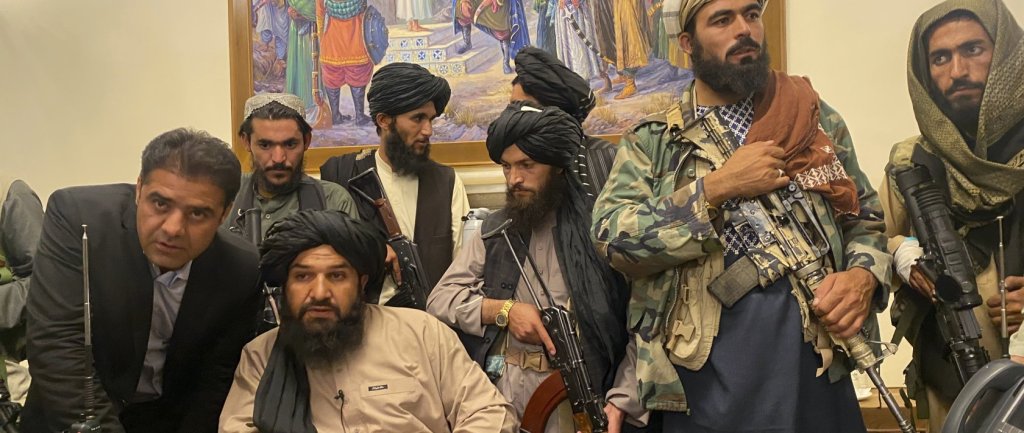
Who would have thought that Biden’s presidency would mark the end of empire? We had the August 2021 evaporation of what Biden called America’s:
‘Afghan military force of some 300,000 strong — incredibly well equipped — a force larger in size than the militaries of many of our NATO allies.’
The Taliban took over Kabul and the presidential palace (picture above) without firing a shot.
Now we have the humiliation of the Israeli army by Hamas and the collapse of Israel’s economy. Israel’s diamond trade (the leading export) is down because of Ansar Allah, agriculture (concentrated in Galilee) under Hezbollah fire, tourism non-existent, and tech companies (other than Intel subsidised by Biden to the tens of billions) running away.
The world watches on their video screens powerless to act as the empire protects the Israeli campaign of genocide. This powerlessness meanwhile builds up as political force, like the recession of the sea before a tsunami, which will come back and destroy a corrupt empire at its centres. These are epochal times.
America’s stock is dragged through the mud in front of a changing world in which the ‘West’ is now economically in the minority. Biden’s machine politician Zionism increasingly repels the empowered majority. His odious ‘bear hug’ can never be forgiven, as Democratic Congressman Ro Khanna tells us.
At the same time the US presidency’s impotence shocks Gulf rulers, once the pillars of empire. Biden is humiliated in Afghanistan, in Yemen, in Iraq and in Lebanon as his diplomats shuttle between Middle East capitals not to seek stability but to strive for the exact opposite – to promote displacement and suffering. Regional powers have found that the empire is not necessary.
They do have it in their power to control events and bring peace and stability. But if Netanyahu takes things to the brink because Biden is allowing him to, they will have to think carefully about how to stick to the plans they have made for their own survival. They need to continue to resist the irrationality of imperial pressure – not only for their sake, but that of the planet.
Israel is blinded and inviting the unexpected.
This article pulls together some of the themes covered on this site over the past two years – a period of seminal change.
1. Biden – the Last Emperor
Who would have thought, say at the time of the January 6 Capitol riots, that we would be facing a Trump – Biden rematch? Do either of these two characters have the answers to overhaul a decrepit American society and a reset of America’s poisonous relations with the world?
Biden, during his term, espoused a Neo-Keynesianism-lite, and raised the taxes necessary to fix the economy and society, but only as far as a donor-bound Congress would allow. The idea seemingly worked for him in the mid-terms, when the Democratic Party cynically backed the more extreme MAGA Republicans to discredit their opposition, and when a politicised state apparatus colluded in outlawing Trump and discredit him as much as possible.
The taxes were used, however, to make reforms at home that were not designed to deal with all the urgent infrastructural and social questions, but rather to support Cold War 2.0, and to undermine rather than cooperate with China for a better world. The internationalists at the Democratic Party also brought in a Soviet-style régime of censorship that has culminated in the ban on TikTok (yes it is a ban, however they dress it up), to deny young Americans access to all the damning information about their corrupt policies.
Who would have thought that events in Gaza would come to be at the centre of political events such as these, and influence the prospect of Trump coming to power and taking his revenge (which is what his rule would be about) on the Democratic establishment?
The neocons – who took over the internationalist cause in the 1980s onwards and went on to destroy the world – are now figuratively, and literally, out of ammo, as Victoria Nuland’s resignation suggests. It was clear that a re-emergent Russia had won the war against NATO expansion back when Ukraine’s stronghold in Bakhmut fell and Russia formally annexed the four provinces of Ukraine that surround Crimea to the north.
Washington is still scratching its head about Ukraine, as the new Russia consolidates. Blind, self-destructive neoconservative policies have firmly merged Russia into the Chinese conglomerate. The disastrous nature of this outcome for the United States was emphasised in the lead video on this site.
George Kennan, the State Department official whose policy of political containment of the Soviet Union was subverted and militarised by Dean Acheson and Paul Nitze in their anticommunist Cold War strategy (NSC – 68), wrote, in 1966, ‘… the heart of our problem is to prevent the gathering together of the military-industrial potential of the entire Eurasian landmass under a single power threatening to the interests of the insular and maritime portions of the globe.’ Zbigniew Brzezinski, who manipulated an impressionable Carter into a reboot of the Cold War, wrote, after the Soviet Union fell, that ‘for America, the chief geopolitical prize is Eurasia’ and of the need for Russia to be dismembered, controlled and pitted against China. Thus the empire brought about it own end.
The fascist hubris of neoconservatism – the hubris that saw the United States turn away Russia’s innumerable attempts at consolidating a relationship with the West, and reject any peace terms over Ukraine, only ever understood the world in terms of blind force. This was a cult of state officials that originated with Albert Wohlstetter, defence analyst at RAND, who invented the concept of ‘pre-emptive’ force. This cult took its ‘Trotskyist cell-like’ modus operandi from writer/publishers Irving Kristol and Norman Podhoretz.
Neocon political scientist Meyrav Wurmser called these Russian mafia clan dynamics in American administrations ‘love among people around power’ (Wedel 2009: 259). Through thick and thin they backed each other to gain influential policy-making jobs and, in Tucker Carlson’s unforgettable description, became ‘bureaucratic tapeworms.’ They weaved themselves into the system, as they salivated from their armchairs over games of Risk they played with real live populations. Anne Norton describes the academic strand of neocons as “larger, softer men, with soft white hands that never held a gun or changed a tire.” They learned from their mentor, Leo Strauss, how to hide their hate for anyone outside their clan, and give authority to their bigotry and their racism through reinterpretations of ancient philosophy.
America never developed a theory of liberalism and democracy to counter these depraved notions, beyond mere posing and lip-service. Jacksonian democratic ideals (which live on inchoate in the American psyche) never translated into ruling policy-making organisations. In the 1890s, the American polity took a hierarchical, authoritarian turn that saw democracy as a mortal enemy. The history of progressivism in America has, ever since, been one of different phases of self-satisfied delusion exploited by the servants of authoritarianism to brand America. It’s odd that the left actually never ever feels used.
This is the core problem of our modernity. Modern history debatably is about the rise (and fall) of America. The inheritance is now a new Orwellian authoritarianism in Zionist colours and a neocon parasitism that shaped and raped the world on behalf of Pentagon capitalists. The Palestinian resistance came, however, out of the blue, to deal a decisive blow for democratic ideals and for the ideas of free peoples who are minded to claim sovereignty for themselves at any cost. This is why we demonstrate for Gaza.
If neocons had their comeuppance in Ukraine, their Zionist commitments since their alliance with the Likud Party (consecrated in Menachem Begin’s alliance with televangelist-in-chief Jerry Falwell in the late 1970s) have now exploded into flames.
Israel is in despair as Netanyahu hunts on in vain for anything that can redeem its military reputation as the ‘empire’s Rottweiler.’ Gaza may be ravaged, but the resistance is unbowed, looking at the prospect even of annihilation by the empire, with defiance. It has mortally wounded its enemy, although we haven’t seen yet how America and Israel are going to ‘dress up’ this astonishing defeat.
The empire is panicking over how to supply Saudi Arabia’s demand for a two state solution as the idea is rebuffed by Netanyahu. It wants to save the empire’s key project of a Biden Corridor from Europe, through Israel and the Gulf to India.
So an overfed Mahmoud Abbas finds himself lobbied by the United States and the United Kingdom to ‘reform’ a Palestinian Authority (PA) that the Israelis have thoroughly trashed as they kill and maim their way through the West Bank. The idea came to Abbas to appoint an asset manager, Mohammad Mustafa, as prime minister and call it ‘technocracy.’ It will end up as a sort of Bureau of Palestinian Affairs (BPA) with nominal statehood to take charge of the reservations on which Palestinians in Israel would live. Its branch in Gaza would probably be at the far end of the bizarre pier which Biden is building in the sea off Gaza’s beaches, from which food would be dispensed to queues of Gazans through plastic COVID-proof shields.
Even that is too much for the extreme-right wing government of Israel.
But just as Israel is on a hiding to nothing, so is the empire. What it wants is no longer there. Saudi Arabia has made its peace with the Axis of Resistance and has left the starting-gate on China’s Belt and Road course. Besides, India, the empire’s decoupling Mecca and the Holy Grail of the Biden Corridor has become neoliberalism’s last repository – at an enormous cost to its people. As India climbs to the top of the GDP growth tables, it collapses to the very bottom of the inequality league and the world’s pollution index, even as Modi’s rule sets the country’s complex ethnicities at each other’s throats.
1a. The choices in front of us: what the neoliberal empire wants to offer us.
Let’s rewind a bit. What are the two paths forward that we are presented with as global citizens?
At the core of the imperial project in the Middle East has been the plan to compete with China’s Belt and Road Initiative (BRI) through the implementation of the India-Middle East-Europe Economic Corridor (IMEEC) (or ‘Biden Corridor’).
What are the end games of US/UK/EU imperial preservation vs. Chinese nation-building?
India is the empire’s Holy Grail and is labelled* ‘the world’s largest democracy’: during 2023, India presented itself as the alternative to China in a state visit to the United States in June. At the G20 meeting in September, in New Delhi, which Xi Jinping avoided, Modi announced himself as neoliberalism’s saviour and the key to the Biden Corridor’s success. He showcased India as the fastest growing economy in the world as measured by GDP. India would allow multinational corporations to pursue their decades long policy of crushing wages. The Modi programme is completely devoid of the social and environmental reforms that are necessary for the long-term well-being of the country, and is therefore detrimental to growth in the long-term. **
China as a communist state is labelled* ‘authoritarian’: China’s core notion of an ‘ecological civilization’ in Chinese Communist Party (CCP) ideology means rolling out a programme of region by region rehabilitation of areas that have suffered ecological degradation from decades of fast growth, together with focusing on technologies that will help to save the planet. They have already delivered on batteries, EVs, solar power, and are developing the kind of space technologies that will be crucial for the survival of our industrial human civilization it inevitably depletes the planet’s resources. China is the only country with a plan (and the executive capacity) to reach fossil fuel freedom asymptotically.
[*More on these labels and political definitions in the post-script at the end].
[** See note on the meaning of the contradiction of India being part of BRICS in the post-post-script at the end]
2. The Empire’s Gazan collision and Israel’s blind careen into the unexpected.
So back to the narrative: The plan to ‘normalize’ relations between Israel and Saudi Arabia and forge the link from Europe to India through the UAE’s port of Jebel Ali and save the empire, collided with Gaza in October 2023.
The Hamas attack was followed by a full-fledged mobilization of American naval forces to the East Mediterranean and visits first by Secretary of State Blinken and then President Biden to Israel. Hundreds of US political advisers, military commanders and special forces participated in an effort to bolster an Israeli régime devastated by an attack that had destroyed its credibility as a security guard for empire.
The main intention of the attack’s Gazan architects, however, was the ‘trap’ set for any Israeli ground invasion Gaza. The US warned Israel about this. Israel’s right wing government saw an opportunity for ethnic cleansing. But even as Gazan civilians suffered devastation, their nieces, nephews and cousins underground have dealt, over six months of fighting, a mortal blow to the Israeli army’s reputation for invincibility.
Israel launched into a killing spree of unprecedented proportions in Gaza, to the horror of a watching world. Bombing from the air, shelling from tanks directly into people’s flats, shooting them in the street, rounding them up like animals and torturing them to death in prison. Violence has spread to the West Bank as detentions there also spiral. To the thousands of Palestinian prisoners that Hamas has asked to be released in exchange for Israeli hostages, 7,500 have been added in the last six months.
No amount of protest across the world makes any difference. The genocidal intent of Netanyahu’s right wing government led to the ‘provisional measures’ demanded by International Court of Justice (ICJ) under the Genocide Convention on 26 January. Israel, typically, called the judgement ‘antisemitic.’ The ruling required Israel to desist from expelling Palestinians from their homes, from denying them access to adequate food, water, fuel, shelter, clothes, hygiene, sanitation, and medical supplies and to cease ‘the destruction of Palestinian life in Gaza.’
The ruling was repeated on 16 February. Israeli forces nevertheless continued their killing spree, as the state of South Africa, the principal plaintiff, horrified by the forced famine of the Gazans, insisted now on more forceful measures.
On 29 February, Israeli forces shelled a crowd of a thousand Palestinians waiting for trucks carrying food. Israel immediately denied responsibility for the ‘flour massacre’ and issued a video (picture below) seeking to show the deaths as the fault of a stampede. A BBC investigation went to the trouble of showing that the video was doctored. That the BBC sprang to life on this matter reflected a queasy British establishment at the heart of empire that is increasingly embarrassed at Israel’s out-of-control ‘killing rage.’ Yet the UK’s submission to the service of empire still doesn’t falter.
Israel repeated the exact same scenario on 14 March.

Even America seems embarassed. On 7 March, Gaza became Biden’s most important foreign policy issue in his State of the Union address.
Biden is now suddenly critical of Israel’s atrocities in the face of his terrible poll numbers, with an Arab-American vote in the primaries leading an outraged public to vote ‘uncommitted’. These voters might now even vote for Trump in the November elections: ‘Just because I can.’ It isn’t just the Arab American vote. The ICJ decision on the South African complaint against Israel is effectively a complaint against Biden’s leadership.
With South Africa’s moral authority pitted against Biden we see a decisive shift of the black vote against the Democrats. What we have in the current poll numbers is a clear shift since the Gaza War started (see below)

Source: Real Clear Politics
In his State of the Union address, Biden made the surprise announcement that he would “direct the U.S. military to lead an emergency mission to establish a temporary pier in the Mediterranean on the coast of Gaza that,” he said “can receive large shipments carrying food, water, medicine and temporary shelters.” Israel muddies the waters of this meek declaration of American independence with stories about Israeli contractors, not the US armed forces, building the pier.
But any question of American independence is moot as the United States continues limitless supplies of weapons to Israel which clearly are illegal. Biden’s warnings to Israel that he is revisiting the arms supplies issue are election PR and are not credible.
The whole Pier idea, in the words of the Washington Post, is a desperate attempt to show the American public that ‘the United States is doing something.’ But the project doesn’t made sense from the humanitarian point of view. Is it intended simply to give Netanyahu more time to execute his genocide?
The fact that the Democratic Party machine is in trouble, as elections close in, is clear from Chuck Schumer’s demand that Netanyahu should go and that fresh elections be organised in Israel. The demand was received with horror by the neoconservative clan, expressed most stridently by Norman Podhoretz’s stepson-in-law, Eliott Abrams, in his piece on the Council on Foreign Relations (CFR) website. How dare Schumer speak this way, Abrams says, Israel is not a banana republic! It is the Middle East’s only democracy!
Never mind that it is an apartheid state, and an artificial construct packed with extremist settlers – clearly a neoconservative’s dream.
Which begs the question as to how the United States and the United Kingdom are going to get the Bureau of Palestinian Affairs (BPA) off the ground, and the notion of limited Palestinian statehood that Saudi Arabia is willing to accept, over the objections of Netanyahu and the Knesset?
Netanyahu repeatedly threatens a Rafah incursion. As Hezbollah warns of retaliation, Israeli generals say they are not prepared for escalation on the Lebanese front. Israeli forces are worn down in Gaza. Their recent repeated attempts to gain control of Khan Younis on the basis that it is the Hamas HQ, have all failed. Israeli forces have been eviscerated since 7 October. Israel blocks the release of any information on army losses, but there are urgent calls for 14,000 new recruits, most of them required to fill officer grades.
Recruitment, furthermore, faces opposition. The very same ultra-orthodox Jews who have been instrumental in tilting Israeli politics to the extreme right, refuse to allow their young to join the armed forces. Sephardi Chief Rabbi Yitzhak Yosef said that, should the government enforce compulsory military service on them, they would leave Israel en masse. Is the commitment there for the secular Israelis to carry the can and go on getting killed?
As Israel sinks into its contradictions, taking the empire with it, the resistance in Gaza resolutely faces death.
As Netanyahu’s intention to continue destroying Gaza and its people remains unopposed by the Biden administration, the war seems to be widening – the bet on which the gambler has staked everything.
Ansar Allah is widening the scope of its attacks to the Indian Ocean and down to the Cape, crippling any prospect of easing inflation and any potential for a soft landing for the American and European economies. Biden’s protection of Netanyahu has meant he has had to field the largest naval response to a maritime threat since WWII, without having been able to degrade Ansar Allah’s capabilities. Gulf rulers are steering well clear (Bahrain doesn’t count), they’ve been there before.
But what Netanyahu’s bet relies on just can’t happen. The intense diplomacy the US engaged in – see section 4 below – to avoid a regional war is a clear indication that there isn’t the will or the soldiers to put ‘boots on the ground’ in Lebanon, Yemen and Iran on the scale of the 1991 and 2003 Iraq wars. Yes the gambler will get weapons, intelligence and arial support. But Netanyahu will have to go it alone against a very sophisticated enemy.
The unexpected will happen. The enemy will take the war to Israel as preparations in Syria indicate. It cannot afford to continue its war of attrition as the Gazan genocide turns suddenly into a starvation and disease driven catastrophe. The Golan, Galilee and the West Bank will explode.
3. The Israel lobby and how neoconservatism destroyed the Empire
American politics is full of irrational divisions and contradictions, but none more glaring than the fact that the Republican isolationists appear, at least on the surface, to be rabid Zionists. Republicans, especially House representatives in the right-wing Freedom Caucus are committed to ending the ‘forever wars.’ How can they do that if they are Zionist? This becomes an important consideration as a Trump presidency threatens.
This is all part of the greater contradiction, namely that AIPAC forces American politicians to prioritise Israeli interests over those of the United States. John Mearsheimer and Stephen Walt have written in the ‘Israel Lobby’ that, ever since the demise of the Soviet Union, there has never been either a moral or strategic imperative that can be argued to rationally justify the United States doing Israel’s bidding in the way that it has. Israel “…does not behave like a loyal ally [and] Israeli officials frequently ignore US requests and renege on promises.” This powerful special interest group is not concerned with “the long-term American interest.”
This dysfunctional influence works even to deny its own reality. US neoconservative state officials with ties to Israel’s Likud Party worked in Israel’s interest, for instance, to press for war with Iraq, although Saddam Hussein was not a threat to the United States. Bob Woodward wrote about how Paul Wolfowitz (Deputy Secretary of Defense under Donald Rumsfeld) wanted to go to war in Iraq after 9/11, even before Afghanistan, although Saddam was not involved. James Bamford also wrote about how Scooter Libby (Dick Cheney’s chief of staff) helped fix the evidence on the supposed weapons of mass destruction in Iraq that Colin Powell, to his eternal shame, presented to the UN as the main argument for going to war with Saddam. These are merely two instances of the wider neoconservative campaign to pressure Bush on the question of Iraq.
The Iraq War is the ultimate example of a policy decision taken against the long-term American interest, and in Israel’s interest. But it is taboo to say so. After rubbishing the idea that going to war with Iraq was to do with oil, Michael Kinsley wrote that “the lack of public discussion about the role of Israel … is the proverbial elephant in the room: Everybody sees it, no one mentions it. The reason is obvious and admirable: Neither supporters nor opponents of a war against Iraq wish to evoke the classic anti-Semitic image of the king’s Jewish advisers whispering poison into his ear and betraying the country to foreign interests.” The charge of antisemitism in the event of any criticism of Israel, means that the Israel Lobby at once determines American foreign policy even as it makes any mention of the fact a blackballing offence. How did this all happen?
3a. The neoconservative turn: The first question is to ask how neoconservatism inserted itself into mainstream American politics. The election of Jimmy Carter in 1976 was a consequence of the defeat of the United States in the Vietnam War. Carter promised to lead the country in a new open and moral direction, with an absolute commitment to human rights. He set about implementing détente with the Soviet Union, which Secretary of State Cyrus Vance agreed with, but which his National Security Adviser Brzezinski, who initially would keep his sceptical views to himself, didn’t.
At the heart of Carter’s declared foreign policy was the idea of a ‘comprehensive peace in the Middle East,’ and a grand Geneva peace conference to mark his presidency. Brzezinski worked assiduously and systematically, however, to turn the open-minded and flexible president from this approach. Indeed, Carter was the first US president who would talk about a Palestinian ‘homeland’, arranging as he did a joint US-Soviet declaration in October 1977 to table the idea of the ‘legitimate rights of the Palestinian people’ in the context more generally of ‘principles of sovereignty, territorial integrity, and political independence’ for all states in the Middle East. But he would be undermined.
The idea of the territorial withdrawal of Israel to 1967 borders was abhorrent to many Jewish leaders linked to AIPAC. The strength of their views was actually a new development contemporaneous with a ‘revolution’ in Israeli politics. This saw the Likud (previously Herut) Party headed by Menachem Begin, long in opposition, emerge ahead of the ‘Alignment’ (subsequently the Labour Party), in the elections of May 17, 1977. The result shocked Carter (as it did British PM Callaghan). Begin led the revisionist faction of the (Jewish) Zionist movement, was a disciple of Ze’ev Jabotinsky, its founder, and had served in the Irgun militia, which the British had always deemed ‘terrorists.’
Begin held the West Bank to be an integral part of Israel, and considered the Palestinians as a minority grouping that could at best aspire to limited autonomy within a single Israeli state. This view clashed with Carter’s. When Carter pointed out the contradiction that Palestinians would become the majority in such a state, Begin responded with his plans for ‘mass immigration’ of Jews. Thereafter, he would break all his insincere agreements with the United States on the matter of settlements.
At the same time, Carter suffered attacks from Pentagon capitalist hawks. Led by Eugene Rostow and Paul Nitze (the creator of NSC – 68 with Dean Acheson), these hawks founded a new iteration of the 1950s Committee on the Present Danger (CPD) immediately on Carter’s election in November 1976 in order to reboot a Cold War that Carter wanted to put an end to. The right wing of the Democratic Party, along with the Republican Party, saw the statement about Palestinian rights in the US-Soviet declaration as an indication of the weakness of the policy of détente that potentially signalled a return of the Soviets to the Middle East.
Brzezinski’s success in turning Carter against the Soviets didn’t, however, include a conversion to Zionism. Reagan, on the other hand, was committed to the CPD and was a declared Zionist. Henry ‘Scoop’ Jackson left the Democratic Party in disgust to join Reagan. He was Pentagon capitalism’s main Congressional enabler, was known as ‘the Senator from Boeing,’ and was a disciple of Albert Wohlstetter and his doctrine of pre-emptive war. Scoop Jackson took his aides with him, and this included Richard Perle and Paul Wolfowitz, who had met Jackson through Wohlstetter, Bill Kristol (Irving’s son), Charles Horner, and Douglas Feith. Also crossing over to Reagan’s Republicans were Elliot Abrams, mentioned earlier as Podhoretz’s stepson-in law, who served as special counsel to Jackson (1975 to 1976) and Jeane Kirkpatrick, a contributor to Podhoretz’s Commentary Magazine.
Podhoretz and Irving Kristol fashioned this movement’s narrative, defiantly adopting the derogatory term ‘neoconservative’ thrown at them from the left, as the movement’s name. For these intellectuals, the lack of patriotism of the Vietnam protesters, the scepticism of New Left, the hippie movement’s destruction of family values, and the challenge to authority of the Black Power movement, had all undermined the authority of the state and traditional society.
This reactionary movement would ‘save’ America by uniting the country behind a forceful empire, Israel would become the bulwark against Soviet expansion, and the neoconservatives the vanguard party of an international movement in the tradition of Trotsky. As lapsed believers, theirs would now be a secular Jewish faith in the militaristic state of Israel and its rightful rule over the Arabs/Muslims. With the demise of the Soviet Union, neoconservatives and the new generation of Likud politicians, which after Begin were led by Netanyahu, would recast the enemy as the Arabs/Muslims themselves.
3b. The turn of evangelicals to Zionism: At the level of policy élites, Carter’s attempt to lead the United States into a new era of democracy and humanism was scuppered by the neoconservatives. However, the actual votes that brought Reagan to power at the popular level came from a turn to politics by Christian evangelicals, with televangelist Jerry Falwell as the key personality of the turn.
A previous article on this site covered the history of how the so-called ‘movement conservatives’ were galvanised by Barry Goldwater’s nomination in defiance of the Republican Party establishment in 1964.
These movement conservatives would seek in vain to galvanize the millions of potential votes among evangelicals who saw only evil in politics. This changed only when Jerry Falwell saw the 1973 Supreme Court decision in Roe v. Wade as a reason to campaign among his televangelist peers against secular liberalism. The new religious politics would be structured around the minority ideas of dispensationalists that mainstream Christianity took to be heretical. Dispensationalism provided the Biblical prophecies that should be fulfilled in current events. The new idea was to peddle redemption by engagement with current events in born-again readings of “the news” that would frame collective political action. Christians could now be judged and spared by nudging events towards the Bible’s prophecies.
Christian missionaries struggling with the problems of Palestinians rue the day that the mainstream church allowed Palestine to be defined by Zionists. But to be able to define a narrative for the world, we learn from neoconservatives that there must be awareness, commitment, and organisation. The Christian mainstream is about social justice rather than racist murder and mayhem, but its ministers were unprepared for the power of TV. By the time the televangelists were done, it was too late, even some evangelicals look back in despair at outcomes they didn’t expect.
It would only be with Begin’s win in 1977 and his frequent trips to the United States in the course of the Middle East peace negotiations that Carter had launched, that Falwell became Zionist. Carter’s dream of a comprehensive peace solution was reduced to a disappointing bilateral deal between Egypt and Israel at Camp David (1978). Begin would court Christian Zionist backing for his strategy of subversion of Carter’s aims and for his goal of ‘preventing Palestine’. Egyptian president Anwar Sadat submitted to Begin’s plan, driven by US media attention and Time Magazine covers that fanned his personal vanity, and a habit of smoking hashish that loosened his grasp of detail in negotiations.
One of those ministers from the Christian mainstream fighting for Palestinian rights, Thomas Getman, wrote, ‘Begin… saw the necessity of the theo-political match made in heaven. Likud courted the relationship with leaders such as [Rev. Jerry] Falwell, [Pat] Robertson and other TV preachers who captured the TV time for most Christians, and from the booming fundamentalist Zionist churches in the South. In 1979, with great fanfare, Falwell was presented a private jet by Begin, purportedly to affirm the [televangelist’s support for] Israeli policies such as their impending 1981 bombing of Iraq’s nuclear site, but also to spread the Zionist action plan.’ Televangelism was about the money.
This history has driven the United States into a position in which it has become complicit in the racist and genocidal acts of the Israeli state that the ICJ will rule on definitively in the coming years. Even as America defended Israel against the ‘provisional measures’ on which the ICJ ruled, it condemned itself to a settler colonialist narrative that has utterly destroyed its soft power in a new world which has been described as ‘turned inside out’ – one in which the Global South has overtaken the ‘West’ in terms of production and trade – in which, besides, it is vocal and determined about opposition to post-colonial imperialism.
The soft power of the United States is shot even as its military dominance is challenged both at the level of great nuclear powers and that of the asymmetric power of tech-enhanced militias, and as it loses it financial dominance. Financial dominance is not to be confused with Dollar dominance, for when this is lost and the capacity for attracting capital at low cost diminishes, dollar dominance becomes a net burden on the domestic economy and employment.
China, meanwhile, has taken ownership of the high ground in this new world, using the opportunity of the sessions at the ICJ in early March to insist on the legal right for Palestinians to ‘armed struggle’ against Israel as a coloniser, while recognising Hamas as an authentic element of the ‘social fabric’ of Palestine. (China’s treatment of its minorities mustn’t be forgotten, but that subject is several degrees of analysis away from the issue of settler colonialism and demands a separate article).
In the United States, meanwhile, the public stirs. A democratic movement sets out to dismantle the lynchpin of empire – the Israel Lobby. It took the excesses (even by Israeli standards) of recent events in Gaza, to clarify Zionism as a genocidal creed in the public mind, and the handmaiden of Pentagon capitalism.
4. The Energy Paradigm Shift and the challenges of Saudi decoupling from Empire.
Saudi-Iran and the New Diplomacy: Previously on this site: ‘On March 10, China brokered a peace deal between Iran and Saudi Arabia. This caused a wave of heart attacks across the US foreign policy community, which had over the years carefully crafted the idea at the foundation of Middle Eastern empire-building that there are “Sunnis” and “Shias” and that they are like oil and vinegar.’
What followed this was the emergence of a ‘New Diplomacy’ between the two regional powers and an almost surreal calm descending on both Iran and Saudi Arabia as almost every other country in the region came to be consumed in the events of the Israel-Gaza War.
Saudi Arabia held football matches featuring Ronaldo and Messi and staged a Grand Prix. Iran quietly held elections in which the conservatives won. Neither country did much about Gaza publicly apart from condemn Israel’s actions at the emergency meeting in Riyadh of the Organization of Islamic Cooperation (OIC) on 18 October which called for an end to the Gaza War and at the subsequent international summit in Cairo on 20 October, where the Arab states, led by Egypt, took a united stand against the position at the time of the US, UK, Germany and Italy as the principal backers of Israel’s actions.
Through the conflict, Saudi FM Faisal bin Farhan al-Saud and Iranian FM Hossein Amir-Abdollahian have made almost as many statements on the subject as each other, and Amir-Abdollahian visibly kept bin Farhan informed of the decisions that were being made by Hezbollah. While they shuttled through different geographies, they came together in Davos and took similar stances on the conflict. The whole thing has been surreal.
Amir-Abdollahian kept a watchful eye on Lebanon, which he visited several times, as Biden advisor Amos Hochstein and various diplomats from the UK, France and Germany visited Beirut to try – in vain – to put pressure on acting Lebanese PM Najib Mikati to move to stop Hezbollah’s actions, while faithfully conveying Israeli threats, and filling the country with spies dressed up as back-packers. Mikati seems to have an uncanny ability to shrug his shoulders that few people knew about, while sending his tiresome stream of visitors packing with a smile.
Hezbollah and Ansar Allah in Yemen pursued their Axis of resistance actions in support of Gazans autonomously. None of this worried Saudi Arabia (or indeed the Emirates), who made no strident statements of any kind and carried on business as usual. They even rejected US calls to join the naval coalition against the Yemenis, and did this even though Ansar Allah promised to widen its actions as far as the Gulf of Oman, if Israel didn’t stop its action against the Gazans.
It became clear that all the main players were talking to each so as not to escalate the war. The US talked directly with Iran, Iran mediated between Hezbollah and Saudi Arabia, and Saudi Arabia talked directly with Ansar Allah through the backchannel it had established in Oman in September 2022. The only party that wanted a regional escalation of the war was Netanyahu and his government in Israel.
4a. Saudi Arabia and the Palestinian Question: The position of Iran in the geopolitical scheme of things is clear, given that it joined the Shanghai Cooperation Council and that it is proceeding with a comprehensive strategic treaty with Russia. If Saudi Arabia’s position is less well understood, this is because it is a country in transition.
Where Iran promoted the Axis of Resistance as an asymmetrical response to American imperial hegemony in the Middle East, Saudi Arabia is usually seen as a collaborator with empire – and its élites as a comprador class keen on the ‘normalisation’ scheme that Trump and slum landlord Jared Kushner were rolling out across the Middle East, when the idea of the ‘Abraham Accords’ was consecrated around a glowing orb in 2017.
Yet it didn’t normalise. It demanded Palestinian statehood as a condition of normalisation. The feeling grew in the West, however, that as Israel dragged its feet over the matter, and as Saudi Arabia developed informal relationships with Israel anyway, that the whole matter would just go away. Kushner’s idea of the ‘deal of the century’ was to follow the Abraham Accords with incentive to the Gazan population and a building programme to relocate them to Sinai. But this was delusional. Saudi Arabia had always supported the idea of Palestinian statehood and this was unlikely to change.
It was King Abdullah in fact, as Crown Prince, who launched the ‘Arab Peace Initiative’ in March 2002, following UNSC Resolution 1397, which was intended to defuse the Second Intifada, and set the agenda for a two state solution. The Second Intifada erupted when negotiations over the terms of a Palestinian state between PLO leader and President of the PA, Yasser Arafat, and Israeli PM, Ehud Barak (mediated by Bill Clinton) failed. Saudi Arabia has formally held to the two state solution of the ‘Saudi initiative’ ever since.
At that time, all Palestinian and Lebanese resistance groups received backing of one form or another from both Saudi Arabia and Iran, whether Fatah, Hamas in Palestine or Hezbollah in Lebanon.
After Yasser Arafat died in 2004, Palestinian legislative elections were eventually held in January 2006. However, a rift between Fatah and Hamas over the refusal by Hamas to recognise Israel and to accept the outcome of the Oslo Accords had occurred. By implication, Hamas would be turning its back on the Saudi plan.
Despite the fact that Hamas won the 2006 election overall, Palestinian affairs descended into war. The United States had listed Hamas as a terrorist organisation and Fatah sought to use the opportunity to push Hamas out of power, only to be expelled from Gaza. Fatah took over the Palestinian Authority and the West Bank and kept Saudi backing, while Hamas took over Gaza and kept its Iranian backing. Gaza was then besieged by Israel. The siege and political divisions continued even after Hamas softened its position.
Only in April 2023, six months before the al-Aqsa attack, was there a thawing of relations between Hamas and Saudi Arabia. That rapprochement was a function of the peace deal between Saudi Arabia and Iran, which had been concluded just the month before. It was a clear indication that Crown Prince Mohamed bin Salman (MBS) was widening his country’s contacts to all Palestinian factions. In fact, the establishment of a Palestinian state under the framework of a two state solution had become more than just the commitment made in 2002, it became a strategic necessity under the new development plan, Vision 2030, just as the peace deal with Iran did, and the cessation of hostilities agreement with Ansar Allah (September 2022) did.
The Gaza War offered MBS an opportunity to try to squeeze political concessions out of Israel and the United States that would not otherwise have been possible. When the Saudi offer to Israel was conveyed in a deal conditional on a two state solution, it would better be described as a demand for a recognition of Palestinian statehood by Israel in return for diplomatic relations.
Israel’s, followed by America’s, recognition of Palestine would be an epochal coup for the guardian of the Two Holy Mosques, and the only way Saudi Arabia could ever balance its relationships with the United States and Iran as the same time.
But there is more to the Palestine question than that for Saudi Arabia.
4b. Palestine and Saudi Arabia’s Vision 2030: MBS announced Vision 2030 on 25 April 2016, which went to the Economic Council and was approved on 5 June. Reading the development plan brings to light the fact that the country’s Islamic heritage is intended to play a crucial multifaceted role in what is a national strategy and a complex and ambitious conception for the country’s future that seeks to take the country out of oil dependence.
Saudi Arabia lies in the zone which global warming will make unliveable. Its revenues meanwhile are in the vast majority derived from the fossil fuels that is making this happen. The December 2023 COP28 deliberations in Abu Dhabi were an indications of the bind that the Gulf states find themselves in. The climate summit was run by Sultan Ahmed al-Jaber, head of the Abu Dhabi National Oil Company (ADNOC). It concluded with the unambiguous statement that fossil fuels are the cause of global warming. Gulf leaders it has to be clearly understood are in organised panic mode. The Gulf states have to convert their economies and societies into a sustainable form – by using the very revenues from fossil fuels that will dry up as the paradigmatic shift in energy grips the world.
This dilemma is behind the revolution that took place in the Saudi polity.
Vision 2030 now defines the nation and there is no time to lose. The jump from a tribal oligarchy, to a rational bureaucratic absolute monarchy came during the purge of the country’s oligarchy, between 4 November 2017 and 30 January 2019, in which period the critic writing for the Washington Post, Jamal Khashoggi, was gruesomely murdered in Istanbul in 2018. The country’s élites were coaxed to the Ritz-Carlton, the very same venue which had seen the announcement of Vision 2030, and in what came to be known as the ‘Night of the Beatings’, were shaken down. The management of the country’s finances would be tightened and no-one was exempt from following the development plan.
Science, technology, and renewable energy are crucial to the overarching plan. The level of research and development in the country’s technology sectors has grown over the last 15 years. In the Nature Index global research rankings, Saudi Arabia is thirtieth and stands above all other Arab countries and Iran. Vision 2030 was the plan aimed at converting this research output into diverse new industrial and commercial applications. For instance, the production of hydrogen is being developed as a way of leveraging existing resources to change the country’s export profile in the context of the new paradigm, albeit ultimately extensive solar farms will feed into the production of green hydrogen.
King Abdulaziz City for Science and Technology (KACST) is the leading research centre and has many specialist institutions developing different non-oil related technologies. But developing export revenue from technology exports is risky and competitive. So there is a focus therefore on import substitution in the military sector that will see the production of satellites, unmanned aerial drones, robotics, and cybersecurity systems and in energy-linked technologies such as maritime transport of gases such as hydrogen.
That’s all well and good. But to develop the economy more broadly requires a domestic consumer market driven by both a change in consumption habits and an increase in visitors. The development of sporting activities, entertainment and tourism is intended to transform the consumption habits of Saudi nationals while attracting foreign visitors in large numbers.
The ambitious projects planned for these sectors such as Neom (The Line) and the Red Sea Project (Amaala), however, will take some time to complete and face considerable challenges. The main problem is the need to be located next to Sinai. The proximity to Egypt is necessary for access to large numbers of trained hospitality staff, and are not viable if peace does not come to Gaza, Sinai and the region. This is part of the reason for the importance of settling the Palestine question and making all the recent peace deals with the country’s neighbours. The increasing military sophistication of the region’s militias, in particular, have underscored Saudi Arabia’s vulnerability.
Egypt’s government may have said no to the relocation of Gazans to Sinai, but Saudi Arabia said it louder. Abdelfattah Sisi would have buckled under pressure if Saudi Arabia hadn’t been determined and the United States equally determined to maintain a close rapport with Saudi Arabia. Every time Blinken travelled to Riyadh, he came back with the same message for Israeli leaders: you can have normalisation, but we want a Palestinian state.
There is another important aspect to the need for a Palestinian state. Vision 2030, the brochure says, is to firstly to ‘focus on people and the Islamic faith. This will happen through a series of commitments, including: increasing the number of Umrah visitors from 8 million to 30 million annually; establishing the largest Islamic museum in the world; doubling the number of Saudi heritage sites registered with UNESCO.’
Quite apart from seeking to enhance the well-being of Saudi citizens by protecting and developing their ‘heritage’, economic benefits are planned to be derived from an enormous, planned jump of visitors from the nations of Global South who wish to visit Saudi Arabia’s holy sites. This is the least speculative aspect of Vision 2030, given that demand exists amongst the world’s 2 billion Muslims for religious tourism to Saudi Arabia, well in excess of the country’s current capacity.
It is therefore not only a political necessity for the Saudi régime, under its role as guardian of the Two Holy Mosques, to keep to its pledge to obtain Palestinian statehood and thus to ward off criticism (or worse) from Iran, but it imperative that it resist being associated with Israel and the United States and their settler colonial project to enhance Saudi Arabia’s status among the nations of the Global South. In a poll of public opinion in sixteen Arab countries conducted in January 2024, 89 percent of respondents were outright hostile or deeply sceptical to the idea of diplomatic relations with Israel.
Many were calling for stronger action from Saudi Arabia to halt Israel’s Gazan genocide, such as an oil embargo. But it is not at all clear that such drastic action would have the necessary effect. The last time Saudi Arabia embargoed supporters of Israel in the 1973 war, the result was for the country to suffer a bitter betrayal at the hands of the vacuous and vain Anwar Sadat when he signed the 1978 Camp David Accords, arguably the root cause of today’s impasse in Palestine.
The Saudi Arabian government today is in a strong negotiating position, because of the overriding desire of the United States to establish the relations between Israel and Saudi Arabia that will bring into being the Biden Corridor. Saudi thinks it can walk the fine line. Netanyahu stands against even the idea of a Palestinian state, however. In the United States, the leading elected Jewish politician at the core of the Democratic establishment, Chuck Schumer, has taken the stance that Netanyahu must go. But given that Biden is giving Netanyahu free reign, Saudi Arabia faces a serious challenge to its credibility and legitimacy.
The civilizational narrative at the core of the Vision 2030 idea stands threatened. Saudi Arabia, of course, can stand its ground in the event that Netanyahu continues the genocide in Gaza, widens it to the West bank, and make the establishment of a Palestinian state impossible. It doesn’t have to normalise. But if the Saudi régime doesn’t stand its ground, the New Diplomacy will come to an end. Saudi Arabia will fall out with the Axis of resistance and Ansar Allah will become both a military and socially revolutionary threat – Abdelmalik al-Houthi will rapidly take the high moral ground in the peninsula, buoyed by his string of victories against the ‘Amrikaan’ and the ‘Inglees.’
4c. Saudi Arabia and the Chinese Belt and Road: Vision 2030 was announced by MBS in April 2016 after his father’s state visit to Beijing in January. That was the occasion when China and Saudi Arabia signed what was called the Establishment of a Comprehensive Strategic Partnership. This was a big deal. Wang Huning, Politburo member and the Chinese Communist Party (CCP)’s ideology chief, said in his announcement, that ‘[b]oth sides agreed to strengthen docking of their development strategies.’ The similarity in the structure of the two development plans is important. They are both state-driven and led by state-owned companies and organisations.
Both, however, realise that to fully realise and fund these plans, the need remains of involving the private sector to invest and play a role within the parameters of these plans and within the rules established by the policy-makers.
It is in that respect that Saudi Arabia’s search for a balanced relationship with the United States is crucial for its future. For instance, the largest EV plant in Saudi Arabia belongs to the US company, Lucid Motors.
[Given that the role of the private sector is very important, it is the role of politically-driven Western commentary to denigrate those plans and the policies and political systems of those countries to stop private investors from supporting them.]
The idea of the ‘docking’ of China and Saudi Arabia in their development plans stands out particularly in the crossover between China’s prioritisation of the development of smart cities in its 2020 version of ‘Made in China 2025,’ and the launch of Saudi’s flagship Neom project, called ‘The Line’, a city for 9m people that is 200m wide and 170km long, that can be crossed in 20 minutes and that produces virtually no carbon emissions.
In 2016, agreements were signed to launch dialogic synergies between China’s Digital Silk Road Initiative (DSRI) and Saudi Arabia, in technologies related to smart city and smart energy grid management, and digital infrastructure such as fibre optics, and e-governance.
After MBS’s February 2019 visit to China, in which he signed agreements for the establishment of petrochemical plants in China by Saudi Basic Industries Corporation (SABIC), cooperation deepened. While many countries had followed the US lead in banning Huawei due to perceived national security risks, Saudi Arabia granted Huawei the contract for the countrywide deployment of 5G networks. By 2023, Huawei also became the leading supplier of cloud services.
Furthermore, the Saudi government research-coordinating body, King Abdulaziz City for Science and Technology (KACST) began cooperating with China Satellite Navigation Office on the manufacture of satellites using the BeiDou Satellite Navigation System, as well as on the project of establishing a permanent space station for Saudi Arabia. KACST has been producing and testing a variety of components related to satellite manufacturing and launched an experimental optical camera that was used in China’s Chang’e-4 lunar mission.
Other Saudi Arabian organisations, such as Saudi Technology Development and Investment Company (TAQNIA), are involved in the development of different digital and computing technologies, as well as various EV and UAV technologies, in collaboration with China, but the emphasis that is being put on the development of space-related technologies stands out.
Although many Saudi nationals have gained scholarships to study in China, habits only change slowly and the vast majority still study in the West, principally in the US and the UK. Yet China’s share of Saudi Arabia’s total international research collaboration was 28.3 percent in 2023, exceeding that of the United States (26%), Germany (10.1%), and the United Kingdom (10.3%). This is a result of the nature of China’s outreach policies under the Belt and Road Initiative. We see, for instance, that King Abdullah University for Science and Technology (KAUST) has had three Chinese presidents and has recruited hundreds of Chinese students and faculty members over the years.
Xi Jinping made his second state visit to Saudi Arabia in December 2022, after reciprocating King Salman’s visit in 2016. He signed 30 agreements in which Chinese companies invested in various technologies, renewable energy, agriculture and tourism, doubling Chinese foreign direct investment in Saudi Arabia at one stroke. It is in this context that Saudi Arabia joined the BRICS collective and signed a Yuan-Rial currency swap facility.
We have to wait and see, however, if the Saudi régime is capable of maintaining the momentum that has built up behind Vision 2030. In the event that the idea of a Palestinian state becomes impossible and the Saudi régime is unable to stand up to the pressure from the empire, its relationship with China and the neighbours that surround it will be undermined. Then it will become a mere front line state in Cold War 2.0.
*P.S. On the question of labels and political definitions.
The Biden administration has made a big deal of these labels in its democracy vs. authoritarianism road shows (I can’t imagine why most of these take place in Seoul! Are the Koreans so sceptical?). Readers of the articles on this site will have indeed seen that some considerable scepticism is warranted regarding the designation by the United States of itself as a democracy.
There is, however, a growing interest in authoritarianism in the world that has resulted from the longevity of the CCP and China’s exponential rise. The literature on this subject should be widely read (see the introduction in Fewsmith 2021, and Geddes et al 2018, but especially the important analysis in Jowitt 1993, despite the fact that Ken Jowitt failed to predict the survival of the CCP) .
I apologise for the somewhat opaque and unanalysed remarks I previously made about Saudi Arabia and the Emirates as at once ‘tyrannical’ states and states that have now made the transition from tribal states to rational bureaucratic absolute monarchies (I repeated this above). So I would like to clarify.
Jowitt makes the important distinction between regimes that are ‘charismatic’ (i.e. focused on personal rule) and those that are ‘impersonal’ charismatic and that are based on promulgating an ideology that transcends persons and makes heroes out of the rank and file (think those huge paintings and sculptures of ‘the worker’ in Soviet society).
In the CCP, ideology is crucial and explains the glaring fact of the longevity of this single party state. Ideology chief Wang Huning has been an integral part of the Politburo under three different leaders – no other party official has had that kind of career. Ideology does, however, need to alter with the times and that is what leadership contests in the CCP are all about.
So how do we define the current Saudi régime? The régime, suddenly faced with an existential crisis of unprecedented proportions, responded with a comprehensive socio-economic plan: Vision 2030.
Such a plan makes no sense to a Western audience, but bears a close resemblance to a CCP-type ideological statement. The way that the country’s Islamic heritage was established at the core of the document, recalls Deng Xiaoping’s ideological shift when the Soviet Union collapsed. A longing for the re-establishment of the ancient Middle Kingdom was substituted for the communist dream. In the Saudi case, a longing for a return to the Golden Age of Islamic Science was established as ‘the Saudi dream.’
So it would seem that the Saudi régime should be credited for introducing the crucial element of ‘impersonality’ in its political revolution, albeit that in this period we have witnessed the use of extreme violence on persons.
But how is ‘impersonality’ reconciled with monarchy? I suppose we have to go back to those kings and queens in the past that were defined by an idea. Frederick II of Prussia and Catherine II of Russia brought massive change to their countries under the idea of the ‘Enlightenment,’ and their names have carried the suffix ‘the Great,’ ever since, as a consequence of this.
For MBS to get into that league, he would have to resist succumbing to pressure from the United States to bend to its will, in order to realise the idea behind Vision 2030.**
*P.P.S. 24 March 2024 On the contradiction of India as a member of the BRICS group.
BRICS is not a physical institution, but it does carry the idea of independent nations joining in support of each others’ claims to total sovereignty in defiance of empire. This is what moving from a unipolar to a multipolar world means. Furthermore, the purpose of insisting on total sovereignty is to transfer command over the state to a nation’s citizens, where each citizen is no more than a number with an absolute equal share in the state. Modi’s India, on the other hand, is at once setting up a racist hierarchy and delivering the state to corporate rule. Where other BRICS nations may have imperfect systems in practice, the ideal in law remains for citizens’ equal rights. In India, where this was the ideal, it is no longer the case.
**P.P.P.S 9 April 2024 On Vision 2030’s attempt to attract the American private sector
The part of Vision 2030 which relied on global private sector investment isn’t working. The American private sector which Saudi Arabia hoped to attract to fund its massive projects is merely taking advantage of the incentives being offered without offering anything in return. This means there will be a far greater reliance on China as a foreign investor in the future, with all the regional and global implications that fact brings with it.
[Ref: Prt 14 Post-Script 21; info@globalshiffft.com; © 2024]
 Globalshiffft
Leave a comment