

UK Minister of Defence Grant Shapps threatened the Houthi régime (known as Ansar Allah, which is the name used here) in Yemen, with military action. Defence journals followed this with reports that preparations were for real. What was the point of such threats, however, if the US had already attacked and sunk three Ansar Allah patrol boats carrying rocket launchers? The US attack itself would be counterproductive. After the United States had convinced shipping operators to restart shipping through the Red Sea under its protection, the American attack now promised an intensification rather than an easing of hostilities in the waterway. This led Maersk to suspend operations once again. As the empire seeks to demonstrate to the world that it alone “rules the waves,” it reeks of impotence in the face of the reaction by the Ansar Allah leadership of “bring it on” to US and UK threats.
It was pretty clear to most of those who were approached to form a “willing coalition” to cover for empire in the Red Sea that any such effort would only cause more chaos and disruption. The coalition idea embarrassingly fell apart no sooner than announced. But the worst part for the US was that two mainstays of Neoliberalism Central, Saudi Arabia and the United Arab Emirates (UAE) refused point blank to join in the first place. Could the escalation of threats via the UK have been a way intended to bring Saudi Arabia and the UAE to heel? Countering Ansar Allah action would require invading North Yemen and, since the US is not about to put boots on the ground anywhere in the Middle East, Saudi involvement in particular would be essential.
Revealing is the fact, that behind its threats, the UK is nevertheless using the backchannel established through Oman to reach out to Ansar Allah and try to find a resolution to this current crisis. But if normal human feelings sadly are anathema to American decision-makers, why not just end the butchery in Gaza as Ansar Allah is demanding, for purely political reasons? This is the subject of the conclusion below (Gaza War Endgame). Meanwhile, as long as the Gazan slaughter continues for whatever the reasons, the world is going to have to live with the constant interventions of Ansar Allah in the Red Sea, irrespective of American or British threats.
The New Diplomatic Political Environment: But why do we find the empire forsaken by the Saudi and Emirati pillars of the neoliberal (dis-)order? A previous article here discusses the era of the New Diplomacy. Saudi Arabia and the UAE are in no mood to restart military action against Ansar Allah after a ceasefire to the seven year Yemen War, which has held surprisingly well ever since September 2022. At that time the Omani backchannel was established which allowed direct negotiations between Saudi Arabia and Ansar Allah. This replaced the previous UN-mediated negotiations between Ansar Allah and the Saudi-backed internationally-recognised government of Yemen, the so-called “Presidential Leadership Council” (PLC). The Saudi position was further consolidated with the groundbreaking March 2023 peace deal between Saudi and Iran, brokered by China, in which Iran agreed to stop arming Ansar Allah. The New Diplomacy that resulted from this agreement has dominated regional relations since the start of the current Gaza-Israel war, and has actually been instrumental in keeping this latest war from escalating on all its fronts (Lebanon, Iraq, Syria and Yemen) into a fully-fledged regional war.
It was a Saudi initiative that originally launched peace negotiations with Iran. Those efforts unfolded under cover of Saudi currency negotiations with China. Dedollarisation might be fashionable, but setting up long term Yuan contracts for oil supplies to China to fund the construction of Vision 2030 (Crown Prince Mohamed bin Salman (MBS)’s grand national diversification and decarbonisation project) would be predicated on an urgent need to protect the holy of holies: the Ghawar oil field that Saudi Aramco operates. The Chinese PLA Navy’s now regular stationing of warships in the Gulf is evidence of its importance to China, no less than it is to the empire. Relations with Iran had to be mended if China was going to take Saudi Arabia seriously as a long-term energy supplier, and Ansar Allah would be central to this equation.
Both Saudi and the UAE had been under fire during the long Yemeni War, during which Ansar Allah developed an advanced and large domestic rocket and drone manufacturing industry, with Iranian help. The UAE tasted the same destructive capacity against its own assets that this weaponry is currently having on Israel’s tourist resorts and shipping terminals 2200kms away from their launch pads in Yemen. However, the attacks against the UAE were as nothing compared with the drama of Ansar Allah’s attacks on Saudi Aramco, and the disruption they caused to oil supplies.
The future of Yemen remains uncertain, nevertheless Saudi Arabia is content with its mediation role between the parties to the war, having pushed the UN out of the equation. Ansar Allah controls territory with 80% of the country’s population, the capital Sana‘a (the largest city with a population of 2,500,000), the main port on the Red Sea of Hodeida, and the crucial Bab el-Mandab straights (see the green area on the map below for the Houthi/Ansar Allah controlled area). Meanwhile, the PLC (the internationally recognised “government”) control the country’s second largest city, Taiz (with a population of 600,000), and its principal oilfields in Marib, albeit that they do so thanks only to the Saudi and UAE military backing that has so far been provided. Ansar Allah, albeit the dominant military power within Yemen, couldn’t overcome this combined opposition in its attempt to take Marib by force in 2021. Through the new Omani channel, Saudi Arabia now negotiates payments from PLC oil revenues, to Ansar Allah, to cover its state employee salaries. Never mind that the PLC is upset that this is taking place without its consent. It is after all, only a puppet government for a minority of the country’s population.
Ansar Allah, on the other hand, represents the politics of the deep seated resentment of the mass of the Yemeni population related to its inability to benefit from the revenues of the country’s resources in general, and oil revenues in particular. This is originally the result of the long standing manipulation of property rights by the previous long-running (34-year) régime of Ali Abdullah Saleh in collusion with US oil companies at the very beginning of the neoliberal era, and which this article returns to in the next section (What Ansar Allah has against America and Israel).
Returning to Saudi interests, what needs to be emphasised is the extreme cost of the 2015-2022 Yemen War to the Saudi purse, calculated (as at beginning 2020 alone) to have cost $265bn. With its enormous financial and organisational commitments to Vision 2030, the Saudi Arabian government is clearly rational in prioritising peace with Ansar Allah.
While Saudi Arabia comes out of the war controlling the PLC (“government”) areas, the UAE comes out controlling Yemen’s southern ports through a band of mercenaries that goes by the name of Southern Transitional Council (STC) and that holds three of the eight seats on the PLC. Especially important among these ports are Aden, Mukalla, Bir Ali, the terminus for the Marib gas pipeline and the Shabwa oil pipeline, and Al-Shihr, the terminus for the Hadramout oil pipeline, although the location of the latter two can only be found on the map (see below) by following the pipelines to the southern coast. It also controls the relatively smaller oil field of Shabwa.
Although UAE trade with Israel is directly impacted by Ansar Allah sanctions, it is unlikely to want to cross Saudi Arabia, with whom relations have been decidedly rocky in the course of the Yemen War, and without whom military action against Ansar Allah is unthinkable. Besides, the costs of war to UAE is unlikely to have been much less than that paid out by Saudi Arabia, given that it has often supported opposing sides in the conflict at the same time, something which will become clear later.
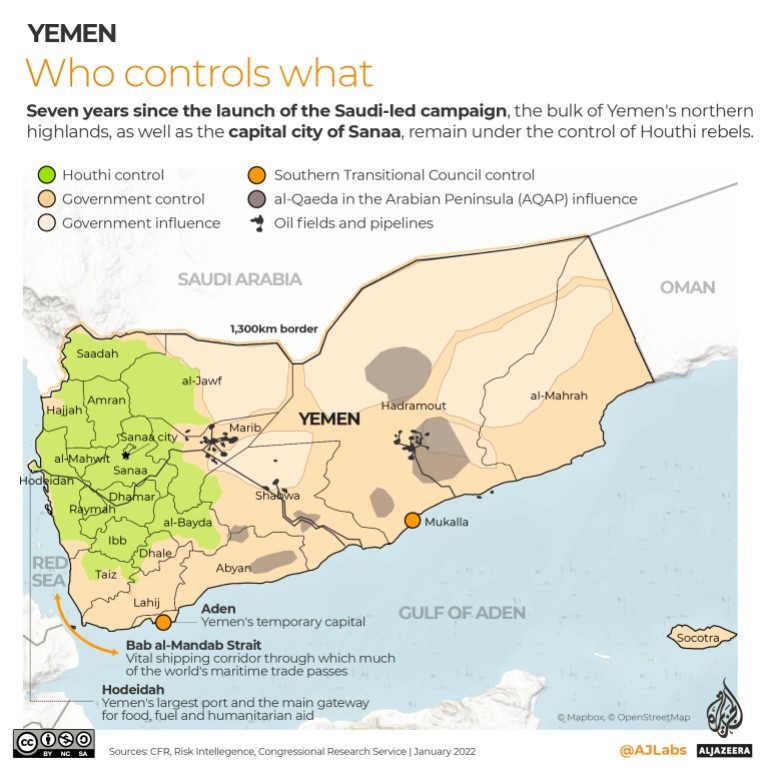
The map above, subject to creative commons, and sourced from Al-Jazeera, shows the position of the parties as at January 2022, a few months before UN mediation started between the parties to the war in April 2022, and is largely still valid.
Saudi Arabia, MBS, Vision 2030: The US will find it extremely difficult to impose its will on Ansar Allah directly. But also, consideration of broader shifts in the political environment shows that the US is likely to find – as the dust settles when the Gaza War ends – that Saudi Arabia will have moved on from where thing were in the Trump era.
In 2017, Donald Trump launched a Middle East blitz organised by his son-in-law, Jared Kushner. Kushner was a family friend of Netanyahu, who muscled Trump’s principal adviser on strategy, Steve Bannon, out of the White House. Netanyahu would regularly stay at the Kushner home on his visits to the United States. Kushner and his father Charles, who went to jail for fraud, are real estate developers. As with many of the Biden administration’s policies (attempts at neo-Keynesianism, trade war with China) Biden policies are extrapolations of Trump’s. But the structure of the India-Middle East-Europe Economic Corridor (IMEEC) or “Biden Corridor” specifically harks back to the atavistic Trump-Kushner idea that empire is not about political relations between groups but about acquiring real estate. This is a fairly crude notion of empire, but one that intersects with Israel’s far right ethnic cleansing ideas.
This particular vision of empire clearly spoke to Trump, who is also a real estate developer. He organised moving the US Embassy to Jerusalem, cancelled Obama’s July 2015 Joint Comprehensive Plan of Action (JCPOA), and brought MBS’s father, King Salman, and Egypt’s dictator, Abdelfattah Sisi, to join him in holding a glowing orb at the launch the “Abrahamic Accords:” an alliance between Israel and the Arab states aimed at destabilising Iran. The Arab countries and their populations would be physically reorganised by American, principally Jewish, real estate developers. Their form of disaster capitalism would get the backing of the cream of neoconservative ideologues, who would demonise displaced persons daring to push back… as “terrorists.” Israel, meanwhile, was ready with all the necessary technologies and methods, rigorously tested over the years on Palestinians, to deal with such recalcitrants.
Thanks principally to the miraculous Ghawar oilfield, Saudi Arabia is immensely wealthy. The constant hectoring by the Biden administration over the need for the country to go forward on “normalisation” under the Abrahamic Accords demonstrates its importance to empire, but it also betrays a nervousness about what is actually around the corner. Vision 2030 was a mere theoretical blueprint a year old, and MBS not yet formally Crown Prince, at the time of the strange Trump séance around the glowing orb (May 2017). MBS had gained (more detail later), a lot of power by March 2015 when the Yemen War started, a war that was to be in MBS ‘s charge from the start. Only after June 2017, when he became Crown Prince, did he arrest and shake down the country’s oligarchy to the last robber baron (November 2017). This included Prince Meteb, the son of the last king and head of the National Guard. MBS then launched into wholesale destruction of his opposition, including it seems the killing of Jamal Khashoggi (October 2018).
Since then, MBS has followed the logic of making Vision 2030 a reality. Saudi Arabia changed. The Trump-Kushner slum landlord approach could only deliver a playground for a new set of oligarchs to make their fortunes, this time American and Israeli ones. The sheer scale of the various elements of Vision 2030 spoke of the need to engage, as discussed above, primarily (although perhaps not only) with the Chinese state. China both as a massive oil customer, and as an aggressive bidder for construction projects in the context of the Belt and Road Initiative, is in direct conflict with the Biden Corridor. If this wasn’t enough of a wedge between it and empire, to be able to move forward, Saudi Arabia has, of necessity, come to terms with the various elements of the Axis of Resistance that surround it geographically, in particular with Iran and Ansar Allah.
The Gaza crisis has shaken Washington to the core. However things may ultimately unfold, it has blown apart the Trump-Kushner-Biden world view and all its well laid plans. The panic was best expressed by President of the European Commission Von der Leyen (on behalf of her US masters) in her speech of 18 October, where she spoke of the ‘major geopolitical implications‘ of this latest outburst of violence between Palestinians and Israelis and its dire implications for ‘the historic rapprochement between Israel and the Arab countries.’ The momentous nature of these events and the dashing of imperial dreams seem to be contributing to the fatalism infecting the Biden administration right now (see Gaza War Endgame below).
Even as the Gaza crisis unfolded, more bad news rolled out of the Gulf with Putin’s lightning December visit to Abu Dhabi and Riyadh. Everyone remembers Biden meekly visiting Saudi in 2022 to ask for oil output increases to help with the chaos his sanctions against Russia had caused, only for MBS to turn around and restrict oil output. Biden’s relationship with MBS had soured over his remarks about Khashoggi and the Saudi handling of the Yemen War. These matters might be important in the relationship between states. But the logic of this discussion points elsewhere… to the overwhelming importance of other imperatives, specifically those surrounding Vision 2030, as being the decisive factors in the future transformation of the Saudi state. If MBS now actively seeks to maintain $100 p/b oil price, to everyone’s horror, it is because those plans require higher oil revenues. And this requires the cooperation of Russia within the OPEC+ format.
The Dollar empire has been all about oil surpluses finding their way back to the United States in exchange for security and weapons. Oil surpluses are now going to find their way to China under the Belt and Road Initiative instead, which is why the large supply contracts with China can be in Yuan. The obvious question does arise, however, as to whether the stranglehold that the United States now holds on Saudi Arabia’s US manufactured weapons systems, for their management, servicing and spares, will pose a problem. What Putin came to offer, why he visited the Gulf flanked by four SU-35s, posing as the victor of the Ukraine War, was weapons: in exchange for his help on the oil price. Changing weapons systems to Russian from American manufacture, once you are tied to US supplies, is almost impossible, as Turkey has found out. Possibly what Putin intimated to MBS (from one post-neoliberal state-builder to another) was that a Turkish solution was possible. Building a quite separate spare capacity made up of Russian sourced weapons may offer leverage to recalibrate the arms trade with the US as pure business.
The meeting between MBS and Putin was quite a sober affair. In contrast, Mohamed bin Zayed (MBZ), ruler of Abu Dhabi and leader of the UAE, offered the Russian leader a full-blown state reception, sparing nothing. After Putin’s visit, MBS may ponder the advantages of the Middle East returning to a 1960s bipolar order, where the “other” pole is no longer the USSR, but is the vastly more attractive China + Russia Eurasian conglomerate that has formed in the course of the Ukraine War. MBZ, who comes over as a pillar of the unipolar world order has, on the other hand, always secretly treated the world as if it were bipolar, quite unconcerned that Western institutions disapprove and that they (oddly) call the practice… “sanctions busting.”
Of Tyranny and Freedom in the Middle East: Let us make no mistake: Saudi Arabia and the UAE are tyrannical states. But they have towed the US’s imperial line to date because there was nothing else for it. As the United States declines under the toxic and destructive leadership of corrupt and remarkably unintelligent leaders who offer no vision of a new world other than the prospect of imposing their hegemony by force, a Eurasian conglomerate arises that is economically larger, more creative, and less cringingly hypocritical. Let us make no mistake either that it is the different forces in the Middle East fighting for sovereignty against US hegemony that have coalesced under the umbrella of the Axis of Resistance that are liberating this critical region, and that allow Saudi Arabia and the UAE the room to change and to prosper. Both states, however, have worked against these liberating elements, paying scant attention for instance to the Palestinian cause over the years. Yet it is al-Aqsa Flood which will go down in history as the crucial act which finally broke the region’s chains.
***There is an important caveat to all this. Saudi Arabia and the UAE, have each lost their traditional tribal character as polities, first the UAE under MBZ and lately, as we shall see below, Saudi Arabia (quite dramatically) under MBS. They are rational bureaucratic absolute monarchies now, albeit that they depend for their character on the individual character of their rulers. For instance, in a Wikileaks cable dated 24 January 2007 of a conversation with US Undersecretary of State Nicholas Burns, we learn that MBZ has always disapproved of the idea of elections; that he thought that any political party inspired by ideas of religious origin, whether it be the Muslim Brotherhood, Hezbollah or Hamas, was dangerous and populist, and that he didn’t even trust the soldiers in his own armed forces because of their Muslim culture and education. But even MBZ admits in the cable that his brother Abdullah didn’t agree with his views. He also needs to be contrasted with Hamad bin Khalifa al-Thani, who abdicated in favour of his son, Qatar’s current ruler. His views revealed in secret tapes (only the first two videos in this sequence are relevant) released from Libyan intelligence archives after the fall of Muammar Ghaddafi, are in stark contrast with those of MBZ. In his conversations with the deceased Libyan leader, Hamad al-Thani talks about his concerns about the future of the Arab World and the need to support opposition groups, in order to guide them wisely into forming new political structures for the region, ensuring thus a soft landing for a post-monarchical world. He founded al-Jazeera in order to do this, and al-Jazeera has indeed lived up to his hopes. Where al-Jazeera has stumbled from time to time, this would only spawn new media outlets such as al-Mayadeen, founded by journalists who held different views to their editors and so left the Qatari media agency for greener pastures.
Older History: What Ansar Allah has against America and the curse of the Bush Dynasty.
It is worth repeating that the Axis of Resistance is a mutual help association and not a sort of Iranian empire. In his first speech of the war on 3 November 2023, Hezbollah leader Hassan Nasrallah clarified that the Al-Aqsa Flood action of 7 October had been a surprise to the rest of the Axis members, and even to some factions within Gaza itself. He continued the theme in his latest speech of 3 January 2024, berating those who insisted that Houthi/Ansar Allah action in the Red Sea was somehow ordered by Iran. This is the product of commentary framed according to the “Sunni vs. Shi‘a divide” promoted by academics of empire. But it has now been exploded for the myth it always was under the realism of the New Diplomacy. As mentioned earlier, Ansar Allah is the political expression of a people’s historical resentment. The advent of neoliberalism and the arrival of American oligarchs on their soil is etched in their minds as a bad thing. This is why they feel fulfilled by conducting armed confrontations with the US in the various seas around Yemen. They don’t need commands from afar when deciding to intervene on the side of justice, in the case of Gaza.
Since the ascendency of Ali Abdullah Saleh in 1978 as President of North Yemen (the Yemen Arab Republic), the transfer of power to his former vice president Hadi in 2011 (North and South Yemen had united in 1990), and until the Yemen War was initiated by Saudi Arabia and the United States in early 2015, the Yemeni people experienced waves of different kinds of economic deprivation, exploitation, and violence. Saleh and his Al-Ahmar clan lunged headlong into the neoliberal model of development crafting deals over oil reserves with members of the Hunt, Rockefeller and Bush families in the early 1980s. When Hunt Oil made discoveries of oil beds in Marib in 1984, this would be in an area populated by nomads, where there were no clear borders between North Yemen and South Yemen (the communist People’s Democratic Republic of Yemen). (Note that where oil exploration was going on in the area between Marib and Shabwa, North and South Yemen actually faced each other in a West to East direction).
Steps were taken by the Saleh régime in North Yemen to delineate property boundaries at this time, where the most startling act of all was the carving out of a new al-Jawf province out of Marib province, which left the new Marib to form a thin southern slither of land containing the oil properties that had been discovered and that would be sold as assets to oil companies. The nomadic tribes were then registered as residing in al-Jawf. The gerrymandering was naturally resisted and this resistance itself was weaponised by Saleh as the “terrorism” that became the inevitable reverse side of neoliberal globalisation’s coin, the two sides of a balance sheet, where both sides profited the régime in different ways. Even after it had been united in 1990, as still a relatively small country, the United States nevertheless made sure that Saleh’s Yemen was armed to the teeth… disproportionately: a factor that became important in its subsequent divided and violent history.
George H. W. Bush, then Reagan’s vice-president, and former head of the CIA, visited North Yemen to inaugurate Hunt Oil’s refinery there in 1986. The Bush family were steeped in the oil business from the days of Bush the elder’s grandfather, and his own connections with Middle Eastern oil were so deep that he would be called “the Saudi vice president.” All the Bush children went into the oil business. Bush family friend Ray Hunt of Hunt Oil would later use the close ties he had with Bush the younger (George W.) to make Hunt Oil one of the very first companies to drill for oil in Iraq after the end of the 2003 war, even before any licences had been organised by the Iraqi government. Be that as it may, the importance of Bush the elder to Hunt Oil in Yemen was that Hunt Oil made most of its money not by simply pumping oil, but through being a full-spectrum operator, hence the building and operating of refineries, pipelines and ports. Laying pipelines and building infrastructure in Yemen is what Bush the elder helped Ray Hunt with, when he diverted funds to Yemen from a US Export-Import Bank US-taxpayer-subsidized $1billion loan that he arranged for Saddam Hussein’s Iraq. Called “Iraqgate,” this scandal landed Bush the elder in a quandary as he decided what to do about Saddam’s invasion of Kuwait.
North and South Yemen would resolve their differences by uniting in 1990, giving Saleh the upper hand over a régime in the south based in Aden that had lost its main sponsor, the USSR. Southern leaders formed the Socialist Party (YSP) to contest elections. While YSP party policy favoured the masses a great deal more than Saleh’s neoliberal policies, they voted according to tribal affiliation and ignored policy manifestos. Saleh’s General People’s Congress (GPC) won the 1993 elections and the result was an IMF loan, and the usual austerity, poverty and mass emigration that followed. Saudi Arabia was booming and Yemenis went to work there for a pittance. They also picked up Salafi ideas whilst they were there, ideas which came back to create a new set of ideas around resistance to globalisation, a set of ideas which would get those people labelled as ‘Al-Qaeda.’ The original “terrorists” from the 1980s who were Zaydi Muslims (a form of Shi‘ism which shares little of Iran’s ideology) would eventually come to be called “Houthis” after a latter-day Zaydi revivalist from the 1990s.
More Recent History: The causes and outcomes of the Yemen War, and the creation of the modern Saudi state.
If the root causes of discontent are to be found in the older history described above, the proximate cause of more recent political change emerges in the form the Arab Spring protests of 2011 as a popular but disunited reaction to the indiscriminate violence of the Saleh régime always dressed up as counter-terrorism and backed up by American arms. The tensions in the country had escalated ever since elections which had been due in 2009 were cancelled. Then upon Saleh proposing changes to the constitution which would have consolidated his power and that of his family, massive protests erupted on 27 February 2011, leading to chaos, defections from the military, and resignations from the government, up until March 18 when Saleh loyalists opened fire on demonstrators.
At that point, Saleh’s political base started peeling away. Sheikh Sadiq al-Ahmar, the head of the Hashid tribal federation, and General Ali Muhsin al-Ahmar, declared support for the opposition, so coming into conflict with loyalist security forces in the capital. Just as he did in Egypt with Mubarak, on April 3, Obama called for Saleh’s resignation. Reflecting Saudi concerns at the instability, the Gulf Cooperation Council (GCC) sought to mediate in the conflict, but Saleh kept evading until he was severely wounded in a bombing attack on June 3. Having to go to Saudi for treatment, his vice-president, Abd Rabbu Mansour Hadi took over. But with Hadi in power, counter-revolutionary forces began bearing down on Yemen. Just as with the popular protesters, they weren’t united except on the negative principle of perpetuating the neoliberal order.
Hadi was backed by the United States, and the GCC countries, so he continued to rule although Saleh returned to Sanaa on September 3 after completing his treatment. Just as they would in all the Arab countries shaken by the Arab Spring, Saudi Arabia, Qatar and the UAE would vie for influence as Hadi pursued the neoliberal policy of untrammelled privatization. He wasn’t so much president as auctioneer. Banking, electricity, agricultural and oil sectors including infrastructure, refineries and terminals were put up for sale in an indiscriminate fashion as popular protests gathered pace and intensity. Hadi faced two additional problems, however. The first was the conflicts of interests between his backers. He incurred the UAE’s wrath, for instance, when his government cancelled Dubai Port World’s contact to manage Aden Port in 2012, citing lack of performance and a conflict of interest with its commitments to Djibouti Port.
The second was the fact that the coming to power of a Muslim Brotherhood president in Egypt, through free and fair elections, rattled MBZ. We know from the 2007 Wikileaks cable discussed above that MBZ is authoritarian, anti-democratic and allergic to Islamic populism. Furthermore, we know that he has acted on these beliefs to the farthest degree imaginable. We also know that some of his interventions in that regard have helped to change the course of Middle East politics. Most specifically, MBZ had an extremely close relationship with the highly influential figure of Khalid al-Tuwaijri, who was General Secretary of the Saudi royal court at the time of King Abdullah, and that through that contact MBZ managed to convince the King to side with the United States, the United Kingdom, Germany and Italy in backing the coup which removed Morsi from power in Egypt in July 2013.
All this would be relevant to Hadi’s future because his domestic power base in Yemen lay in the Muslim Brotherhood Party, al-Islah. Even though Hadi was Saudi Arabia’s man in Yemen, by March 2014, King Abdullah would put al-Islah on Saudi’s terrorist list. This sounds irrational, but the date is important, because it follows Hadi’s intention to federate Yemen into six autonomous regions in January 2014, which shocked the Houthi/Ansar Allah elements in the Northwestern provinces. In addition to other grievances, they began to fear a return to the inequitable distribution of oil revenues of the 1990s, and led to their take over of Sanaa by force in September 2014 holding Hadi and his ministers under house arrest. Ansar Allah had fought six wars against Saleh in their north Yemen mountain stronghold and were aligned with the broad democratic and social justice goal of the popular movements that took to the streets in 2011, of which they were the most organised element. They joined these same popular movement as they opposed Hadi’s privatizations in 2014, this time, however, in alliance with Saleh and the remnants of his loyalists. If one could see the hand of MBZ in the blacklisting of al-Islah, it is because he had convinced King Abdullah through Tuwaijri to back the return of Saleh, albeit that this meant funding the Houthi/Ansar Allah power grab to the tune of at least $1bn.
Everything changed when King Abdullah died on 23 January 2015. Tuwaijri was surprised as he sought the removal of MBS’s father, Salman, from his position as crown prince to deny him the throne. The idea was to ensure the succession of Muqrin bin Abdelaziz and to put Meteb bin Abdullah (Abdullah’s son) in the position of Crown Prince. From 31 December, Meteb and Tuwaijri fought to keep Abdulla’s desperate health condition under wraps, denying Salman access. They even enlisted Egyptian TV anchor Yousef Al-Husseini to reveal on his show that a decision would be announced, relieving Prince Salman from his position as crown prince. Al-Husseini said that such an outcome would be better for Egypt and attacked MBS for “meddling in the business of others.” However, Abdulla’s sudden death would lead Tuwaijri and Meteb to seek agreement from Salman that Muqrin be crown prince and Meteb deputy crown prince.
Salman agreed to Muqrin’s position but he put his ally, Mohamed bin Nayef bin Abdelaziz, in the position of deputy crown prince. It wasn’t long though (by 29 April 2015) before Salman shuffled the positions to remove Muqrin, promote Mohamed and put MBS in the deputy crown princeship. Tuwaijri was removed and MBS took on his responsibilities, as well as the economic and defence ministerial portfolios. The latter portfolio included the war in Yemen, which had already been launched on 26 March with MBS’s informal participation, as an urgent volte face in the policy on Yemen.
The new policy now sought defeat of Ansar Allah, which had by now seized power over the majority of Yemen through armed force. Iran had warned Ansar Allah against such a move. Salman used the occasion to call for a religious holy war against the Zaydi Shia Houthi/Ansar Allah. The manoeuvre allowed him to call the Ikhwan tribesmen traditionally loyal to the al-Saud family that make up the National Guard, to war, and this despite the fact that their leader was a disgruntled Meteb, the biggest loser in Salman’s Saudi power shake-up. Saudi Arabia had three military organisations. MBS, who controlled the Royal Guard and the Saudi Armed Forces, could now control the National Guard as well. Meteb would ultimately be arrested and shaken down with the rest of the Saudi oligarchy.
With the clergy on his side Salman reinstated all who had preached against the Egyptian coup against President Morsi and signed the proclamation declaring the coup illegal under Islamic law. Salman benefited from this as the Grand Mufti backed his call for general conscription to back up the war effort in regard to Yemen. Thus, King Salman and the Sudeiri clan’s plan to consolidate all power in MBS’s hands and the country behind him had worked. The Yemen War was not only essential for the transfer of power that had taken place in Saudi Arabia but also for the destruction of the tribal system of rule and the establishment of a rational bureaucracy and absolute monarchy. With the war started against Ansar Allah, Hadi was brought to Riyadh and the Islah Party of Yemen reinstated. MBZ had no choice but to cooperate, although that particular path wouldn’t go in a straight line. The United States had no choice but to cooperate, although Obama’s reasons for supporting the war were ironically the same reasons he gave for withdrawing from the war in Syria, protection of the soon to be signed (July 2015) JCPOA Iran nuclear deal.
The Gaza War Endgame and a delinquent American administration
The United States seems to have concluded that both the defeat of Hamas by the Israeli military (with, it might be added, the aid of special forces from the US, UK and France) is not possible. Neither is the ethnic cleansing of Gaza of its citizens, which Secretary of State Blinken was pursuing at the outset of the war. It is equally not feasible and very unlikely to happen. But the ongoing butchery is still costing Biden dear in this election year. What is Biden doing? Has he noticed?
There are indirect signals that the US wants a wind down, whether in its redeployments or in its more recent decisions on certain weapons supplies. Many state employees are resigning from their jobs in protest. But there is no serious discussion in the White House about pulling arms supplies that are being used daily to kill and harm civilians. Added to the popular disgust at the action in Gaza is outrage at the insulting spinning of ongoing civilian deaths as collateral damage. The calculation seems to be if you kill 10 civilians, 10% of them MUST be fighters, so you are killing a fighter. The brains of Israeli military planners are melting. They really want to stop the war, if the arguments between the general staff and the Israeli Cabinet are anything to go by.
Israeli politics is in stasis. Netanyahu extends the war to stay in power and avoid the jail time that awaits him. Everybody knows that. The extreme right wing cabal that he has formed with Bezalel Smotrich and Ben Gvir faces the writing on the wall. Unexpectedly it seems a new Israeli Supreme Court judgement is going to deny their attempt to establish party rule for themselves and their friends, above the law. If they are to have the Apocalypse they so desire, to ethnically cleanse Palestine of its population, it has to be now or never.
Is this what Netanyahu was trying to achieve with his order of the murder of Hamas leader, Saleh el-Arouri, yesterday (2 January 2024) in Lebanon’s capital, Beirut? Breaking protocol and infringing Lebanon’s sovereignty, was he hoping to incite Hezbollah, under whose protection el-Arouri lived, into the kind of overwhelming response that would bring the United States into the war? Or, having failed to achieve any kind of military win in Gaza, and having suffered major casualties both in Gaza and Israel’s northern border, was he just trying to score some kind of result? Any result?
If he wanted to incite Hezbollah into a rash act, he must have been disappointed with the outcome. Hassan Nasrallah, in his speech today (3 January 2024) was not taking the bait, differentiating as he did between a criminal act that would find its recompense in the field, in the normal course of events, and such new circumstances as might present an existential threat to the State of Lebanon. In the latter case, clearly, there would be all out war. But in the former case, the opportunity would simply and inevitably present itself for exacting a price from Israel for breaking the normal rules of engagement.
Israeli media is tying itself in knots trying to understand where this is all going, as indeed is the Israeli military who are waiting for instructions. The air force continue randomly killing civilians as if on autopilot: 10 civilians = 1 fighter, easy.
Iraq is in flames as is the Red Sea. The US Navy doesn’t know what to do about Ansar Allah.
The neocon magazine The Economist says that Netanyahu has to go. But what is Biden doing about it? He’s staring at humpty dumpty, knowing he can’t put him back together again. That’s what. The Middle East is lost to America.*
Gaza 25,000 unarmed civilians killed, 60,000 injured, 8,000 missing and counting. The moral sphere is lost to America.
It’s time for Biden to go. His mind has already gone. He is absent, his administration delinquent.
* P. S. (6 January 2024)
We can begin to see further changes in the Middle East Region beyond those that have been elaborated above:
(i) Ansar Allah will likely benefit from a change in its status from branded “terrorist” organisation to formally recognised representative of the Yemeni people as it attracts widespread support for its actions in the Red Sea from all factions in Yemen, beyond the support it already has from the majority of Yemen’s population. Furthermore, Saudi Arabia’s refusal to respond to US demands to act against it does constitute tacit support.
(ii) After the recent exchanges of fire between Iraqi militias supporting a Gaza ceasefire and US forces, there are now new demands from the Iraqi government for all US troops still stationed in bases in Iraq as “advisers” to leave the country. This will have knock on effects on the ability of US troops to maintain and supply its presence in Syria, which is used to support Kurdish pressure on Turkey and to give cover to the operations of ISIS or DAESH.
(iii) Hassan Nasrallah’s second speech of the week yesterday (5 January) also tells us that Israel faces a massive post-war problem in that settlers will not return to the areas bordering Lebanon, which they have vacated and which Hezbollah has completely destroyed, without a new political deal with Lebanon and Hezbollah. Nasrallah fully intends, he says, to use the opportunity to recover all the land that Israel kept after its withdrawal from Lebanon and to force Israel, should it require a security cordon, to locate that, in the future, within Israel itself
[Ref: Prt 13 Post-Script 19; info@globalshiffft.com; © 2023]
 Globalshiffft
Leave a comment