
Cold War 2.0 earns its name not least by virtue of the fact the United States is waging it on two fronts: in Europe against Russia and the Pacific against China.
In Europe, in Ukraine specifically, the US and NATO’s effort against Russia is shipwrecked. There are many who see that now damage control is vital, but establishment voices in Washington seem to be unable to come to terms with reality. The war has forced Russia into a hard “pivot to Asia” of its own, in a new alliance with China, which China’s own plans to convert its development model to one of internal demand-led growth, has given Russia a good reason to focus on its economy. This has turned Russia’s strategy in Ukraine from one initially focused on dismantling the gun platform established there and aimed at its head, to one of a defence in depth that promises to be both impenetrable and asymmetric, in order to protect its economy and society. The southeast of Ukraine has thus become a shock absorber of sorts for the Russian Federation, although the rest of Ukraine promises to become a wasteland if the United States continues to live in denial. But if the Washington establishment understood little of Russia’s initial strategy, it doesn’t understand the new turn either. This isn’t the first time that the US foreign policy establishment has suffered from delusions. Roosevelt and Truman were convinced by their advisers that Chiang Kai-sheck was in complete control of China, until 1949. Contrary advice was available from able analysts, but it was interpreted as wishful thinking and communist advocacy.[1]
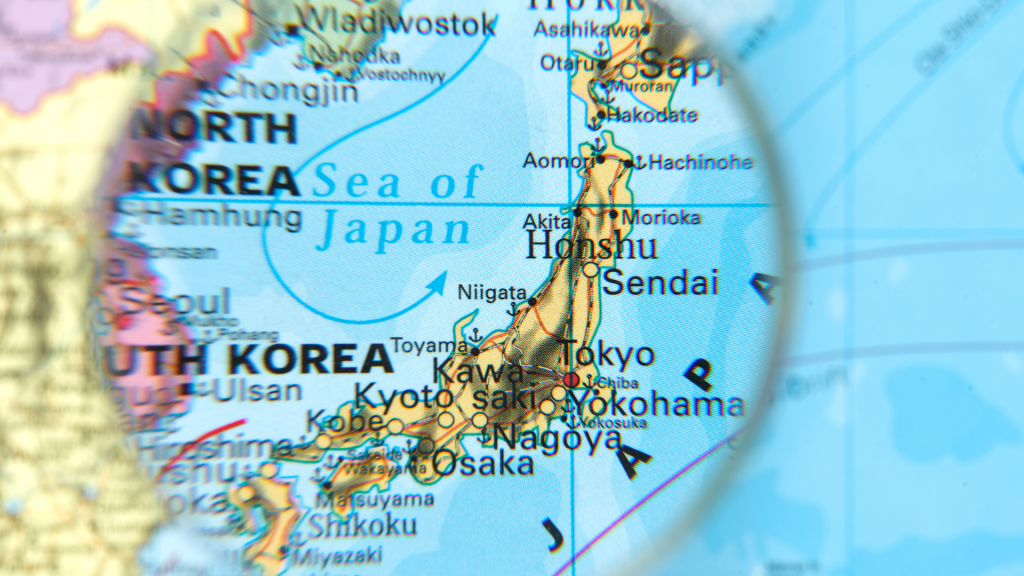
In the Pacific, on the other hand, the US strategy depends on continuing its perennial alliance with Japan’s Liberal Democratic Party (LDP) in its face-off with China. The aggressive stance towards China is leveraged on what are essentially three barren rocks and five uninhabited islets in the East China Sea called the Senkaku Islands. If defending these rocks seems like somewhat of a strained argument for war, the opposition Democratic Party of Japan (DJP) rejected this very argument when it came to power in a landslide in the 2009 elections, on the platform of seeking a closer “fraternal” alliance with China. The Obama administration would be instrumental in scuttling the DJP government in the first of many coups engineered in the course of the 2010s. But, unlike in Ukraine, Washington wouldn’t need to resort to far right thugs to topple this government. More staid bureaucratic figures would take on that role. Japan is ruled by a bureaucratic élite, which is institutionally, even biologically, descended from the Samurai families of the Tokugawa Shogunate.[2] It has survived both the Meiji and the postwar régime changes. The DJP would thus seek to dismantle its power at its peril, reaping the whirlwind in a reprise of the alliance of convenience between that élite and the US that was sealed in the 1950s.
This Faustian alliance came as America smarted from the shock of Mao’s Communist victory in China. The shock led to the visceral reaction in Washington circles that somehow China had been ‘lost,’ and their unfounded belief that those analysts like John Paton Davies who had predicted Mao’s victory, had in fact engineered it. This began the McCarthy era. It also led to America’s fascist “turn” in Cold War 1.0. Kishi Nobusuke, the ex-economic czar of Japan’s Chinese colony of Manchukuo, was tasked with launching the LDP with CIA funds in 1955 for the express purpose of purging the left voices that dominated political opinion in Japan at the time. Despite the nationalist sensibilities of Kishi and his cohorts, Japan was turned into a US protectorate against the will of its people, for which the US would pay a heavy price, allowing Japan’s commercial cartels the freedom to compete aggressively in the US market without the need to open up their own markets, and do so thus at the expense of much of American industry. Arguably these events would set the scene of the later search for cheaper labour by American industry in their drive to outsource, and thus usher in the neoliberal order. Kishi’s arcane arrangements, meanwhile, turned Japan into a single-party state, despite its democratic trappings, and gave the LDP the tools to enable it to dispatch its enemies to oblivion with extraordinary efficiency, which is what it did with the DJP in 2009.
The DJP government limped on as one leader after another was brought down during that year and the next, each one forced to renege on core policies, leading to their eventual rout at the polls, as a betrayed and outraged electorate stayed home. It was Kishi’s grandson, Abe Shinzo, who eventually lead the LDP back to power on a slender 29% of the popular vote. Abe would be fixated on rehabilitating his class, calling the Manchukuo mandate glorious, and praying at the Yasukuni shrine, which memorializes the souls of millions of Japan’s war dead, but also those of fourteen Class A convicted war criminals enshrined there in 1979 by right-wing priests. Upon his accession to power, Abe sought to militarise Japan and to repeal Article 9 of the Constitution, which outlaws war as a method of dispute settlement, and which the US deeply regretted forcing on Japan before its pro-fascist “turn” in Cold War 1.0. Since then, the dream long haboured by the Pentagon of a Japanese military “interoperable” with US forces, in other words, under one command, adopted as policy by Abe, would become reality under his disciple and successor, Kishida Fumio. Kishida recently signed a new “alliance”anti-China” pact with the US on behalf of Japan. Meanwhile, the US suffers, it seems, yet further delusions, imagining that a Pacific version of NATO can be erected that includes both South Korea, and a militaristic régime in Japan that is unapologetic for the events of the 1930s.
But that is the least of the US administration’s delusions because there are problems on this score in Japan itself. Abe may have been able to reinterpret Article 9 to allow so-called ‘collective self-defence’ as the road to militarisation. But given the lack of popular support which has barred repeal of the article, and which is the reason for relying on interpretation for this new policy, the risk of a future legislative reversal always remains. [3] The risk is very high not least because the LDP is incapable of delivering economic prosperity to the Japanese. Abe sought to buy popular support for his unpopular policies as his grandfather had done, by generating an economic boom. But much has changed since the Reagan administration challenged Japanese economic dominance by establishing the Plaza Accords in 1985, forcing a Yen revaluation (along with a revaluation of all the currencies of America’s trading partners), to bring Japanese growth to an abrupt stop. The Japanese Ministry of Finance (MoF) sought to remedy this situation by engineering an asset price boom in stock and real estate prices in Japan to compensate Japanese companies for the loss of profits they suffered as a result of Yen appreciation. But there would be no equivalent response in the real economy to the mountains of debt created under this policy of monetary expansion. No restructuring was undertaken for an economy reliant on exports, so the domestic earnings and wages weren’t forthcoming that could sustain the new asset price levels. The inevitable crash of 1991 led to two decades of recession. For Abe, in the 2010s, overcoming this with a return to the US market to generate growth would be exceptionally difficult given the march that US and South Korean companies had stolen on Japan in the personal computer and mobile phone sectors by then. Japanese industry had been relegated to producing only the intermediate goods and tools necessary in the production of new digital products. Abe was also blocked on the domestic economy because the MoF, to which he was beholden for his return to power, was fixated on reducing a long-term inherited budget deficit and insistent on its policy of austerity.
The kind of internal demand-led growth China is now pursuing was therefore out of bounds to Abe and continues to be so under Kishida. “Abenomics,” as it was called, was a desperate attempt to reflate the economy with endless money infusion, but the outcome in the face of weak internal demand and bureaucratic interference was inevitably a new asset price boom and a régime of capital exports to the United States that became the linchpin of the neoliberal world disorder. In the process, Japan overtook China as the biggest buyer in the world of US Treasury debt. [4] Such real growth as Japan did experience in the 2010s was in fact driven by capital goods exports to China. So, the question arises as to whether Kishida’s militarism and his new anti-China alliance with the US is not in fact driving a final nail in Japan’s economic coffin. The country had at one point adopted the name of Nihon (or Nippon), ‘the land of the rising sun,’ specifically to mirror the name China had given it of Ji-pang (or Zu-pang), which meant ‘the sun’s origin’. But the sun seems now to have set on Japan. If we live in a time when populations are generally at odds with their political classes, nowhere comes close to emulating the passive aggressive behaviour of the Japanese people towards their politicians. The Japanese seem to have lost interest in voting, consuming, and even in marrying, or indeed having children, and are increasingly more interested in organising acts of collective disobedience. Can Japan’s hidebound élite survive this in the long term?
At both sharp ends of Cold War 2.0, Ukraine and Japan, we see different kinds of devastation, and in both cases the story we follow today begins with one or another kind of coup aided and abetted by the Obama administration against the democratic process. (There was also, by the way, a third coup blatantly aided and abetted by the Obama administration in 2013 in Egypt which brought the Arab Spring to an end, which I actively wrote about between 2013 and 2015.[5])
The shipwreck that is the Ukraine Front: General Mark Milley, currently Chairman of the Joint Chiefs of Staff of the US armed forces, said on 17 November last year, before he was contradicted by a White House staff concerned solely with passing a record military budget through Congress, that things are going extremely badly for Ukraine, and that some kind of armistice with Russia was necessary, if not urgent.[6] Condoleezza Rice (US Secretary of State 2005-9), and Robert Gates (US Secretary of Defence 2006-11), in their Washington Post article of 7 January, repeated Milley’s assessment of a general economic, infrastructural and military collapse in Ukraine, but reached entirely different conclusions, namely that a massive arms escalation was necessary to support Ukraine’s “heroic” efforts and to stunt not Russia’s but, according to them, Vladimir Putin’s territorial ambitions.[7] Brigadier General Erich Vad, recently retired military advisor to Chancellor Angela Merkel, in an interview with German media on 13 January,[8] said that a Ukrainian military defeat was inevitable, and that an armistice was urgent. But then he added a completely new twist to the narrative. Vad said that defeat in Ukraine would not only deal an incalculable blow to NATO prestige, but the extent to which the Ukraine régime has been lionised by the media, and Russia demonised, meant that such defeat would produce a political shock. Scales would fall from people’s eyes, and an anti-American backlash in the empire’s European heartland would follow.[9]
Why are two military officers, one American, the other German, urging a cessation of hostilities, whilst two civilians, both American, urge massive escalation, based on an assessment of the same facts? The crucial difference is that the two civilians, Rice and Gates, premise their entire argument, delivered from their armchairs, on knowledge they think they innately possess, when they say, ‘both of us have dealt with Putin on a number of occasions…’. Actually, both are trapped by the delusional narrative of Western media General Vad pointed out has created the kind of alternative reality that, if burst by the pinprick of real, visible defeat, is liable to lead to revolution in his country. Rice and Gates insist that they have personal knowledge that, as they say, ‘Vladimir Putin remains fully committed to bringing all of Ukraine back under Russian control or — failing that — destroying it as a viable country.’ Russian policy is thus apparently only what Putin wants, and to boot Putin acts from the motives of a spoiled child. For these reasons, they continue, it is necessary to ‘urgently provide Ukraine with a dramatic increase in military supplies and capability — sufficient to deter a renewed Russian offensive…’ But this prospect is not on Putin’s mind at all. Many voices in the state Duma (for instance in the A Just Russia and Communist parties) are highly critical of Putin for what they call his half-hearted commitment to the war. Having survived the most extreme sanctions ever levelled by the United States on any country, Putin and his advisors are more concerned with preserving economic normality and prosperity in Russia, than they are ramping up the war. As he just said to the Defence Board:
‘We will not repeat the [Soviet] mistakes of the past, when we harmed our economy to boost our defence capabilities, regardless of whether it was warranted or not. We are not going to militarise our country or militarise the economy, primarily because we have no need to do it at the current level of development and with the structure of the economy that we have.’[10]
In saying this, Putin isn’t wishful thinking. Russia is lucky to be basking in the sun of China’s transformation, positioned as it is at the core of Xi Jinping’s Belt and Road Initiative. His interlocutors at the Valdai Discussion Club, at the St. Petersburg International Economic Forum, and in the lobby for those oligarchs that remain committed to the domestic Russian economy, known as the Russian Union of Industrialists and Entrepreneurs (RUIE), are telling him to grasp the opportunity with both hands and to ignore the war party. One of the leaders of the war party, by the way, is Sergei Glazyev. Glazyev used to advise Putin, and his absence from the Russia’s leader’s side tells the tale in of itself.
Dimitri Medvedev, in his capacity then of Russian president, began in 2008 what Putin would later continue: [11] the habit of regularly tabling proposals for discussion with the United States for the development of a new European security architecture.[12] The annexation of Ukraine was not part of any of those proposals, although keeping Ukraine out of NATO was. The United States ignored every single one of those efforts, treating Russia as an annoying supplicant that didn’t deserve a cogent answer to its proposals. We can call this pursuit of negotiations, stage one of Russian policy on Ukraine, the first of three distinct stages of in the development of Russian policy over Ukraine.
There were some negotiations that the Europeans did in fact pursue (without the explicit presence of the Americans), when the February 2014 Maidan coup was followed by the Minsk I (5 September 2014) and II (12 February 2015) agreements between Russia, Ukraine and the Organization for Security and Cooperation in Europe (OSCE). These agreements were meant to stop the fighting between the Kiev régime and the rebels of the Russian-speaking provinces of the Donbas, who rejected the coup government in Kiev, and were mediated by Germany and France. But these negotiations, it turns out were not what they seemed. In fact, the reason why the Minsk agreements never worked was laid bare by German ex-Chancellor Angela Merkel on 7 December,[13] and by French ex-President François Hollande on 28 December.[14] Both leaders stated that those agreements were signed not with any intention of securing peace with Russia, but as a ruse to give Ukraine the breathing space to turn itself into a fully armed gun platform aimed at Russia, with NATO’s help. Russia was considered not worthy of diplomatic engagement and considered fair game for the worst kind of duplicitous behaviour in diplomatic history. The question is why?
The answer that is usually given is that Ukraine is a free and independent nation, that Russia is governed by an autocrat – Putin – and that not even the slightest demands by a régime like the Russian one are worthy of the West’s time of day. But this is where the delusional Western narrative about Ukraine begins. What is “free” and “independent,” about a nation whose freely and democratically elected leader, Victor Yanukovych, is overthrown in a coup micromanaged by the Obama administration.[15] Yanukovych had agreed to early elections when disputes arose about Ukraine’s agreement with the EU. Instead of waiting for elections, the US State Department helped is his violent replacement by leaders of a narrow right wing faction, who immediately turned around to attack the ethnic Russian communities of the Donbas that comprised some 25% of the country’s population. And just as a so-called “free” and “independent” Ukraine is a manufactured product of the American and Western imagination, so is the “heroic” Ukraine that is being fed, with a gun to it head, into what is essentially a Russian meat-grinder on the war’s front lines. The whole Rice-Gates argument is, astonishingly, that much more force should be applied to this frightful and failing process. But why?
For Rice-Gates, the Russian army is simply a barbarian horde. The whole Western narrative on Ukraine is about not listening to Russia, not seeing the facts, not understanding Russian intentions, repeating the mistakes of the Roosevelt and Truman administrations in China. When Putin announced the invasion of eastern Ukraine, he called it a “special military operation.” This military surgery could be called the stage two of Russian policy towards Ukraine. It’s intent was to “demilitarise” Ukraine, in other words to knobble the gun platform that had been built over eight years (2014-22) targeting Russia. The area of Ukraine currently under Russian control, which Russia has now formally annexed, is roughly the area that was acquired in the early weeks of the war. The early Kiev offensive was a feint intended to minimise opposition to Russian advances in the south east. Once ensconced there within a week of the invasion, Putin called for peace talks, and pulled out of the Kiev area ahead of the fourth round of talks that were held in Istanbul on 14 March 2022. Stage two had a negotiating content – up to a point. When the talks failed, however, the Russians simply put their meat-grinder in place. This involved the very ordinary, conventional mass industrial warfare that Russia would surprise the Pentagon with, and that consisted of relentless artillery barrages on a scale not ever seen.[16] The entire strategy was focused on degrading the Ukrainian military, with territory taken and ceded with the only purpose of inflicting maximum damage. In such a scenario, Russian losses were never going to approach those suffered by Ukrainian armed forces committed to holding onto land and withstanding long sieges. Most significantly, a daily report of Ukrainian losses became the daily fare in this hideous resurrection of WWI. It has to be said that the most unusual part of this war has been the daily fare of Russian Ministry of Defence reports on the gruesome progress of this “demilitarisation.”[17] What the Milley-Vad commentary sees clearly is the point just made – that any territory gained or ceded in Ukraine by Russia has been and will continue to be merely an instrument used for the destruction of Ukrainian military capability.
The Milley-Vad commentary is opposed to escalation and calls for an armistice. How will this be possible? Putin’s New Year’s address to the nation, broadcast on 30 December, tells us that ‘Russian servicemen, militiamen and volunteers are now fighting for,’ among other things, ‘reliable guarantees of peace and Russia’s security.[18] Duplicity has a cost. The US and NATO will have to find a way to climb down from their tree and agree to a demilitarised zone (DMZ) of considerable proportions for an armistice to be reached at all. The US security state now frequently tables ideas for armistice and a DMZ in Ukraine seeking a face saving way out of the morass it didn’t plan for.[19] Its sanctions failed to bring down the Putin government, and its plan to weaken Russia isn’t working. Attempts to exit started in earnest with Jake Sullivan’s visit to Ukraine in early November last year,[20] and the most recent effort was contained in David Ignatius’ coded message in the Washington Post from Tony Blinken to the Russian leadership published on 25 January.[21] These messages always couched in the propaganda and language of Russian defeat and are consequenty routinely ignored or rejected outright by the Russians. As things stand, Russia it seems will no longer accept terms less than total surrender and the withdrawal of NATO troops to pre-1998 positions.
Barring that, Russia is in the process of unilaterally creating its own DMZ. As a recent statement by the Russian Ministry of Foreign Affairs made clear as part of a long briefing, ‘… given that all negotiations have been terminated by Ukraine, this issue [what will happen] will be resolved on the ground.’[22] Biden’s ‘as long as it lasts strategy,’ the involvement of Polish and Romanian troops, NATO special forces, the continual promises of additional weapons, and commentary of an aggressive nature such as that of Rice-Gates, has meant that Russian missile attacks have been added to the meat grinder on the front line, to degrade supply, transport, and energy facilities behind the front lines. Meanwhile, the Russian shoals against which Western efforts keep crashing in Ukraine are being continually strengthened. Fortifications in depth where the Dnieper river doesn’t offer protection have been built. The Defence Ministry Board meeting on 21 December emphasised the importance of this ‘building of fortifications’, in view of the fact that ‘capabilities of almost all major NATO countries are being widely used against Russia…’.[23]
Thus defence in depth to include the creation of a country-wide wasteland behind the front lines has become stage three of Russian policy in Ukraine. The recent recruitment of 300,000 reservists in Russia, followed by the planned increase in Russia’s professional army by half a million soldiers, has many commentators envisaging a future grand invasion. But this will never come. The new forces are intended to man the defensive posture in depth that that will cover the entire of Ukraine and protects Russia’s new focus on its economy and social development. Furthermore, the simultaneous incorporation of the Belarussian armed forces into the Russian military system has many also imagining an invasion of Kiev from the north. But that also will never come. Russia is simply returning NATO’s Ukrainian favour by building a new gun platform in Belarus targeting Europe, where Russian nuclear missiles will also be stationed. Planning for a ‘renewed Russian offensive,’ which the Rice-Gates commentary calls for, is a rallying cry to keep the barbarians from the city gates. Except that the barbarians have already come, are ensconced within the city walls, and are in the process of turning the entire country into their buffer zone, as America tries desperately to figure out ways of turning the hot war into a cold one.
While Russia continues successfully to restructure its economy and pivot to Asia, its currency – the Ruble (currently on 22 January 2023 at 68.39 = $1) is trading higher than its rate on 22 January 2022 (77.94=$1), before the war, as the Russian Central Bank begins gradually lifting restrictions on capital movements in order to enhance commercial activity.[24] This is the mark of an economy that seems to be able to shrug off a war on its western borders at which NATO is now throwing everything it can to help the Ukrainian army.
The remarks of Brigadier Vad on the delusional Western narrative that risks bursting as the Ukrainian army sinks under the weight of its new arms supplies are instructive. The narrative spinning Russian defeat is indeed fit now to burst. Vad, who wanted to name and shame politicians during his interview, couldn’t have said any of this to Germany’s news and political media. His article appears, instead, in a Cologne feminist magazine, Emma, that is exploiting the yawning gap in the German opinion market.[25] The Springer and Bertelsmann groups that control German news media have always prioritised a commitment to Atlanticism over journalism in their mission statements. Their propaganda is currently mesmerising the nation.
Even more instructive are the criticisms by realist political scientists of the neoconservative doctrine that underscores the anachronistic Bush-Cheney era commentary of Rice-Gates.[26] John Mearsheimer’s realism can be paraphrased by stating Newton’s third law of motion. For every (American) action, there must be an equal and opposite (Russian) reaction. But neoconservatism was never really a political philosophy. Anne Norton relates her time as a student attending the seminars of neoconservatives at university and rates the doctrine essentially as the day dreams of ‘larger, softer men with soft white hands that never held a gun or changed a tire, [and who] delivered disquisitions on manliness.’[27] These soft men must have been astonished in the 1990s to find their intellectual drivel suddenly prized by hard core arms salesmen like Norman Augustine and Bruce P. Jackson at the newly merged behemoth, Lockheed-Martin, that was facing a slump in sales, after the shock ending of Cold War 1.0.[28]
On the rocks claimed by Japan on the Pacific Front: On January 11 we had announcements in Washington from Anthony Blinken and Japanese ministers Hayashi Yoshimasa (Foreign Affairs) and Hamada Yasukazu (Defence), [29] about a new ‘security partnership’ that whitewashes what is effectively Japanese vassalage as a US-Japanese ‘alliance,’ and takes it now onto a fully-fledged war footing. The ministers announced what they called a ‘modernized Alliance postured to prevail in a new era of strategic competition.’ The enemy is predictably China, whose ‘growing political, economic, military, and technological power,’ is said to be ‘of serious concern to the Alliance and the entire international community,’ which is another name for the American empire.[30]
Not to be outdone by the “friendship without limits” between China and Russia (4 February 2022), on 13 January, the White House announced a new ‘unprecedented cooperation’ with Japan, at a ‘historic moment,’ referring to the expansion of Cold War 2.0 now into East Asia. Prime Minister and leader of the LDP, Kishida Fumio, was visiting Joe Biden in the White House. This was the final leg in a tour of the G7 countries Kishida was making, having just announced a doubling of defence expenditure in the next budget to 2% of GDP, to cement the militaristic policy of his mentor, Abe Shinzo. At the minister’s briefing, US Defence Secretary Lloyd Austin articulated the Pentagon’s ‘commitment to interoperability’, which is code for subjugation of Japanese military doctrine to US practice and command. A question from a reporter from the Asahi Shimbun newspaper as to how the ‘Alliance command and control relationship between U.S. and Japan’ would be structured, was carefully glossed over in the press conference.
Japan is becoming an imperial gun platform targeting China in Cold War 2.0, like Ukraine in regard to Russia, until that is, Russia started dismantling it. The weight of history is dragging Japan in this direction. In echoes of the Faustian deals struck in the 1950s between Kishi and the US occupation authorities, agreements were signed at the White House between Kishida and Biden that would see Japan now ‘fundamentally reinforcing its defense capabilities.’ [31] But in the January 13 agreement, reinforcing defence capabilities means the purchase by Japan of long range cruise missiles US Congress has budgeted to build in its FY 2023 $858bn military budget.
What are the prospects, then, for this Japanese gun platform? Since long range cruise missiles are actually offensive weapons, the idea that the whole ‘security partnership’ between the US and Japan is to be premised on the defence of Senkaku Islands is rubbish. On 23 May 2022, after an eighteen year tussle, and a final Japanese Supreme Court judgement that overruled massive popular Japanese opposition expressed in poll after poll, and gritty local Okinawan protests that are still ongoing, an agreement was signed to relocate the Futenma US Marine Corps Air Station base to the pristine, ecologically extremely sensitive, Henoko Bay in Okinawa.[32] The Dugongs of Henoko Bay will be replaced by cruise missiles aimed directly at China.
Maintaining US hegemony in the Pacific is the real reason for the US military presence. But the argument was made in 2009, by the DJP government of Hatoyama Yukio, that this presence wasn’t necessary if the US-Japan relationship were recalibrated as a ‘relationship of equals.’ Japan could easily help the US keep the peace in the Pacific as a sovereign nation, without any of the marks of vassalage, such as military bases for which the Japanese taxpayer is forced to pay an annual $4bn “reverse rent”. Hatoyama became prime minister and the “change candidate” for Japan, ironically, at the same time as Obama. Under the aegis of Ozawa Ichirō, the DJP had developed a programme in opposition to the LDP that antagonised the ruling bureaucratic élite. Ozawa was a powerful political operator, who was the first person in a long time to challenge the post-war LDP hegemonic system Kishi had set up.[33]
Kishi’s deal with the US in the 1950s was no less than an institutional revolution that established a US protectorate, complete with US military bases, against the very vocal wishes of the population, in exchange for the US offer of an unlimited external market for Japanese companies. The deal enabled Kishi to create the class of lifelong salarymen in those companies, as a method of defanging Japan’s powerful unions. Most significantly for the power of the LDP, he harnessed the police, the justice department, and the broadsheet press as adjuncts of a legislature under its control. Scandalmongering by the public prosecutor amplified by the establishment press became a routine method of dispatching enemies. This is what happened to Ozawa. As the polls showed a landslide for the DJP at the August 2009 elections, Ozawa was saddled with “investigations” of one kind or another into his finances, forcing him to cede leadership of the party to Hatoyama, who unfortunately wasn’t as battle hardened an operator as his mentor.
Ozawa’s plan to create a National Strategy Bureau in charge of government policy, reporting directly to the prime minister had particularly angered the bureaucracy.[34] The DJP came to power with 308 seats to the LDP’s 119 seats on campaign promises to establish a social-welfare safety net Scandinavian style, and to reduce consumption taxes. But it was on the promises of a new relationship with China, and an end to US military bases in Okinawa that Hatoyama would be publicly and viciously attacked. Hatoyama declared in a major foreign policy speech that, after the experience of the Iraq war and the Great Financial Crash, America’s unipolar moment had ended, and that Japan now had to live with its neighbours in an “East Asian community” based on the concept of ‘fraternity’.[35] He defanged the Senkaku argument for a US military presence in Japan, when he said that, according to the principle of fraternity, ‘the islands belonged to everyone.’ For the Americans, this was unforgiveable. Worse still, at a tri-lateral meeting in Beijing in early October 2009, Hatoyama told Chinese premier, Wen Jiabao, and South Korean leader, Lee Myung-bak, that ‘Japan has so far depended on the US too much.’[36]
But Washington’s alarm bells rang loudest, when Ozawa, in his capacity now as secretary general of the DJP, took a delegation of 140 lawmakers and 300 entrepreneurs to China the following December, vowing in a meeting with Hu Jintao to develop close and friendly relations between the two countries.[37] US Deputy Assistant Secretary of State for East Asia Richard Armitage would voice his annoyance in a public forum in January 2010 over, what he called, the ‘drift in the US-Japanese alliance.’ He was particularly scathing about the visit to China of Japanese politicians, he said, ‘who hadn’t visited the US in ten years,’ ridiculing Ozawa’s delegation by referring to it as ‘the Japanese Liberation Army.’[38] During Ozawa’s visit to Beijing, Hatoyama received the prospective successor to the Chinese leadership, Xi Jinping, in Tokyo and introduced him to Emperor Akihito. By that stage, the pressure on Hatoyama was beginning to tell and he began to waver. As the US foreign policy establishment rounded on him, the Washington Post led the charge calling him ‘hapless’ and ‘loopy’. The Japanese Foreign and Defence Ministries organised broadsides in the Asahi Shimbun which described Hatoyama’s approach as ‘waffling and dithering,’ condemning his ‘betrayal’ of the Okinawan people and blaming him for making Washington ‘distrustful’ of Tokyo.[39] Eventually, after being brutally snubbed at the Nuclear Non-Proliferation summit in Washington in April 2010, Hatoyama’s premiership unravelled. He caved in to the pressure, agreeing to the Henoko relocation of the Futenma Marine base and resigning on 2 June. The Obama administration demanded Ozawa’s resignation as secretary general of the DJP as well, and this duly followed.
Fury in China at these developments led to new combative stance in its relations with the US and Japan. Three months after Hatoyama’s and Ozawa’s resignations, on 7 September, a Chinese fishing trawler rammed a Japanese coast guard vessel, in a typical Chinese action that sought to establish ‘facts on the ground,’ in this case, over fishing rights around the Senkaku Islands, which were being held off limits by the Japanese navy. Japanese naval officers arrested the crew of the trawler, who were then held in a police station over a three week period, during which China used its commercial leverage over Japan to have the crew released. The United States foreign policy establishment raised a hue and cry over the so-called Mizuki incident, named after the Japanese patrol boat, calling it a humiliation of Japan.[40] The incident was weaponised to bolster the American position in the negotiations over the relocation of the Futenma military base. China was, after all, the ogre everybody said it was. For China, on the other hand, this was a simple message to new Prime Minister Kan Naoto: Tokyo would remain a US vassal or it could have good profitable relations with China. But Kan had already chosen his course when he announced the beginning of the landfill of Oura Bay in Okinawa to accommodate the expansion of Camp Schwab and was rewarded with a photo-op standing beside Obama sporting his signature grin, at the Toronto G-20 summit (June 2010).
The US/LDP hegemony in Japan is built on sand. The Japanese people would turn it over in a second, given half a chance. Take Okinawa as an example. Totally impervious to the bribe money Abe showered on their community, the Okinawans brought an Ozawa ally, Tamaki Deni, to power in October 2018 as Governor, on a platform of resistance to the relocation of the Futenma Marine base. He was also caught saying that he didn’t see any reason why the Chinese shouldn’t fish the Senkaku Islands. The fight isn’t quite finished. In Japan, democracy oddly manages to survive, albeit hamstrung. Meanwhile, in Ukraine, opposition parties are banned, and, as in Germany, except in niche magazines like Emma, debate on the ongoing slaughter is not possible. The delusions of political élites cannot be brought into the light of day.
South Korea: In another bout of blind imperiousness, the US wants to bring NATO to the Pacific by allying Japan with South Korea, irrespective of Korean sensibilities.[41] South Korea’s new president, Yoon Suk-yeol, hailing from the right-wing populist People’s Power Party (PPP), avoided meeting with Nancy Pelosi on her visit to Seoul, after her controversial stay in Taiwan on 2 August 2022 intended to snub China. For his trouble, in a reference to Biden’s 21 December 2021 deeply ironic “Summit for Democracy,” Yoon was roundly castigated by regional pro-American media for letting down “Team democracy.”[42] These reprimands didn’t stop Yoon and his party from announcing their “Indo-Pacific strategy” on 28 December 2022, which stated in so uncertain terms that with ‘China, a key partner for achieving prosperity and peace in the Indo-Pacific region, we will nurture a sounder and more mature relationship as we pursue shared interests based on mutual respect and reciprocity, guided by international norms and rules.’[43] In contrast, where South Korea says it will ‘pursue shared interests’ with China ‘based on mutual respect and reciprocity,’ the text is much more cautious in regard to the new militaristic Japan. With Japan, there would simply be an intent to continue ‘diplomatic efforts to restore mutual trust and advance relations.’ NATO leadership in a recent visit to Seoul spun the idea that in exchange for help with North Korea, South Korea could help NATO with Ukraine, and form a front against future unnamed threats from China. But even in a Q & A in which NATO leader Jens Stoltenberg was thrown softball questions by Korean students, it wasn’t clear why South Korea needed NATO’s help with North Korea, what interest South Korea had in helping Ukraine, and why South Korea should compromise its considerable economic interests with China, if China hadn’t done anything to South Korea to warrant an antagonistic stance on its part.[44] East Asian nations tend to be polite listeners, but they understand their interests better than anyone.
Xi Jinping is right in his approach to war in the Pacific. It is an economic war. Violence on a large scale is seen as unproductive. Where military power is necessary as an expression of economic power, all you need is daft people like Nancy Pelosi to give you half a chance to put your military power on full display for all to see. But war as such should be avoided. Taiwan it is expected will eventually fall to China’s economic embrace. The enormous economic benefits of working with China will not only condition South Korean, but also Taiwanese policy in the long term. Cold War 2.0 pits a United States which passed its unipolar moment in the Great Financial Crash of 2008 and whose government deficit to GDP ratio at 6% is at the same level it was at the height of the Vietnam war, against a growing Eurasian economy. In this economy, China – the largest manufacturer and exporter in the world – and Russia – the largest source of raw materials, energy and wheat – are now politically allied. But most problematic for the budding expansion of NATO in the Asian Pacific is actually the total collapse of its prestige in Ukraine shipwreck. Military weakness unmasked fatally undermines those efforts.
[1] https://www.washingtonexaminer.com/weekly-standard/how-china-was-lost
[2] Clark, Gregory and Tatsuya Ishii. 2012. Social Mobility in Japan, 1864–2012: The Surprising Persistence of the Samurai. University of California, Davis at https://www.semanticscholar.org/paper/Social-Mobility-in-Japan%2C-1868-2012%3A-The-Surprising-Clark-Ishii/0d2c7d3041619c3d0549590d77721ca3f2367473.
[3] Richter, Jeffrey P. 2016. Japan’s “Reinterpretation” of Article 9: A Pyrrhic Victory for American Foreign Policy? Iowa Law Review 101 (3): 1223-1262 at https://ilr.law.uiowa.edu/print/volume-101-issue-3/japans-reinterpretation-of-article-9-a-pyrrhic-victory-for-american-foreign-policy.
[4] https://ticdata.treasury.gov/Publish/mfh.txt
[5] https://www.counterpunch.org/2015/02/26/the-cairo-fiasco-and-the-bonfire-of-liberal-values/
[6] https://youtu.be/eoxCo1mXzEE
[7] https://www.washingtonpost.com/opinions/2023/01/07/condoleezza-rice-robert-gates-ukraine-repel-russia/
[8] https://www.emma.de/artikel/erich-vad-was-sind-die-kriegsziele-340045
[9] http://johnhelmer.net/german-general-tells-us-generals-to-lose-the-ukraine-war-as-soon-as-possible-to-prevent-losing-the-empire-in-europe/#more-70493
[10] http://en.kremlin.ru/events/president/news/70159
[11] Lomagin, Nikita. Medvedev’s ‘Fourteen Points”: Russia’s Proposal for a New European Security Architecture. In Russian Foreign Policy in the 21st Century. Roger E. Kanet ed. 181-203. Basingstoke, HANTS and New York: Palgrave Macmillan.
[12] https://edam.org.tr/en/russia-proposes-a-new-security-architecture-in-europe-and-beyond/
[13] https://tass.com/world/1547141
[14] https://kyivindependent.com/national/hollande-there-will-only-be-a-way-out-of-the-conflict-when-russia-fails-on-the-ground
[15] https://www.cato.org/commentary/americas-ukraine-hypocrisy#
[16] https://www.rusi.org/explore-our-research/publications/commentary/return-industrial-warfare
[17] https://www.youtube.com/channel/UCUnc496-PPmFZVKlYxUnToA
[18] http://en.kremlin.ru/events/president/news/70315
[19] Listen to John Helmer in this podcast starting at minute 17, https://tntradiolive.podbean.com/e/john-helmer-with-jeremy-beck-26-january-2023/
[20] https://www.reuters.com/world/europe/white-houses-sullivan-visits-kyiv-says-unwavering-support-continue-2022-11-04/
[21] https://www.washingtonpost.com/opinions/2023/01/24/blinken-ponders-post-ukraine-war-order/
[22] https://www.youtube.com/watch?v=SLQkgKED0LI
[23] http://en.kremlin.ru/events/president/news/70159
[24] Aug 2022: https://tass.com/economy/1492919 , Nov 2022 https://tass.com/economy/1543481
[26] Mearsheimer, John J. 2014. Why the Ukraine Crisis Is the West’s Fault: The Liberal Delusions That Provoked Putin. Foreign Affairs 93 (5): 77-89. (Sept/ Oct) at https://www.foreignaffairs.com/articles/russia-fsu/2014-08-18/why-ukraine-crisis-west-s-fault.
[27] Norton, Anne. 2004. Leo Strauss and the Politics of American Empire. New Haven, CT: Yale University Press.
[28] https://www.nytimes.com/1997/06/29/world/arms-makers-see-bonanza-in-selling-nato-expansion.html
[29] Abe Shinzo’s conservative revival changed the exception of putting Japanese given names first and family names last when writing English. US officialese hasn’t caught up with this yet.
[30] https://www.state.gov/secretary-antony-j-blinken-secretary-of-defense-lloyd-j-austin-iii-japanese-foreign-minister-hayashi-yoshimasa-and-japanese-defense-minister-hamada-yasukazu-at-a-joint-press-availability/?utm_source=substack&utm_medium=email
[31] https://www.whitehouse.gov/briefing-room/statements-releases/2023/01/13/joint-statement-of-the-united-states-and-japan/
[32] https://www.whitehouse.gov/briefing-room/statements-releases/2022/05/23/japan-u-s-joint-leaders-statement-strengthening-the-free-and-open-international-order/
[33] Since Tanaka Kakuei in 1972. But Tanaka was an LDP insider. Ozawa was an outsider.
[34] Itoh Shoichi, ‘Will Japan be Different?’, Brookings Institution, September 2009. https://www.brookings.edu/opinions/after-the-election-will-japan-be-different/
[35] https://japan.kantei.go.jp/hatoyama/statement/200910/26syosin_e.html
[36] Keiko Iizuka, ‘Three Keys to Japan’s New Diplomacy’, Brookings Institution, Washington, dc 16 October 2009. https://www.brookings.edu/opinions/three-keys-to-understanding-japans-new-diplomacy/
[37] https://www.japantimes.co.jp/news/2009/12/11/national/ozawa-meets-hu-kicking-off-two-nation-trip/
[38] https://youtu.be/AbqO2GU1khQ
[39] McCormack, Gavan. 2010. Obama vs Okinawa. New Left Review 64 (July-August): 5-26.
[40] https://www.nytimes.com/2010/10/18/opinion/18krugman.html
[41] https://www.ips-journal.eu/topics/foreign-and-security-policy/natos-opportunity-in-the-indo-pacific-6422/
[42] https://www.straitstimes.com/asia/east-asia/south-korea-leader-yoon-suk-yeol-snubs-pelosi-over-holiday-adding-to-his-woes
[43] https://www.mofa.go.kr/eng/brd/m_5676/view.do?seq=322133
 Globalshiffft
Leave a comment